Showing posts with label Johannesburg. Show all posts

Thursday, January 07, 2010

around town/joburg: The Zone at Rosebank.

In some of my recent posts on Johannesburg (ok, all of my recent posts on Johannesburg), I've complained about the fact that so much of the city's social life takes place in malls. I feel I should point out here that I am not inherently opposed to shopping malls: I'll be honest and admit one of my favourite activities in Bangkok was spending a few hours worshiping at the commercial temples around Siam. But my complaint with Johannesburg's malls is twofold.

1) Malls are fine as one option, but in Johannesburg they are increasingly the only option. Following Joburg's 'white flight' from the city centre, its residents sought out a social life that was protected within thick walls. As a result, there are now very few places to stroll in Joburg unless you're in a mall-- the last real option for outdoor life, Melville, is getting increasingly sad, rundown and, allegedly, unsafe (The Bamboo Centre an exception).

2) Johannesburg's malls are on the whole rather boring, offering only the same chain stores and restaurants as every other mall.

So here's the closest thing to an exception: The Zone at Rosebank. If you have to spend time in a Johannesburg mall, make it this one. Because, while you'll find many of the same generic shops and restaurants as at the other malls (yes, they have a Spur Steakhouse), there are a few unique shops that make it worth a visit.

1) Sowearto- A play on the iconic township of Soweto, Sowearto offers t-shirts with a hip, Joburg style. Some are direct references on the city, such as the line of t-shirts featuring Joburg's skyline, or labels from traditional South African products, while others are simply fun, like those of label Mingo Lamberto.

2) Stoned Cherrie- All the clothing for sale at Stoned Cherrie is for the ladies, but still worth a stop as these dresses are practically works of art. Traditional fabrics are mixed with couture tailoring, for a distinctly urban take on African style.

3) The Space- The clothing is, again, all for women here (an annoying trend in Joburg shops), but The Space makes up for it with an incredible selection of home-wares. Items range from simple and classical to funky and irreverent, with a good mix of local designs and imported styles. A great place to find something unique for the home, or to pick up an alternative souvenir for a friend.

Now if only there was a more unique offering for a coffee after shopping. As it is, we'll skip the Spur and head to Vida.

Monday, January 04, 2010

around town/joburg: Bamboo Centre.

Though I'm always eager to find new hip places to hang out when I'm in Johannesburg, I always seem to end up returning to the same one: The Bamboo Centre in Melville.

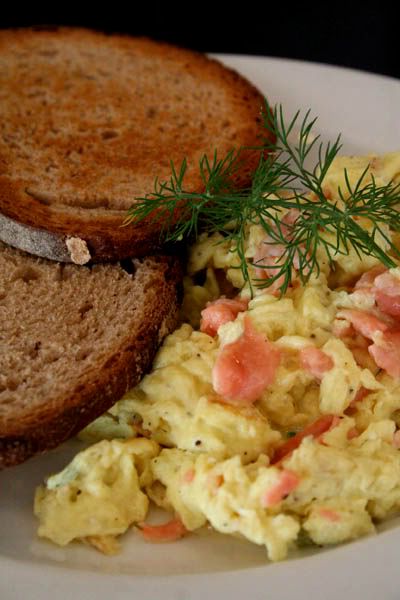
The highlight of the centre is Service Station, which must be one of the best cafes in South Africa. It's all brick walls and concrete floors, and the large bank of floor-to-ceiling windows along the front look out over the lush leafy greenery of Joburg's artifical forest. This combination makes for the ideal spot to meet for a late breakfast (pictured above: fantastic salmon scrambled eggs with dill), or for coffee and an incredible baked good. Toward the back, past the towers of baked goods, there's a small deli, with local specialty foods, imported pastas, and a few choice design items for the kitchen. A meal here is so compelling, that one can almost imagine that this is how life in Johannesburg could be: urban and sharply styled, living a life that is surprisingly not closed off or barricaded in.

And after eating, you can continue the fantasy with a little browsing in the neighbouring shops. Love Books has a fantastic selection of handpicked fiction, cookbooks, and volumes on art and design, plus a huge selection of kids books so well illustrated that even adults will want to page through. Among the shops toward the back of the complex, Black Coffee is a well-known local fashion range (though nothing for men, as is unfortunately common in Joburg), and the Blooming Plate has a staggering range of interesting kitchenwares.

Altogether, a great one-stop spot to browse, relax, and enjoy a vision of urban, modern Joburg-- before returning to the reality of four-metre walls and barbed wire malls.

Bamboo is located at the corner of Rustenburg Road and Ninth Street, in Melville, Johannesburg.

Sunday, January 03, 2010

Love Jozi?

Despite its bad reputation, Johannesburg has some pretty strong defenders. Those who live in the city often love it. Even the fact that the city has so many nicknames (joburg, jozi, egoli) suggests some sort of affection.

But could I love Jozi? Every time I go, I try to answer this question. On this last visit, I looked hard, and tried to imagine myself there. I came up with a few good things about Joburg:
1) The city is greener than Cape Town, as it's set in a huge artificial forest.
2) The residents are allegedly friendlier and more welcoming than in Cape Town.
3) The city is relatively mixed, racially and culturally, which is a refreshing change from Cape Town.

But unfortunately, my list of things I don't like about the city is a bit more convincing...
1) There are too many high walls, too many shopping malls. Who wants to spend all their time indoors?
2) There is some incredible architecture downtown, but the rest of the city is pretty ugly... as I said in #1, too many walls and malls. So much glass and concrete, but no character.
3) Not enough fun spaces-- very few good restaurants or cafes, and if they exist... look at #1... they're probably in a mall or a shopping centre somewhere...
4) Joburg is not a walkable city-- even less so than in LA, which gets that reputation. Put me down on Wilshire, in Santa Monica, or Silverlake, and I'd find cool shops, neighbourhoods, and cafes. Put me down in Johannesburg, and I'd get lost, frustrated... and probably mugged.

So, unfortunately, I still just really cannot see the appeal. But, like I said-- there are loads of other people who do love it. But I feel that I can finally say with confidence that I'm not interested in living in Johannesburg. However, for an alternative take on loving Jozi, check out the Love Jozi clothing line (pictured above, too). As many arguments as I've made against the city, I think their hip t-shirts will make a much more convincing case in favor of it...

Monday, January 21, 2008

There are dangerous people there.

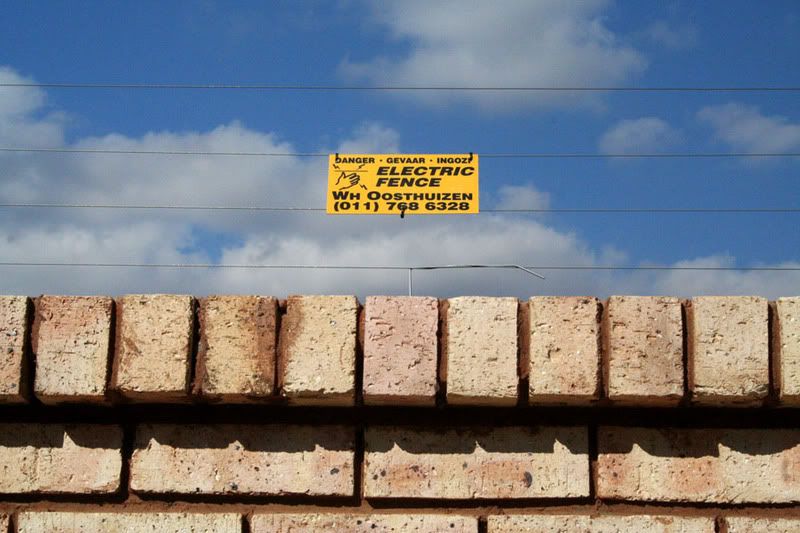
I held on the line, waiting for the woman at Greyhound’s call center to run my credit card numbers again. It was a bracing winter day in Johannesburg, the air lightly scented by the crisp woody smell of dry grass. As I waited to hear her voice, I distractedly scanned the nearly empty parking lot of the suburban condo complex. Like most residential spaces in Johannesburg, this community was gated, with a fortress-like barricade of burnt-ochre bricks surrounding it.

A heavy sigh on the line announced that she was back. “No, I’m sorry sir,” she said. “For some reason your credit card isn’t going through.”

I had been hoping to leave for Zimbabwe the next day, but nothing was working out as I had hoped. The earliest that a seat was available was on the following day, and now for some reason neither of my credit cards were working. “Well, can I pay in person somewhere?”

“Of course. You can come down to the ticket office at Park Station, but you must do it by tomorrow at 4 pm if you want this seat.”

I cringed. Park Station was in downtown Johannesburg. I was already nervous about going there- and now I’d have to do it two days in a row? “Can’t I just pay for the ticket when I come to board the bus?”

“Well, you can try to get a ticket then, but we can’t hold this one for you for that long. And I can almost guarantee that the bus will be full by then.” She seemed tired of dealing with me. “If I were you, I’d get downtown tomorrow.”

Few places terrify the suburban South African imagination as much as downtown Johannesburg. Though it had once been a lively grid of shopping streets and high-rise offices, many people now envisioned it as the epicenter of South Africa’s crime and violence. I was staying in Johannesburg with my friend Marc, and over dinner I told him of my plans. He was leaving early the next morning for a work trip, and wouldn’t be able to take me.
“Not that I’d go there with you if I could.” He shook his head. “First of all, I can’t believe you’re going to Zimbabwe. That place is a war zone.” Marc was prone to exaggeration, and a font of South African horror stories. “But you’re going to downtown Joburg? Man, you want to get killed. The people there are dangerous.”

Early the next morning, Marc dropped me at a guesthouse near central Johannesburg, and wished me luck. After checking into my room, I prepared for the trip downtown. I separated out some cash, took one credit card but left the other. Though I took people’s warnings about downtown Johannesburg with a measure of skepticism, in the back of my mind I kept the possibility that I was going to get mugged.

The day was starting to warm a little when I set out, the expansive blue of the sky not marred by even a single cloud. I walked to where I expected the bus stop to be, but once there, realized I had no idea which bus to take. Which direction was I going? I sat down to wait. After twenty minutes, I gave up. I wasn’t even sure if the bus I wanted stopped here. As I walked back toward my guesthouse, unsure of how to proceed, I saw the crowd of people waiting at the minibus taxi rank.

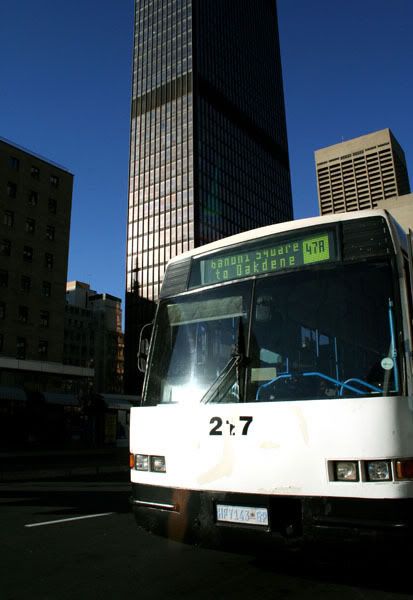
In Cape Town, I used minibus taxis all the time. To me, they seemed an ingenious system. The public bus network in Cape Town was terrible, so privately-owned minibus taxis plied the streets, an attendant shouting out their destinations and ushering passengers in. However, even in laid-back Cape Town, people gasped when they heard that I took the minibus taxis. To many white South Africans, they were little more than moving, metal coffins, associated with reckless drivers and fatal muggings. And this one would be going to downtown Johannesburg. I could imagine Marc’s reaction. “You’re taking a minibus- in Joburg?” But, as I saw it, I had no other choice.

I climbed into the first minibus that slowed to a stop, and ducked into a seat in the back. The attendant slammed the door shut, and we raced on. We zipped down the suburban expressway, through scratching tree branches and golden lawns. We stopped for more passengers: a young man in a corduroy blazer, and two round women in wool sweaters. We started up again, the women barely given time to squeeze in through the door before it was slammed shut. We curved through a neighborhood of quiet warehouses and factories, slid under a bridge, and suddenly arrived in downtown Joburg.

I had heard that all business had fled, leaving downtown Johannesburg deserted. From the ground, you’d never be able to tell. The sidewalks were packed to the point of over-spilling. Fast food outlets were doing a bust trade, and throngs of people were browsing between among shops and merchant’s stands.

I had tried to brush up on downtown’s layout in my guidebook, but looking out the window of the minibus taxi, I felt completely lost. Nothing in this urban chaos matched up to the layout sketched in my mind. I considered my options, and came up with only one: I would have to ask for help. It would label me as an outsider, make me vulnerable, but I didn’t have any other ideas. I leaned in toward the passenger sitting next to me, “Sorry, but are we going to be stopping at Park Station?”

“We won’t be stopping there, but we’ll be passing by.” He was an older man in a checked sweater, and he briefly studied my worried brow. “I’ll let you know when to hop off,” he offered.

We cut through the city blocks, between heavy traffic and crosswalks flooded with people. As we passed a dusty lot contained by chain-link, my fellow passenger called out to the driver, and let me know I should get off here. I jumped out as the taxi slowed, and found myself at a busy intersection, with no sense of direction. I couldn’t see Park Station over the shop’s awnings, and the road was to crowded for me to think. Suddenly I felt a hand on my shoulder, and before I could react, I was pulled down an alleyway.

I turned to see the face of the young man in the corduroy jacket, who had been sitting in front of me in the minibus. “You’re going to Park Station?” he checked.

“Yeah…”

“Alright, come this way.” He lead me down the alleyway, where sunlight was blocked out by tarps shading vendor’s stands. Merchants sold books, purses, designer shoes; street stands turned out richly spiced food for seated patrons. We turned, and he pulled me through an inconspicuous doorway. I found myself in the grandly arched terminal of Park Station.

“So where are you going?” he asked.

“Well, I need to buy a bus ticket- I’m heading to Zimbabwe.”
He nodded, and led me through the chilly corridors of the station to the bus terminal. I expected him to leave me there, but he simply stood waiting as I purchased my ticket. Though he had helped me immensely, I guiltily contemplated why he was doing it. What was in it for him? If he were planning on mugging me, why would he have waited for me to buy a ticket first? Was he expecting me to pay him for helping me?

“Well, where are you going now?” he asked after I stepped away from the counter, my ticket to Zimbabwe in hand.

I told him that I needed to catch a bus back to my guesthouse, and he immediately indicated for me to follow him again. We walked out of Park Station, and through a narrow shopping arcade. As we walked, he told me about himself. He was a student in filmmaking, and he hoped eventually to work for television. He asked me about my plans to visit Zimbabwe, my studies, and how I liked life in Cape Town.

“Yeah, I wouldn’t mind living down there,” he reflected. “But I think I’ll need to stay here- first for studies, then for work.” He stopped, and looked around. We stood in a courtyard hemmed in by stately buildings, where several two-story buses waiting expectantly. “Well, here we are.”
As he shook my hand, I couldn’t help feel confused. Where was the con, the appeal for money?
He smiled again as he nodded goodbye, but suddenly paused as if remembering something.

“You’re coming back to catch the bus tomorrow?” I nodded. He glanced a look back over his shoulder toward Park Station. “You really need to be more careful, especially if you have your suitcase. There are dangerous people there.”

Tuesday, January 01, 2008

The Top 7 Locales of 2007.

2007 has been an incredible year. It was a year of multiple residences, and a year of long travels in strange lands, both familiar and exotic. It was a year in which I was exposed to the wonders of Southeast Asia, and in which I came to grasp the beauty of my own dessert home. This list doesn't represent everywhere I visited this year, or even everywhere that touched me- notably absent are Cambodia, Cape Town, Taos, and a number of spots around Thailand. This list is simply a collection of the places that affected me the most, and have lingered in my mind the longest.

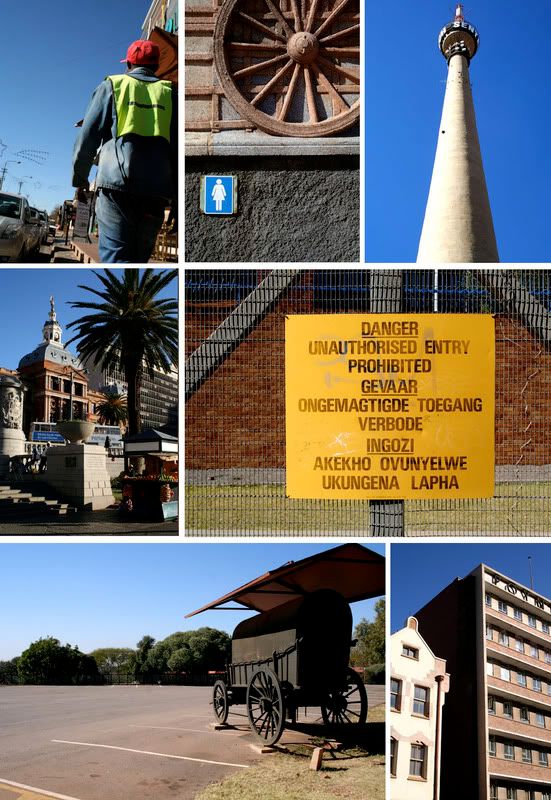
7. Gauteng. The placement of Gauteng at the bottom of my list represents, to a degree, my ambivalence about the place. The social character among many people is of fear: they've built up massive shopping malls and walled-in squares, where they can safely avoid having ever to go outdoors. In 2007 I spent a little time exploring Johannesburg on my own, and for the first time visited Pretoria. The architecture of the two cities cannot easily be described as beautiful, but has an odd ironic appeal. They're an uncomfortable mix of styles that represents so much about the contradicting values in South African culture: from the conservative monuments and boulevards of Pretoria, to burgeoning Urban redevelopment in a downtown Joburg reborn. Yet Gauteng is perhaps the most African of South African landscapes: a rapidly developing center that represents- both symbolically and literally- the financial aims of the continent. Perhaps as a result, one can see a distinctively African modern style in Gauteng, perhaps more easily than in Cape Town. For this reason, Egoli keeps me intrigued, and hopefully I will return to see more.

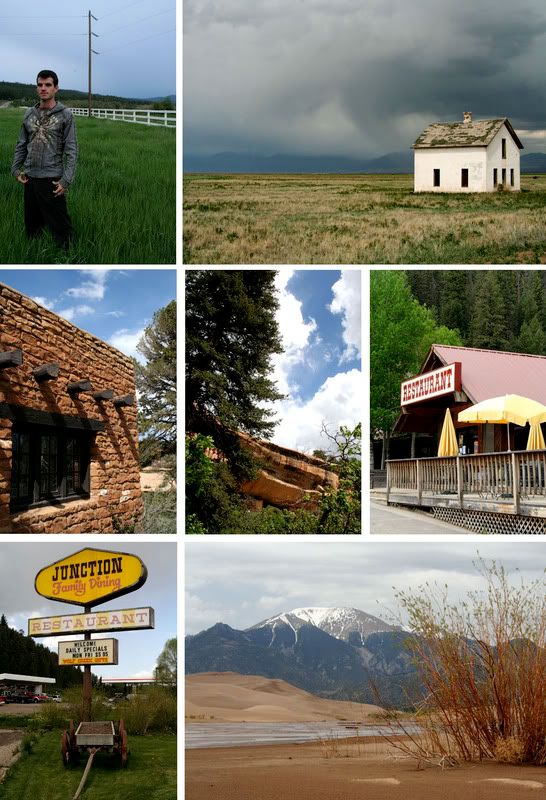
6. Southern Colorado. I visited Southern Colorado often as a child. Just several hours north of my home in New Mexico, it was an easy destination for weekends away or short family trips. But never before this visit have I been so astounded by what a place it is. Perhaps it was seeing through the lens of my foreign traveling companion, or a filter gained from years abroad; either way, Colorado seemed to me a distillation of all the classic images of America, free and glorious. There were horses running in wild overgrown fields, tremendous storms, and ice capped mountains crashing over the horizon of pine trees.

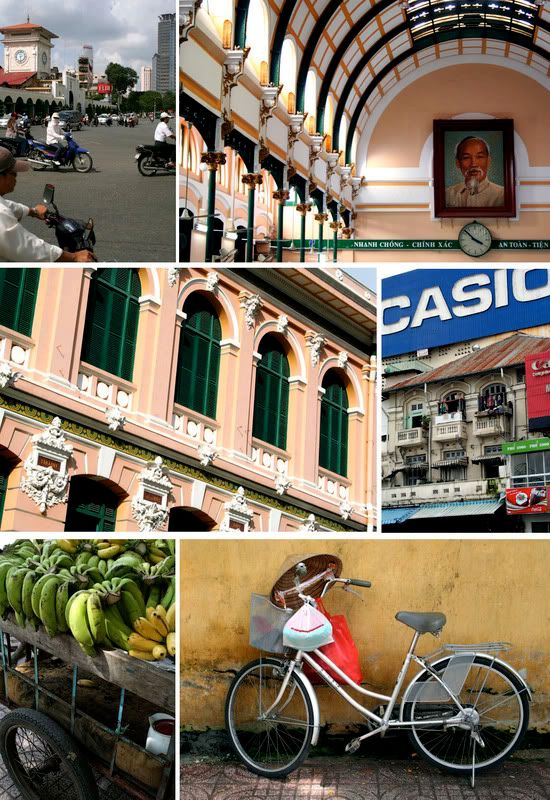
5. Ho Chi Minh City. The home that almost was. For a week I struggled in Ho Chi Minh, worrying about finding work and a place to live. It wasn't until just before I left to return to Bangkok that I was able to see what a truly beautiful, graceful city it is. Where Bangkok is tropical in its steamy, swampy overgrowth, Ho Chi Minh has refined its tropical heat into an elegant style, with pale painted walls, and ornately shuttered windows. The frantic pace of the city is visible in the motorbikes that swarm the street, and yet relaxation is offered in discretely hidden cafes, and in leafy courtyard restaurants. And though I had to choose not to live there in the end, it was undoubtedly one of the most intriguing cities I was lucky enough to visit in 2007.

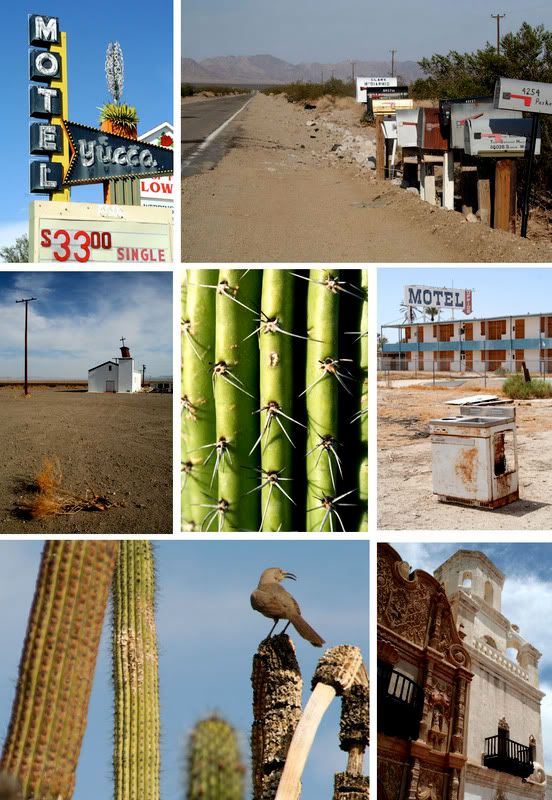
4. The Deserts of Southwestern USA. On our way from Los Angeles to New Mexico, Bordeaux and I passed through the great deserts of the American Southwest. While it was in many ways a home-coming for me, I was struck for the first time what a bizarre and unusual landscape it was. I revisited some places, like Las Vegas and the Grand Canyon, but I also searched out new places I had never been to: Salton Sea, the mission at San Xavier, Sonoma, Organ Pipe National Park. I explored abandoned motels, drove through thunder storms, and slept under the gaze of kitt fox and kangaroo rats. From the neon wasteland of Las Vegas, to the austere grace of Spanish mission cathedrals, to wonderland cactus gardens, I came to see how the desert Southwest is undoubtedly one of the most exotic landscapes in the world.

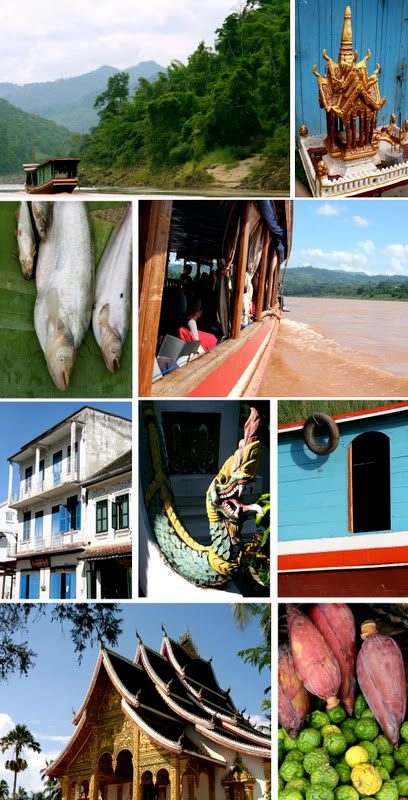
3. The Mekong River. The exotic pleasures of Southeast Asia are given form in the meandering brown river called the Mekong. For almost a month we followed the river, from the overgrown hills of Northern Thailand, through the Oriental splendor of Laos, into the wild, dusty landscapes of Cambodia. The river is home to such incredible places as the elegant village of Louang Phrabang, the stylishly mod capital of Vientiane, and the frontier town of Kompong Cham. It was for me a river of untamed jungles, golden temples, and painted blue shutters. And traveling for two days on a slowboat, through tall lush forest and tiny bamboo-and-thatch villages, is unquestionably an experience that will stay with me long after 2007 has passed.

2. Los Angeles. It may seem odd to make a city where I lived from 2001 to 2005 my #2 spot for 2007, but I have reason. I spent most of 2006 in Cape Town; and though I love the Cape, I thought often of LA. I remembered places I missed, thought of neighborhoods I never got to explore, and lamented the fact that I had taken no photographs of the city. I had lived in LA while going to college, but I had never really gotten to know the city, never became a local. So when I returned to the US in late December, I took it as my second chance to get to know Los Angeles. I arrived in California on New Year's Eve, ready to start 2007 in LA. I got to know the city in ways I never had, discovering the styles of midtown, the charms of Little Ethiopia, and the grungy pleasures of Echo Park. I shopped at farmer's markets, used public transport, become a local at several cafes. I came to really enjoy the way that life existed somehow between asphalt reality and a fantasy vision that Hollywood had created of itself. In 2007, Los Angeles emerged for me as a place not just where I went to college, but as a city that I really know; a city from which I draw inspiration; and a city that I now think of as a distant, beckoning home.

1. Bangkok. The number one place for 2007 was, without question, Thailand's capital city. With it's addictive flavors, hip urban culture, and lush concrete landscapes, Bangkok grabbed me in a way no other city has. I arrived in Bangkok unsure of what to expect, prepared to hate the city. I had been told for years that the best strategy when traveling in Thailand was to fly into Bangkok, and quickly get out to anywhere else. But the moment my airplane lowered below the clouds and I took in the towering sky-scrapers, piercing wats, and python-curves of the Chao Phraya river, I was entranced, and I've only grown more fascinated since.

Monday, June 11, 2007

Winter in Egoli

Winter in Egoli
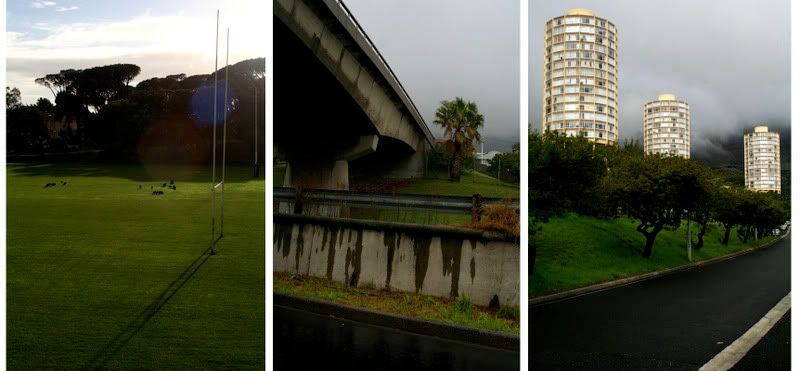
Cape Town, in winter, is wet. Grey clouds, heavy with cold rain, roll over Table Mountain and hang low over the city. Storms stain the roads shiny black. Lawns become so lush that every blade of grass drips with green.
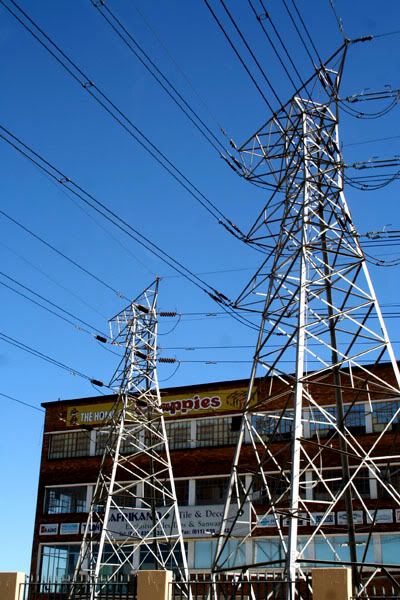
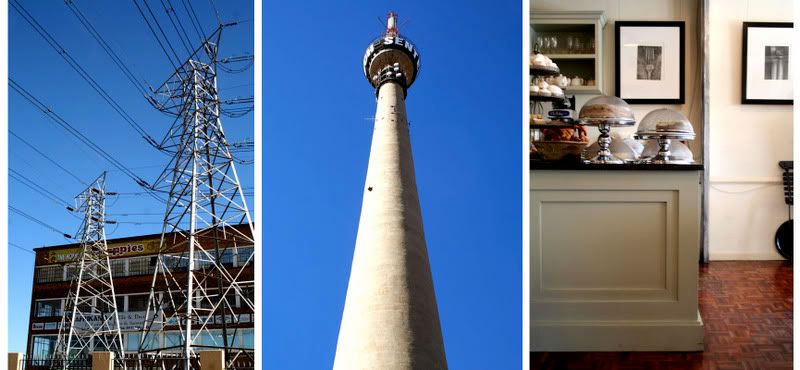
Johannesburg, in winter, dries out. Egoli lives up to it's name- place of gold- as the grass turns crisp and becomes golden, standing out brilliantly against the stark cloudless sky. The sky becomes overwhelming, so harsh that it reflects in blue hues in the concrete and brick of the city. To escape the cold, I had coffee in Melville at Service Station, my favorite coffee shop in Johannesburg (though that might not mean much as, admittedly, I know next to nothing of Johannesburg).
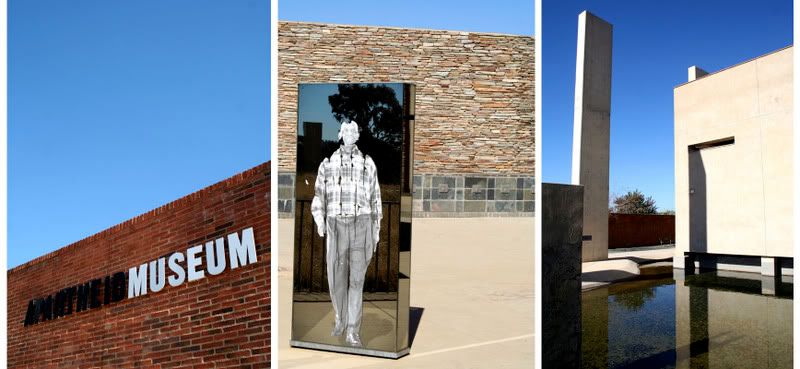
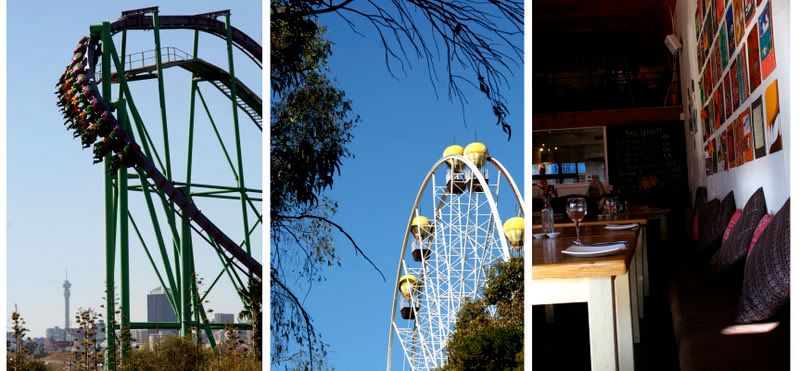
Following directional signs through the city, I eventually reached the Apartheid Museum. I pulled under the turreted entrance arch, sign reading: "Gold Reef City Theme Park and Casino- and Apartheid Museum." Walking from my car to the entrance, I was unsettled by the sound of screams- a disturbing sound installation meant to evoke the horrors of apartheid?- until I realized it was coming from the roller coaster at the amusement park that shares the property with the Apartheid Museum. The museum itself was designed a little like a theme park, with separate entrances for whites and non-whites meant to evoke the racial segregation. The exhibits curved through chainmetal and brick, past photos of domestic workers and Apartheid's architects. The archival video footage was particularly interesting. At a section on Afrikaner nationalism, they showed a 1930s film made to chronicle South Africa's history. Ships pulled into Table Bay, and a gallant Van Riebeek was greeted on shore by a group of kneeling, worshipping khoi-khoi. Another room featured footage of the ultimate right-wing reaction to the fall of apartheid, which manifested itself mainly in obese men dressing themselves in khaki and forming a militia. The museum was designed to tell two stories at once; of a people fighting and praying and dying for freedom, and of a group terrified to lose the way of life they felt they had earned.
Leaving the Apartheid Museum, I looked out at the city skyline through the rides at Gold Reef City. I walked through the parking lot at Gold Reef City, which was of course much more full than the parking lot at the Apartheid Museum. It reminded me of something I had read in the apartheid museum: that in the face of apartheid, most people, white and black, chose to simply go on living, and to make the best of it that they could. Looking at the plaster statues of miners and crowds of children, I opted not to go to the themepark, but chose instead to pursue my own playground. I headed back to Melville, for lunch at the stylish 7th street cafe, Loft.