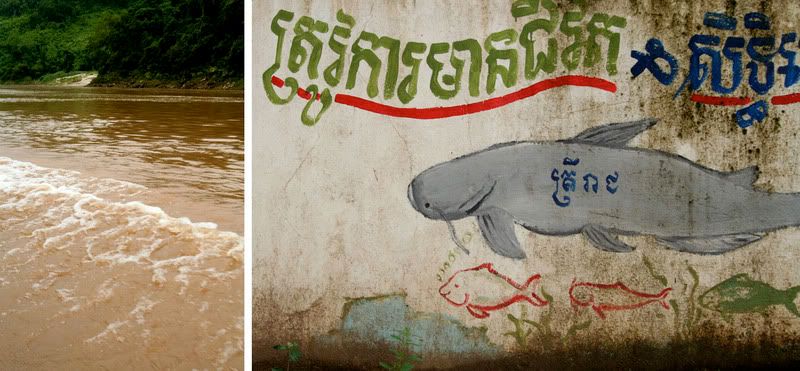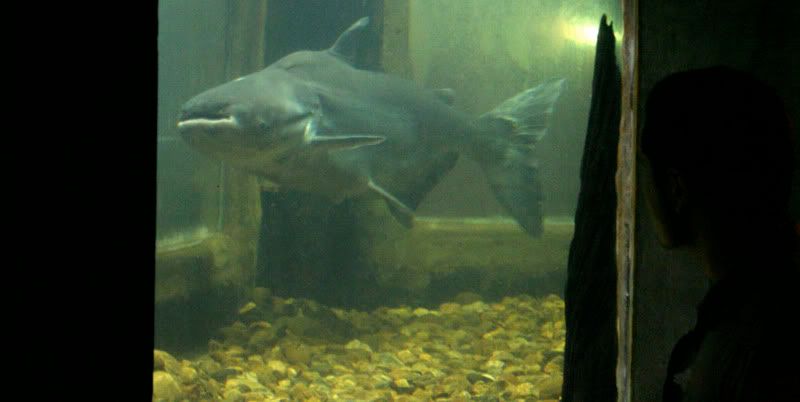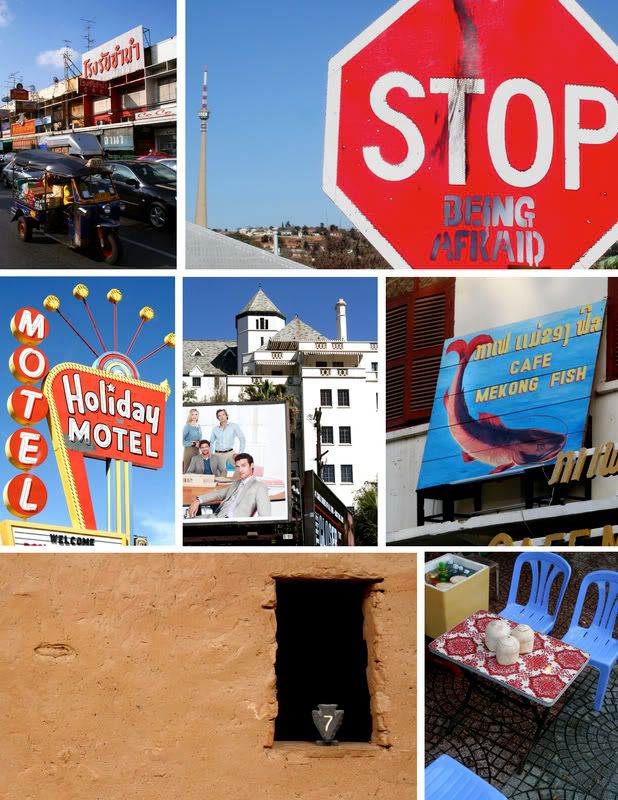
Showing posts with label Mekong. Show all posts

Friday, March 20, 2009

Eating to the Mekong's end.

While Bordeaux zipped off on the back of a scooter, I retreated with my backpack into a tiny pocket of shade. The line of motorbikes and trucks in front of me growled impatiently, waiting for their turn to board the ferry. Feeling a tugging on the hem of my t-shirt, I looked down to find a child, who waved a stack of lottery tickets in my face. Her mother approached, and I assumed she would point out the obvious problem the girl—that I was a clueless foreigner, and didn’t know how to play the lottery—but she simply motioned to the child, and looked at me with her lips pursed in an insistent frown.
To feign being busy, I turned to browse at the snack stand behind me. Packets of candied fruit, bags of coconut taffy, boxes of dry biscuits; all coated in a thin veneer of red dust from the road. I was grateful I’d had a decent breakfast before leaving Saigon. I had come to Mekong Delta for a number of reasons, but the main reason, I reminded myself ironically, was to eat.

My desire to taste the Mekong Delta had been growing for some time, developing out of a vague collection of cravings into a refined and pressing hunger. It had started, perhaps, when my boyfriend Bordeaux and I first decided to move to Southeast Asia. After some deliberation, we had settled on Saigon as our ultimate destination. In retrospect, it’s hard to say why exactly. Bangkok seemed the more accessible option, but horror stories about the pollution, traffic, and urban chaos put me off. But why Saigon? Really, I knew nothing about the city, or about Vietnam in general. If I’m honest, I’ll admit that it was perhaps the idea of being so near to the Mekong Delta that drew me. Though I had no real knowledge of the river, I had assembled a mental pastiche of images, gleaned from travel brochures and old movies. Images of slim boats drifting over sluggish water through an arcade of palm fronds, and giant catfish sheltered just below the surface. Tropical and mysterious, the qualities that were drawing me to Asia to began with.
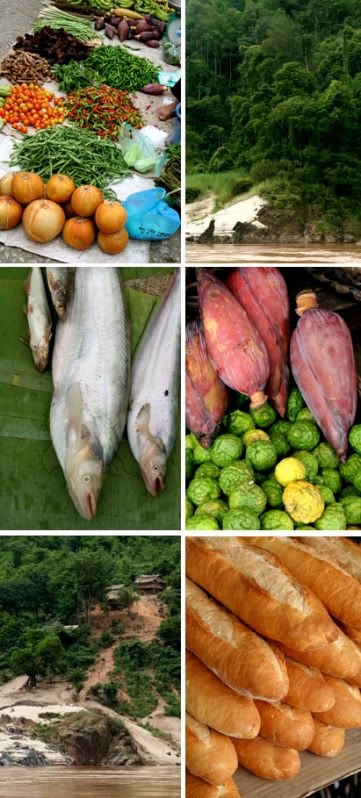
From our arrival in Bangkok to the culmination of our journey, we spent a solid three months traveling. And throughout that time, the Mekong River was a constant guide. We followed it from town to town, drifting downriver at only a slightly slower pace than its muddy brown water. And along the way, we came to know and love how the river tasted. We could feel its richness and fertility in the dripping golden papaya we savored on the banks of Chiang Khong, on the first morning that we saw the river itself; we grasped its salty aquatic flavor in the crisp squares of fried river-weed coated in sesame seeds and dabbed with chili sauce, which we sampled on the promenade in Luang Prabang; and we has tasted its history and culture in the sliver of green mango that garnished a French baguette sandwich in Phnom Penh. But, as close as we came, we didn’t get to taste the river to the end, to the delta.
We made it to Saigon, but only briefly. After only a week in Vietnam, Bordeaux and I boarded a plane and returned to Bangkok. Despite the misguided preconceptions I’d had, we had both turned out to adore the city, and were eager to try living there. So though Vietnam seemed fascinating, we left—never having made it anywhere near the delta. The river’s end remained unseen and untasted, as our plans of living near the Mekong Delta came to an end.

The hunger pangs, however, didn’t end quite so easily. Getting to the delta became a constant goal, a desire I nursed as we lived and traveled throughout the region. And so it happened that over a year later we finally made it there—and I found myself alone, waiting at the ferry port of Ben Tre.
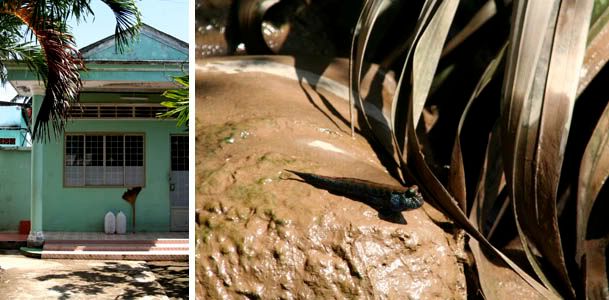
Thankfully, our hotelier returned quickly, and instructed me to climb onto the back of his scooter. We zoomed off, leaving the sun-soaked chaos of the port behind, and slipped into shadow among the leafy gardens of a quiet neighborhood. We passed a string of sugary candy-coloured houses, clacked over a canal on a thin wooden bridge, and twisted into the gate of his guesthouse.

It wasn’t, as I had imagined when I made the booking, a charming boathouse tipped over the river itself, with a hammock slung on the verandah from which I could gaze into the flow of the water. Instead, it was an inland compound of modern mint-green buildings, surrounded by trees. But even though we weren’t on the river itself, there were signs of it everywhere. The air felt sticky with humidity, as if we’d just come on shore after a quick plunge. The garden was flourishing with fruit trees, with pomelos and papaya hanging heavily on straining tree limbs. And a network of shallow streams and canals criss-crossed the yard, giving the feeling that the earth may sink or be swallowed in a flood at any moment. As I climbed off the bike, I found Bordeaux peeking into one of these streams.

“Come, look here.”

All along the bank, there were tiny fish with cartoon eyes, hopping out of the water and onto land. Mudskippers. I’d seen them before in nature documentaries and wildlife books, but they were infinitely stranger in real life. Yet somehow, their amphibious lifestyle seemed to make sense here, where the dividing line between water and earth seemed so thin.
Looking into another patch of murky water, we spied the vague outline of a large fish. It came up to greet us, it’s lips barely breaking the surface of the water. We gazed around the lush garden, continuing our search for wildlife, and spotted a low metal cage partly obscured under some bushes. Looking in, we caught the glimmer of scales on a muscular snake.
“Cobra,” the guesthouse owner informed us. “Maybe you’ll have some for dinner?” We laughed politely, assuming he was joking—though we would later be corrected of this assumption as we looked over the menu for dinner.
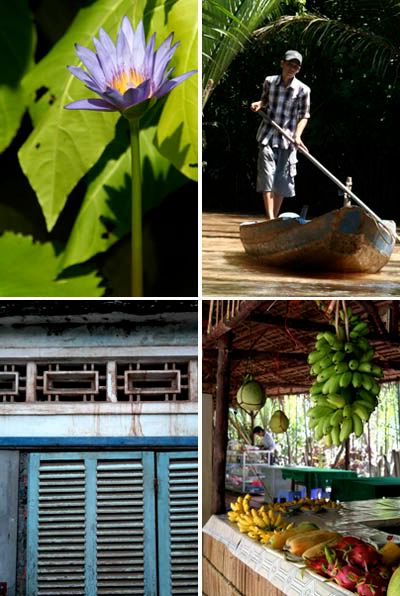
We spent the afternoon strolling around town, peeking into coconut candy workshops, being hailed by men wanting us to witness a cockfight, and sipping iced drip coffee in a neighborhood joint. We returned to the guesthouse as the air was cooling down, just in time for dinner. We sat at a table outside, under a pitched canopy of dried palm leaves. After being presented with two icy green bottles of Saigon beer, we were handed a menu, though we had little reason to actually look at it. We’d booked this hotel with a purpose, to eat their specialty dish: elephant ear fish. The fish that had greeted us as we arrived, in fact.
We had only to order and we were immediately summoned to the same stream where we’d had that sighting. Gripping a long net, our waiter scooped into the water, and lifted out a massive silver fish. He dropped it onto the soil, and as it began to make desperate somersaults, commanded me to take a picture. I obligingly took one shot, though I wasn’t eager to document the last undignified moments of my dinner’s life. Satisfied that I’d captured the moment, he grabbed the fish, and disappeared into the kitchen.
When we next saw the fish, it was in a much-altered state. Supported in a wooden frame, it was held upright, and was set on our table with fins splayed, looking almost as if it had swum there itself to join us. Its skin was now more golden than silver, its scales crisp and flaky. It’s tender meat seemed ready to melt away at the first jab of a chopstick. Accompanying it were a bowl of rice noodles, a stack of thin rice paper, and a plate crowded with piles of pineapple, bean sprouts, tomato, and fresh green vegetables and herbs.
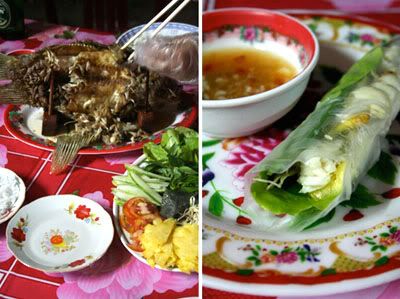
I snipped off a morsel of the fish with my chopsticks, layered it on the rice paper, rolled it up, and bit in. The green vegetables tasted sharp, the pineapple exuded an acidic tang, and the well-fried fish was luxuriant fatty. The rice paper contained it all, holding it in for a moment before the flavors revealed themselves on my tongue. I dipped a second piece into the sauce of chili, garlic and fish sauce; it tasted even better.
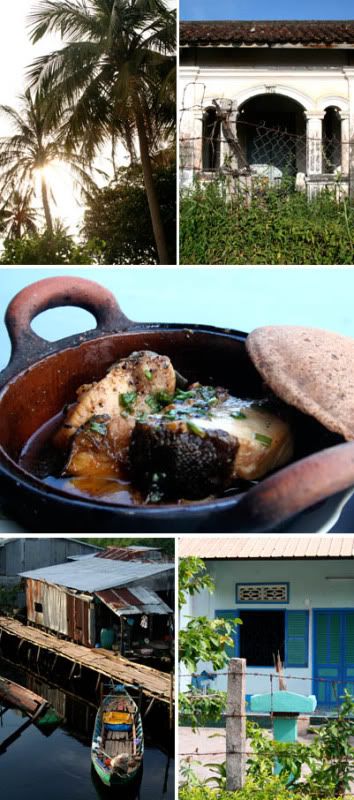
Over the next week, we crossed the entire delta, and continued our slow tour of Mekong flavors. We rode to the far Western border, past wide grassy expanses dotted with Khmer-style temples and pinnacles of limestone, to slurp on sour spoonfuls of canh chua ca. We rode over the waves to the pristine palm-fringed beaches of Phu Quoc, where we dined on salty caramel-sweet claypot fish. And in every meal, in every dish, and at the bottom of every bowl, we encountered the same flavors. Spicy, tangy, salty, sour, and fresh. The flavors that I had come to know as the taste of the Mekong River itself.
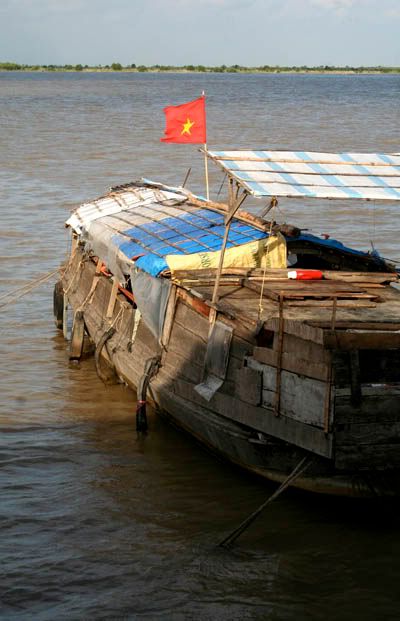
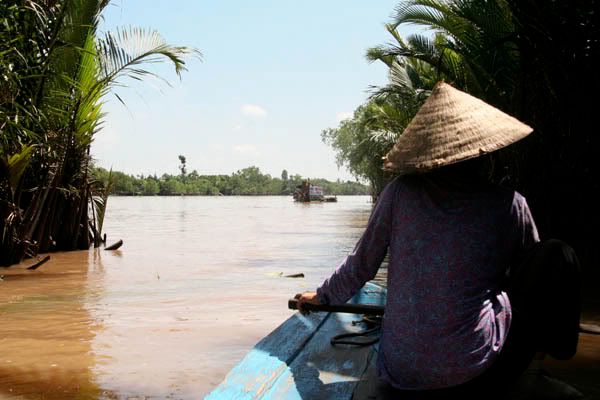
Monday, October 13, 2008

Will resurface soon.

I think this is the longest I've been quiet since I started PrimitiveCulture (hopefully I've still got one or two readers checking in), but I'll try to start posting regularly again. At the moment I'm at the Ho Chi Minh City airport, preparing to return to Thailand. The past month here has been incredible, and though we've been busy working, Bordeaux and I had a great time traveling from Hoi An to Phu Quoc via Saigon. Even though we covered a bit more of the country, I still feel as though I barely know it-- but as always, I got enough of a taste to make me want to come back for much longer some day.

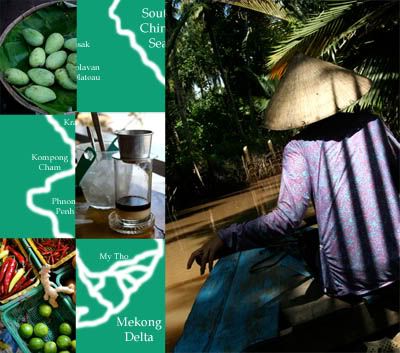
There's a lot I still want to write about- delicious market treats, another cooking course, and --possibly the highlight of the trip-- a too-quick trip across the Mekong Delta (pictured above). But more on all of that soon...

Friday, June 20, 2008

Primitive Ilustrations: Monsters of the Mekong.

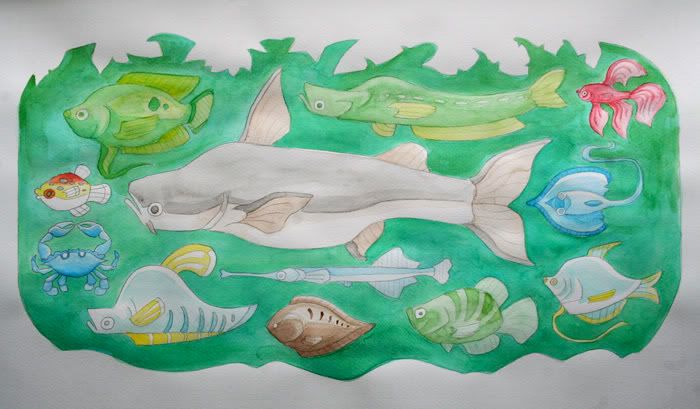
Fairly soon after I moved to Bangkok, I bought a set of watercolor paints with the idea to work on a few illustrations about the places and creatures that I encountered while exploring Southeast Asia. Finally, after living here for nearly ten months, I completed my first one. And whether it was having just finished reading 20,000 Leagues Under the Sea, or the influence of Jess Gonacha of Treasuring - this painting ended up being all about fish.

Tropical rivers have always held a fascination for me, and few regions are as defined by their waterways as Southeast Asia. There's the muddy, empire strewn Chao Phraya; the life giving Tonle Sap; and of course, the monstrous, epic Mekong. Part of what makes these waterways so mysterious is the strange creatures that it conceals.

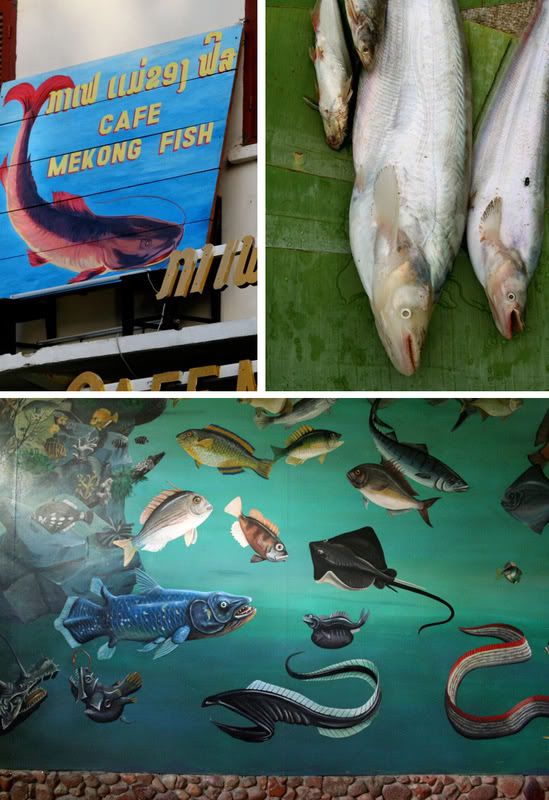
So, in simple stylized forms, I depicted some of my favorite aquatic creatures. In a style inspired by scientific murals (like the one at the Maputo Natural History Museum, pictured above) and the 'Freshwater Fish of Thailand' chart that I had in my classroom, I set them out to display their bizarre forms and shapes. The star of the piece is of course the star of the river itself, the Giant Mekong Catfish.

Tuesday, January 01, 2008

The Top 7 Locales of 2007.

2007 has been an incredible year. It was a year of multiple residences, and a year of long travels in strange lands, both familiar and exotic. It was a year in which I was exposed to the wonders of Southeast Asia, and in which I came to grasp the beauty of my own dessert home. This list doesn't represent everywhere I visited this year, or even everywhere that touched me- notably absent are Cambodia, Cape Town, Taos, and a number of spots around Thailand. This list is simply a collection of the places that affected me the most, and have lingered in my mind the longest.

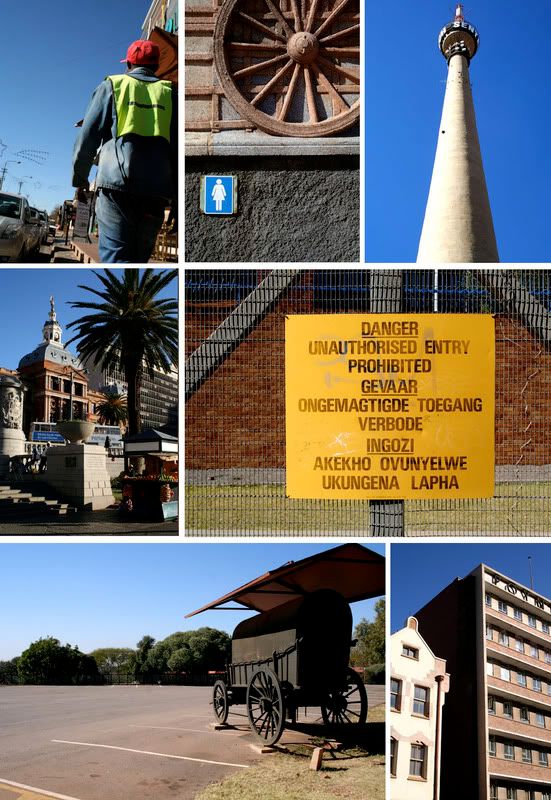
7. Gauteng. The placement of Gauteng at the bottom of my list represents, to a degree, my ambivalence about the place. The social character among many people is of fear: they've built up massive shopping malls and walled-in squares, where they can safely avoid having ever to go outdoors. In 2007 I spent a little time exploring Johannesburg on my own, and for the first time visited Pretoria. The architecture of the two cities cannot easily be described as beautiful, but has an odd ironic appeal. They're an uncomfortable mix of styles that represents so much about the contradicting values in South African culture: from the conservative monuments and boulevards of Pretoria, to burgeoning Urban redevelopment in a downtown Joburg reborn. Yet Gauteng is perhaps the most African of South African landscapes: a rapidly developing center that represents- both symbolically and literally- the financial aims of the continent. Perhaps as a result, one can see a distinctively African modern style in Gauteng, perhaps more easily than in Cape Town. For this reason, Egoli keeps me intrigued, and hopefully I will return to see more.

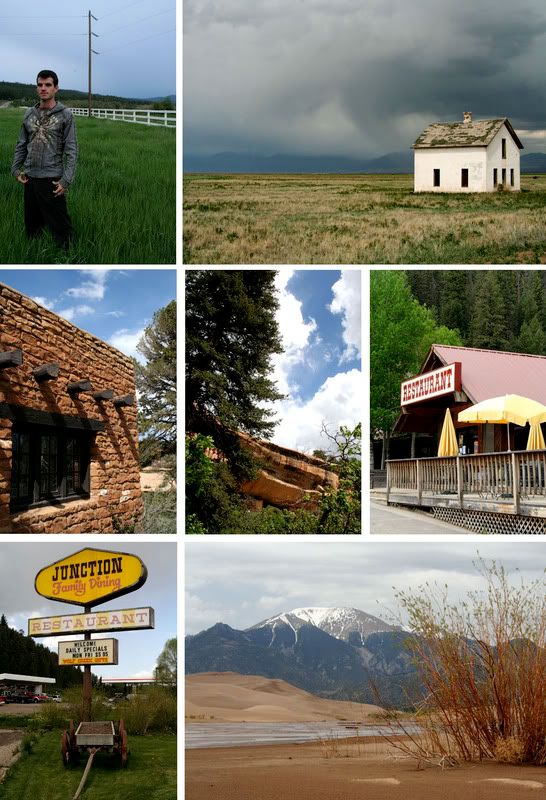
6. Southern Colorado. I visited Southern Colorado often as a child. Just several hours north of my home in New Mexico, it was an easy destination for weekends away or short family trips. But never before this visit have I been so astounded by what a place it is. Perhaps it was seeing through the lens of my foreign traveling companion, or a filter gained from years abroad; either way, Colorado seemed to me a distillation of all the classic images of America, free and glorious. There were horses running in wild overgrown fields, tremendous storms, and ice capped mountains crashing over the horizon of pine trees.

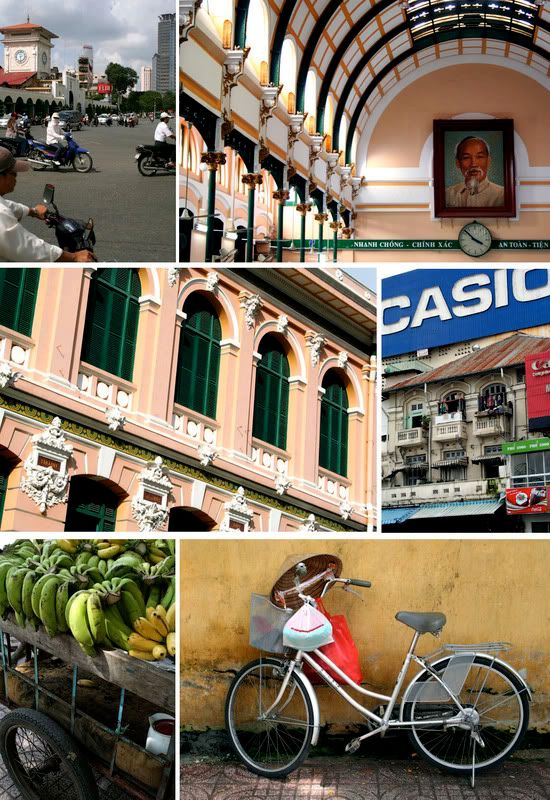
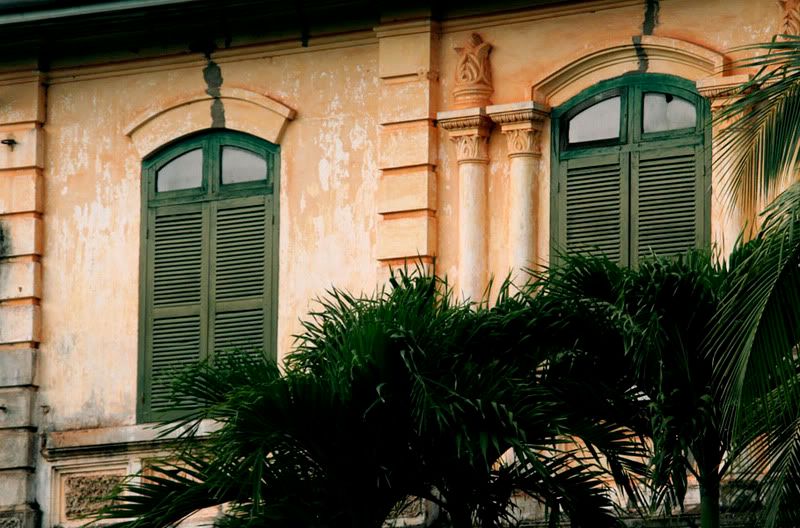
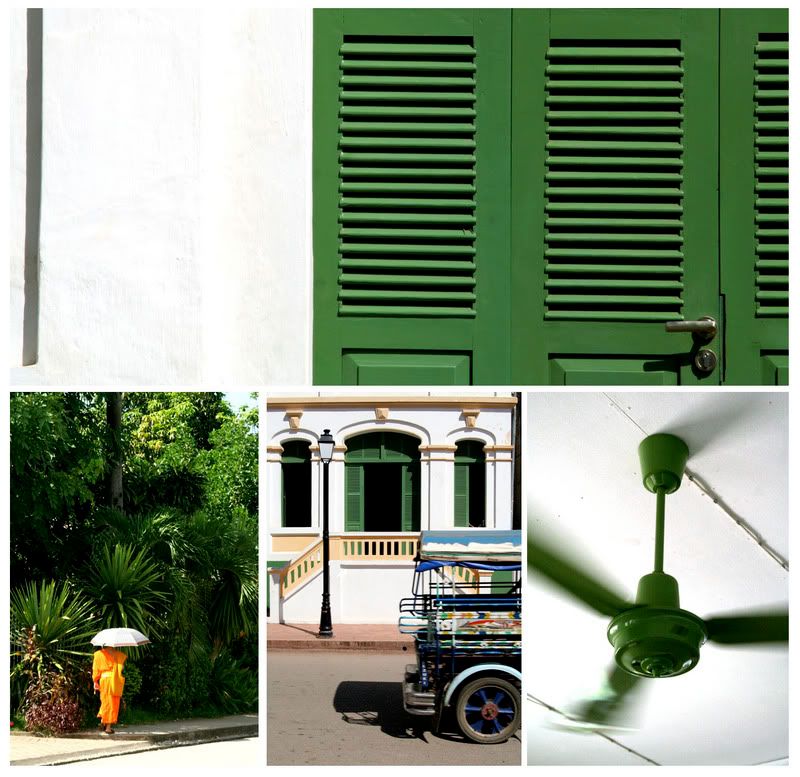
5. Ho Chi Minh City. The home that almost was. For a week I struggled in Ho Chi Minh, worrying about finding work and a place to live. It wasn't until just before I left to return to Bangkok that I was able to see what a truly beautiful, graceful city it is. Where Bangkok is tropical in its steamy, swampy overgrowth, Ho Chi Minh has refined its tropical heat into an elegant style, with pale painted walls, and ornately shuttered windows. The frantic pace of the city is visible in the motorbikes that swarm the street, and yet relaxation is offered in discretely hidden cafes, and in leafy courtyard restaurants. And though I had to choose not to live there in the end, it was undoubtedly one of the most intriguing cities I was lucky enough to visit in 2007.

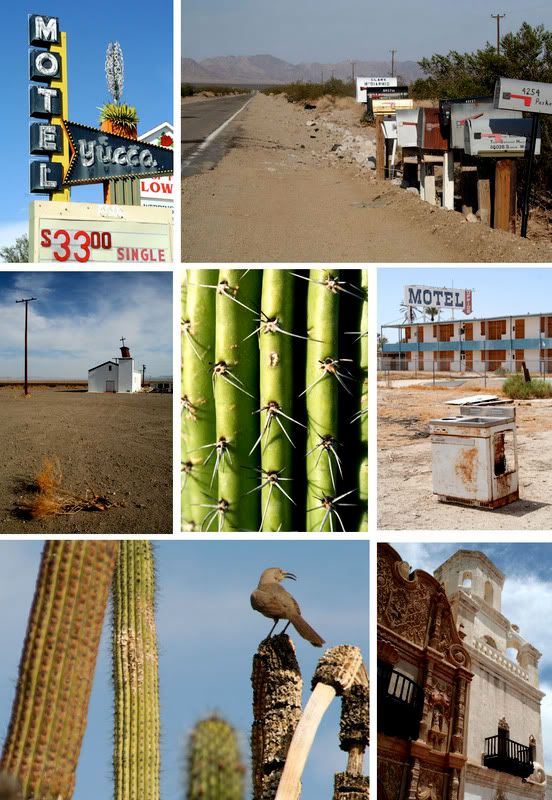
4. The Deserts of Southwestern USA. On our way from Los Angeles to New Mexico, Bordeaux and I passed through the great deserts of the American Southwest. While it was in many ways a home-coming for me, I was struck for the first time what a bizarre and unusual landscape it was. I revisited some places, like Las Vegas and the Grand Canyon, but I also searched out new places I had never been to: Salton Sea, the mission at San Xavier, Sonoma, Organ Pipe National Park. I explored abandoned motels, drove through thunder storms, and slept under the gaze of kitt fox and kangaroo rats. From the neon wasteland of Las Vegas, to the austere grace of Spanish mission cathedrals, to wonderland cactus gardens, I came to see how the desert Southwest is undoubtedly one of the most exotic landscapes in the world.

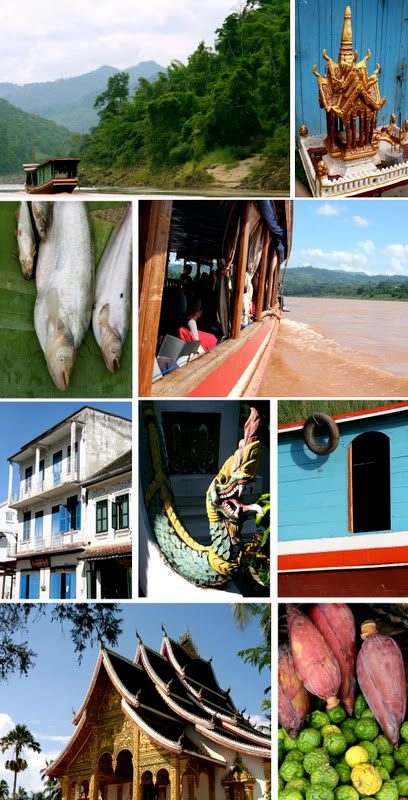
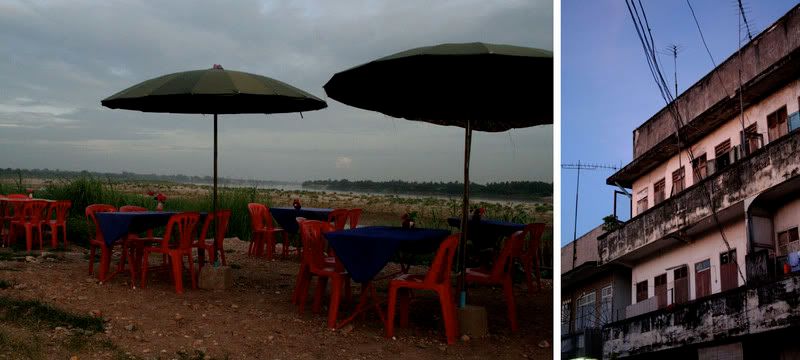
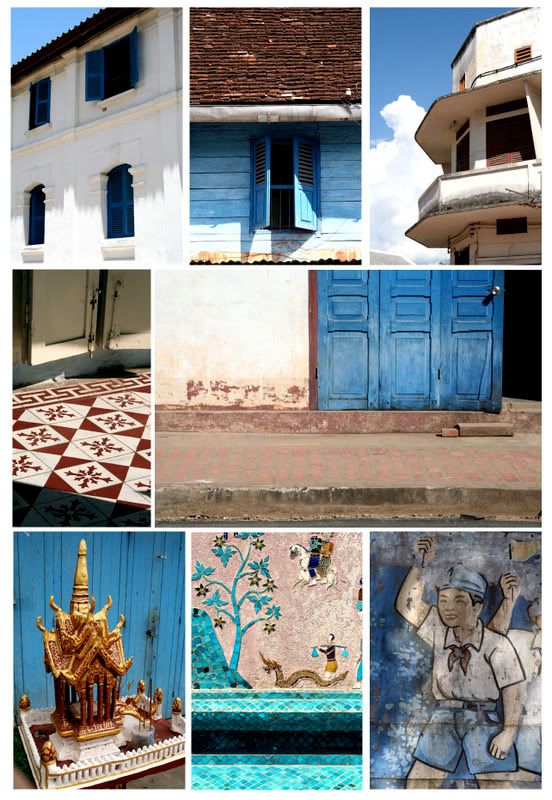
3. The Mekong River. The exotic pleasures of Southeast Asia are given form in the meandering brown river called the Mekong. For almost a month we followed the river, from the overgrown hills of Northern Thailand, through the Oriental splendor of Laos, into the wild, dusty landscapes of Cambodia. The river is home to such incredible places as the elegant village of Louang Phrabang, the stylishly mod capital of Vientiane, and the frontier town of Kompong Cham. It was for me a river of untamed jungles, golden temples, and painted blue shutters. And traveling for two days on a slowboat, through tall lush forest and tiny bamboo-and-thatch villages, is unquestionably an experience that will stay with me long after 2007 has passed.

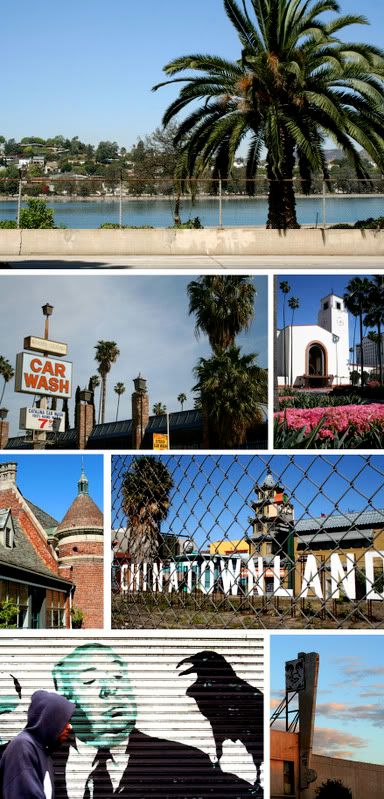
2. Los Angeles. It may seem odd to make a city where I lived from 2001 to 2005 my #2 spot for 2007, but I have reason. I spent most of 2006 in Cape Town; and though I love the Cape, I thought often of LA. I remembered places I missed, thought of neighborhoods I never got to explore, and lamented the fact that I had taken no photographs of the city. I had lived in LA while going to college, but I had never really gotten to know the city, never became a local. So when I returned to the US in late December, I took it as my second chance to get to know Los Angeles. I arrived in California on New Year's Eve, ready to start 2007 in LA. I got to know the city in ways I never had, discovering the styles of midtown, the charms of Little Ethiopia, and the grungy pleasures of Echo Park. I shopped at farmer's markets, used public transport, become a local at several cafes. I came to really enjoy the way that life existed somehow between asphalt reality and a fantasy vision that Hollywood had created of itself. In 2007, Los Angeles emerged for me as a place not just where I went to college, but as a city that I really know; a city from which I draw inspiration; and a city that I now think of as a distant, beckoning home.
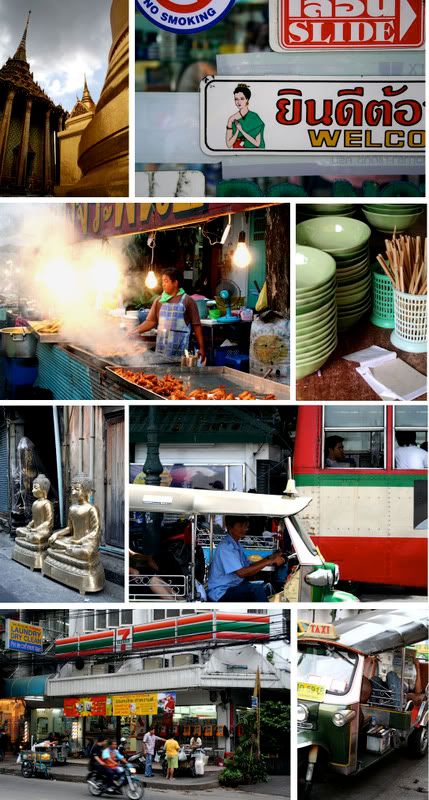
1. Bangkok. The number one place for 2007 was, without question, Thailand's capital city. With it's addictive flavors, hip urban culture, and lush concrete landscapes, Bangkok grabbed me in a way no other city has. I arrived in Bangkok unsure of what to expect, prepared to hate the city. I had been told for years that the best strategy when traveling in Thailand was to fly into Bangkok, and quickly get out to anywhere else. But the moment my airplane lowered below the clouds and I took in the towering sky-scrapers, piercing wats, and python-curves of the Chao Phraya river, I was entranced, and I've only grown more fascinated since.

Monday, September 17, 2007

Weekend Getaway: Visa-run to the Lao capital

At the end of this past week, Bordeaux and I traveled to Vientiane, the capital of Laos. It's a quiet capital city, with a laid back atmosphere that flows from the muddy Mekong river to the wide untrafficed boulevards. Our visit was primarily for bureaucratic purposes, as we needed to apply for 60 day visas at the Thai embassy, but we took the opportunity to have a mini-holiday. Two days gave us just the right amount of time to enjoy the understated urban-exotic pleasures of the Lao capital.
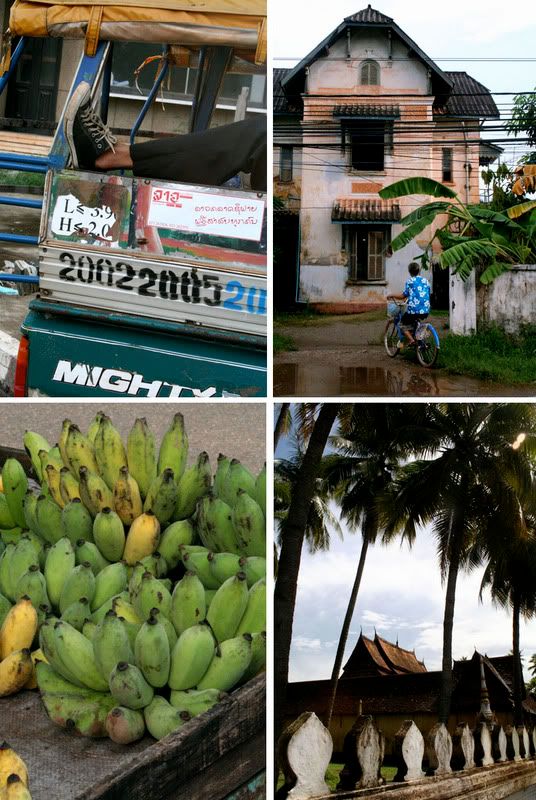
Vientiane is a strange city, hard to describe as either exotic or beautiful, though I think it is both. The city is set among green forest on a bend of the Mekong, looking across the brown waters at Thailand. There aren't too many grand sights worth seeing, but there is still a lot to see. There are traveling vendors, pushing carts loaded with bananas or durian. There are several impressive wats, with golden chedis glittering beneath coconut palms. Perhaps best of all, it has an incredible number of charming cafes and delicious bakeries. Between hours spent in cafes, we managed to find a little time for sight-seeing. We woke up early on the second day to visit The National Museum, which we had missed on our first visit. It was a strange mix of natural history and nationalist sentiment; the dimly lit halls were crowded with concrete dinosaurs, socialist propaganda, and moldy displays on ethnic crafts. There were crude paintings of noble Lao villagers being tormented by French colonialists, and dozens of black-and white photographs labeled to identify 'American Imperialists.' A little later in the day, we visited the city market. Unfortunately, the crafts on sale weren't too interesting, especially compared to what you can find further north in Luang Phabang.
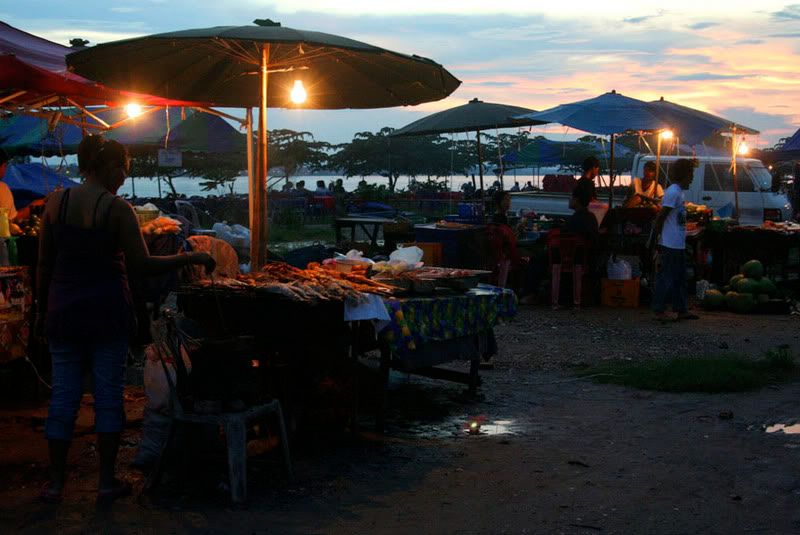
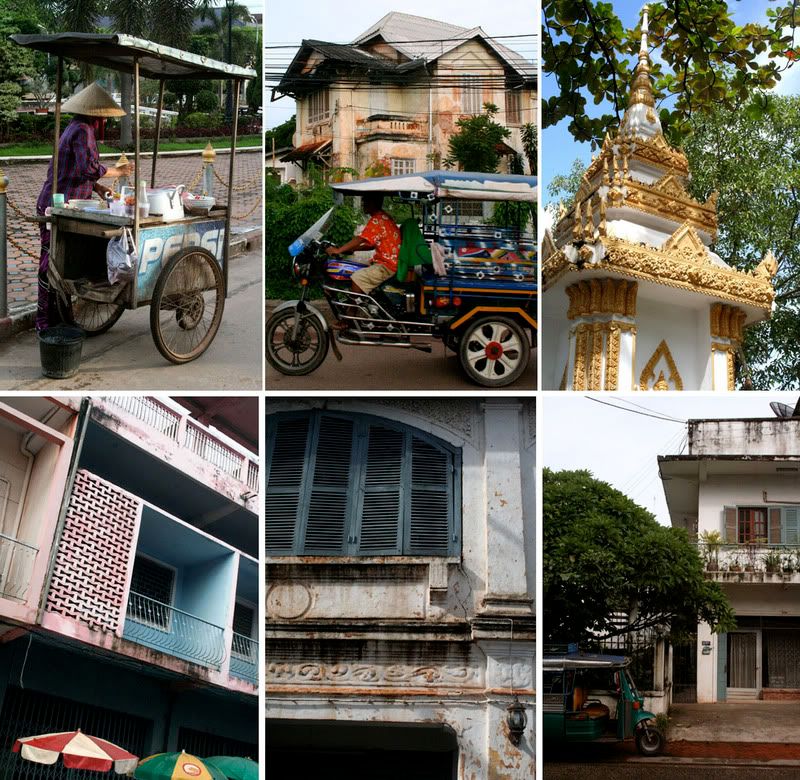
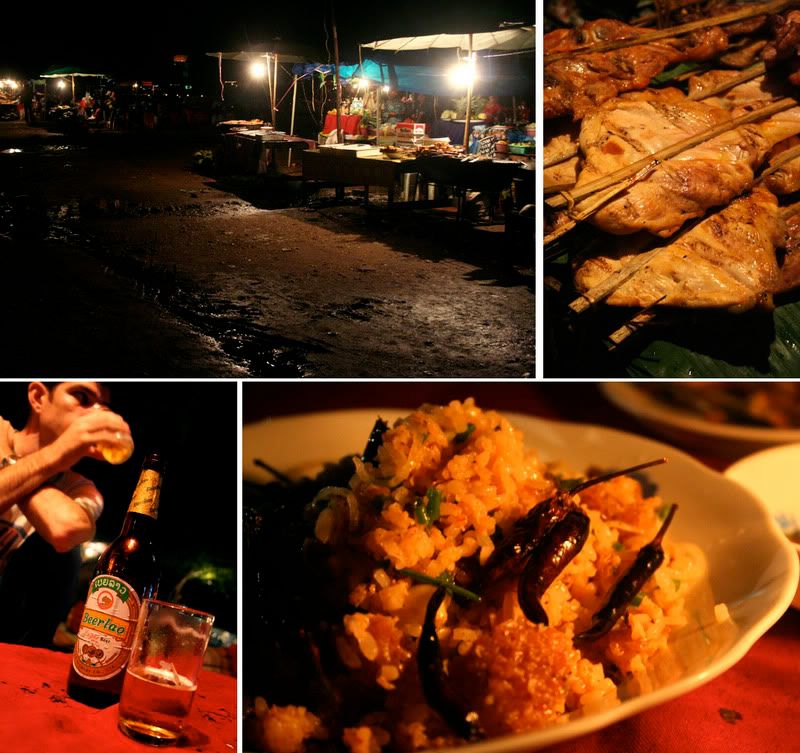
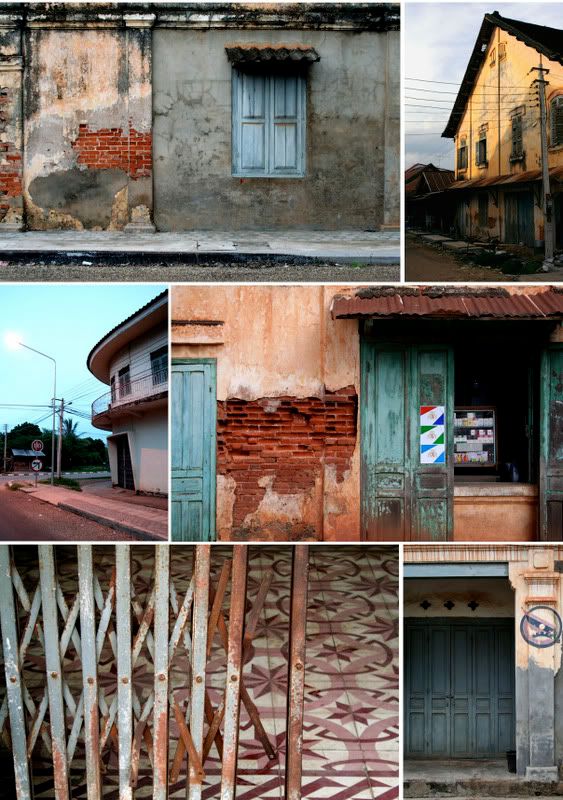
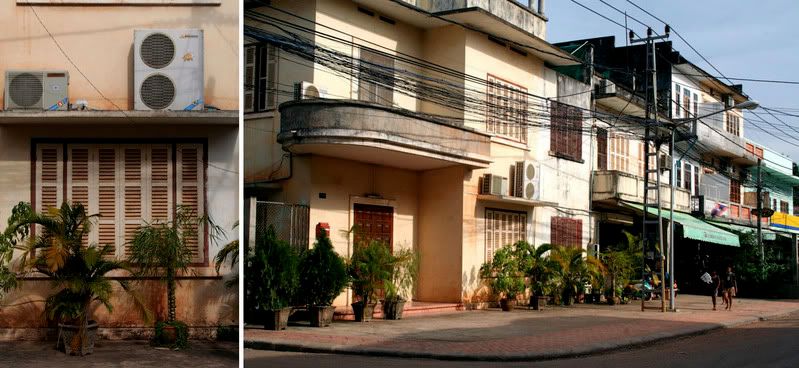
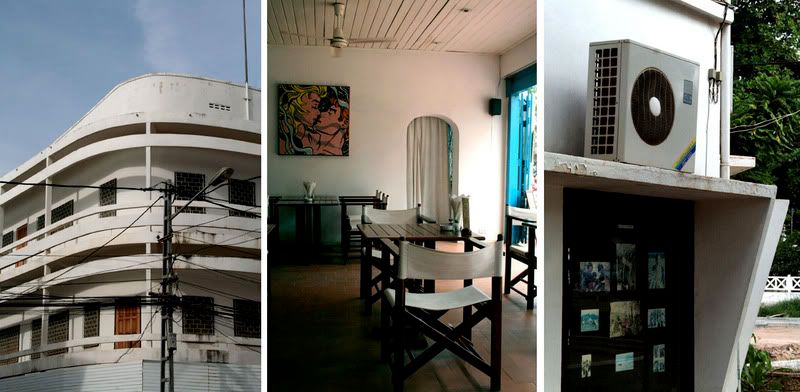
The first thing that struck me about Vientiane when I first visited in July was the architecture. There are mod 1960s shopfronts, all spare lines and angled windows, and there are graceful colonial villas, wooden shutters and banana palm shaded balconies. And unlike in Luang Prabang, where many of the old buildings have been pristinely restored, most of Vientiane's relics are quietly moldering and crumbling. Even the rather stately colonial mansions that are scattered around the city center seem to be neglected, growing mossy in their overgrown gardens. This gives the city a tone of languid timelessness, of being neither perfectly preserved nor of being wiped out for new development. For our only dinner in Vientiane, we enjoyed a Lao feast by the river. At night, a number of food stands set up shop on the escarpment overlooking the Mekong. After finishing a large bottle of Beer Lao from one stand, we searched out another with a fresher looking kitchen. Since everything is out in the open, it's easy to get a quick glimpse of the state of their ingredients and cooking skills. We found a decent looking place that had a busy grill, and a lot of fresh vegetables behind the counter. We ordered a big Lao meal of grilled chicken, spicy papaya salad, and namkhao. The highlight of the meal for me was the the barbecue chicken. While it may not sound too exciting, it is actually a specialty of the area. I had first seen it in Thailand's Isaan region, which shares a similar history, and thus cuisine, with Laos. If bought to-go, it's usually sold with the whole chicken's body splayed on skewers. Since we were eating in, they kindly cut it up and presented it on a plate. There was nothing particularly exotic or distinctly Lao about it; it just tasted like very delicious barbecued chicken. A bit more distinctive perhaps was the namkhao, a dish of brown rice, coconut, vermicelli noodles, and spring onion. It was sprinkled with dry roasted red chilies, which added a smoky spicy flavor, and served with a plate of fresh greens.
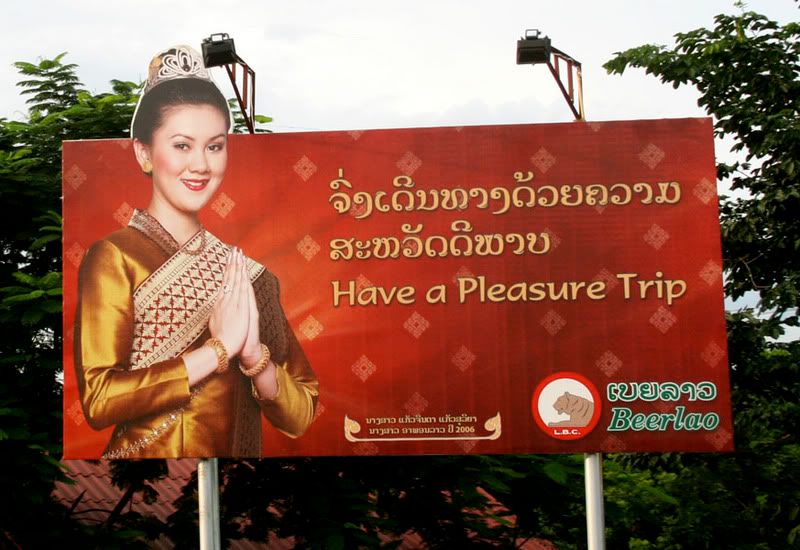
Our two days passed quickly, and after picking up our passports from the consulate we had just enough time for a final stop at our favorite cafe. Before heading for the border, we bought a delicious pate baguette sandwich and two bottles of Beer Lao Dark to enjoy as a last Lao treat on the train. As we crossed the border, we were wished a fond farewell by the brewers of Beer Lao, who wished us to have a "pleasure trip." We certainly did.

Monday, August 06, 2007

Birthday in Phnom Penh.

While the week before my birthday was spent among the jungled ruins near Siem Reip, the actual day of my 24th was spent in Phnom Penh, Cambodia's capital. It was a chance to enjoy some urban pleasures, in one of the strangest capitals in the world.
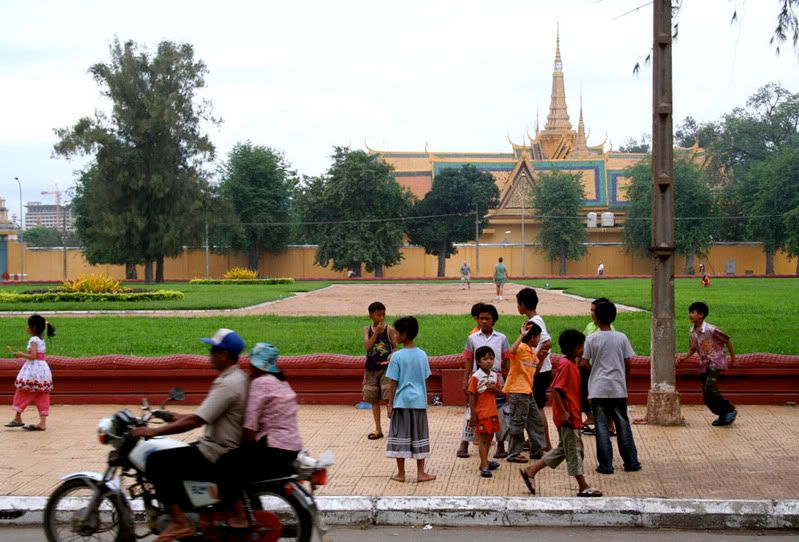
Phnom Penh was a fascinating city, both more pleasant and more jarring than I had expected. After weeks in Southern Laos and rural Cambodia, it was a strange confrontation to be in such an urban space. There were hip cafes and trendy bakeries, serving tasty coffee and elegant pastries. There were leafy avenues, packed with traffic. And there were disturbing signs of poverty and misfortune: amputees sitting on sidewalk corners, mother beggers with sick children in tow.
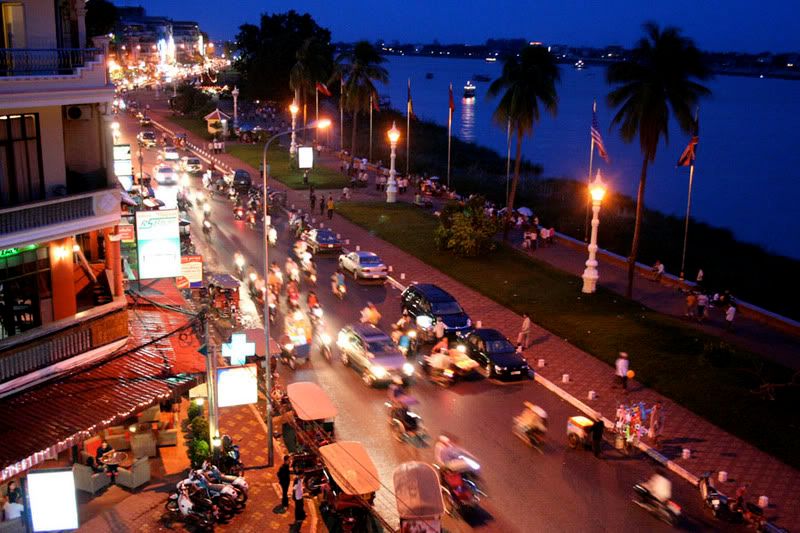
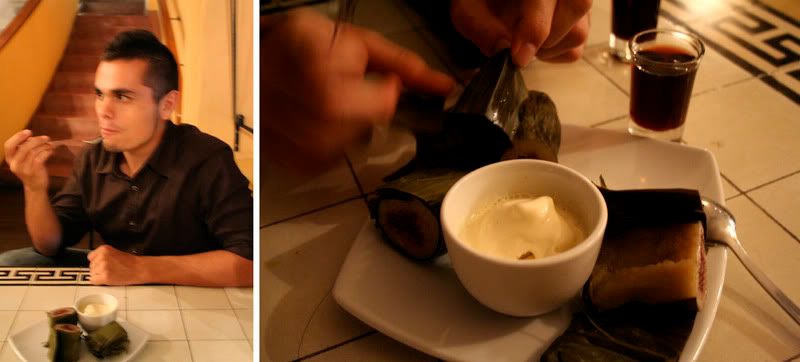
For my birthday, Bordeaux woke me with breakfast in bed, and some gifts he had cleverly gathered. In search of coffee, we walked along the riverbank, peeking in at the disappointing cafe at the dismal Cambodiana Hotel. We found good lattes at Cafe Fresco, and spent most of the afternoon relaxing. For dinner, Bordeaux took me to the Foreign Correspondent's Club. While the Phnom Penh branch of the FCC isn't quite as sexy as the modern white branch in Siem Riep, the restaurant had a nicely casual atmosphere and a beautiful river view. We first visited the top floor, where we ordered cocktails. We then moved downstairs, into the pale-yellow walled dining room, where Bordeaux had reserved a table looking out over the river. I ordered a spicy crab curry, which was incredible. We even ordered wine (a rare luxury for us in Southeast Asia). For dessert, we had an unusual sticky rice dessert, served with melty vanilla ice cream. We also ordered more alcohol- two shots of a warming port that were the perfect end to a great day. The fact that my birthday was so pleasant is all credit of Bordeaux- who not only knows me so well, but was somehow able to plan an incredible day in a foreign city we'd never been to before.

Monday, July 30, 2007

Dolphins in the Mekong.

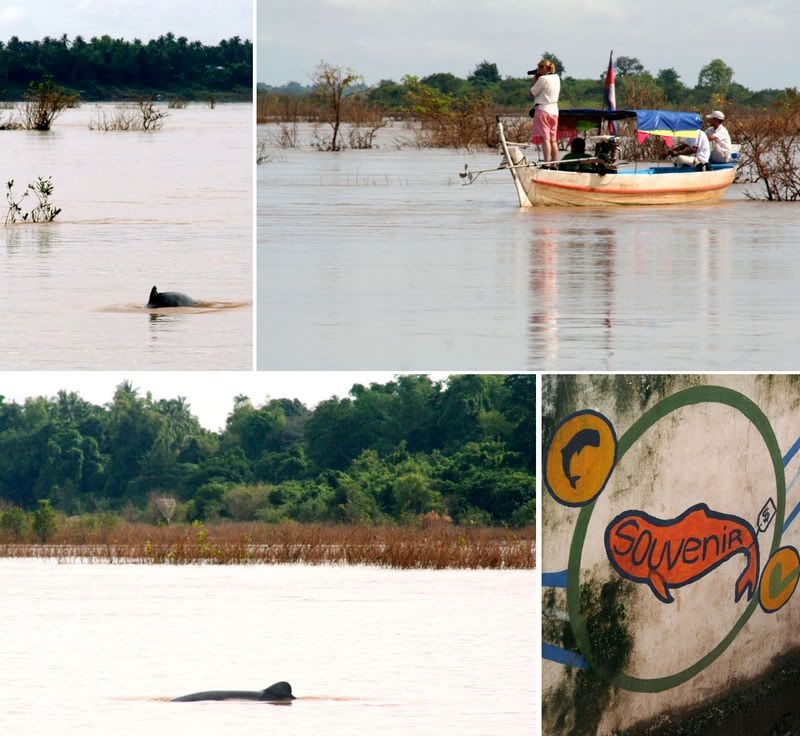
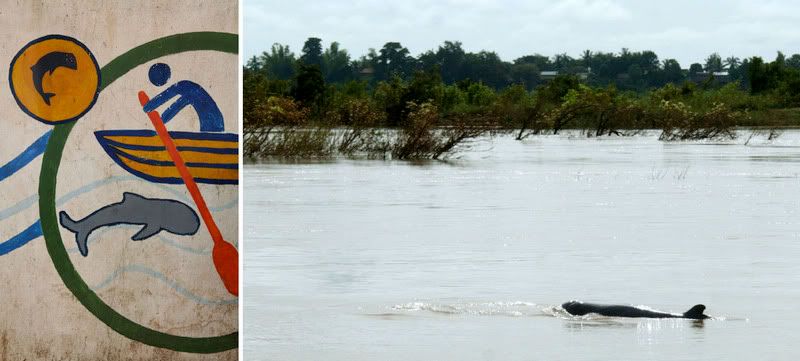
One of the highlights of visiting the area around Laos-Cambodian border is the chance to see the rare Irrawaddy dolphins that live in the Mekong. According to the guidebooks, the dolphins have a special place in local mythology- they're very close to humans, with reports that they have performed heroic deeds, like saving people from crocodiles. For the community living in the area today, they mainly represent a local source of eco-tourism. During the dry season, they can occasionally be spotted in Laos, among the shallow waters around the 4000 islands. During the wet season, it's much easier to see them in Cambodia, where they live in colonies around sunken islands.
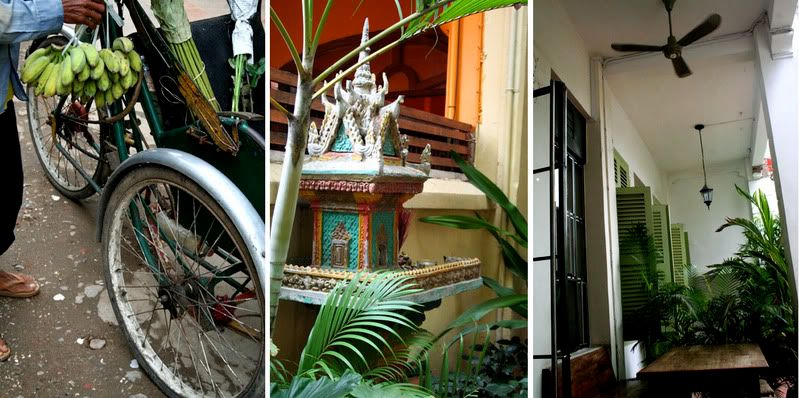
Having spent a beautiful but rough week in Southern Laos- no good coffee or muesli!- the Cambodian town of Kratie welcomed us with an array of simple but comforting Western pleasures. The dining highlight of Kratie was the cafe at the Star Guesthouse. It was situated in a corner spot, across from the food market. Over breakfast or lunch, we watched the goings-on at the fruit stands, and admired the bundles of green bananas that hawkers lugged by. The cafe had a wide range of coffees, good sandwiches using imported ingredients, and my staple breakfast, muesli and yogurt. Kratie itself was a pleasant town, with aged and faded French architecture, and a packed market selling fresh fish and colorful fruit. Just a few blocks away from the town center, and the neighborhoods become starkly more rural; bamboo and wooden stilt houses replaced concrete apartment blocks, and horse drawn carts plodded between moto traffic. The town also had a beautiful location along a wide stretch of the Mekong, which was best viewed from the promenade at sunset, as the golden light filtered through the colonnade of trees.
The dolphins are best seen from Kampie, a small town roughly 15 minutes moto ride from Kratie. The road out was easily one of the most interesting part of the trip. The were beautiful wood homes, with ornately carved accents on the roof and along the eaves; tiny bamboo houses, perched on stilts over muddy water; and all of this piled along the road against a backdrop of intensely green rice paddies. As the moto slowed down, I easily spotted the entrance to the dolphin site; there was a tacky dolphin statue, fading in the tropical sun. We paid the entrance fee, which had risen to about $7 US (well worth it, especially if it actually goes toward protecting the dolphins' habitat)- that included a boat trip with local guides, who were required not to use motors or to chase the dolphins.
From the dock, it was a ten minute boat trip out to the deeper pools that the dolphins favor. I had been worried that we wouldn't see any dolphins- perhaps still thinking of my elephant-less visit to the elephant tower at Ban Na- so I was very surprised how quickly we saw the first dolphin. It's silver fin sliced out of the water, and it disappeared again. I was confused by the fact that the boat driver didn't stop, and didn't seem to pay it any attention- but when we got to our destination, I saw why. We anchored the boat, and watched the water. The dolphins were everywhere. They would appear in pairs, the two fins usually rising in unison. They aren't as playful or as outgoing as their bottlenose relatives, but they still came fairly close to the boat. Occasionally they would show themselves long enough for me to see their distinctive blunt noses and bulbous heads. We watched them for an hour, during which time I tried unsuccessfully to get a good photo. Thankfully, the experience of seeing these strange and rare river creatures more than made up for that.

Sunday, July 29, 2007

Dining on the Mekong.

Unlike Thai food, which, thanks to Los Angeles' many fine Thai restaurants, I was familiar with, Lao food was completely unknown to me before my visit. Though some dishes in Laos were similar to food I'd had in Thailand, there were some notable differences. Lao food in general tends to be less spicy, and most subtly nuanced, with flavors balancing each other out.
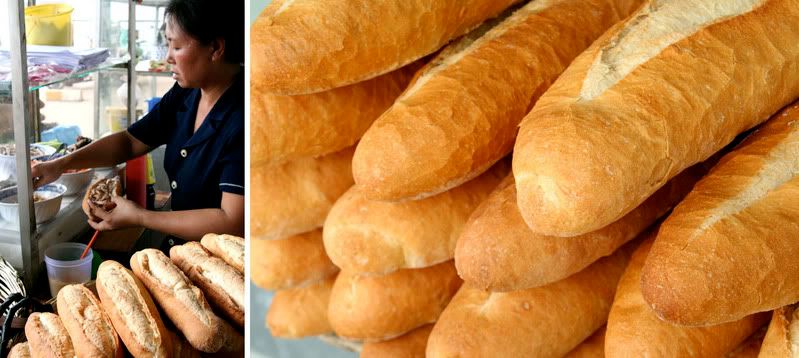
One of the most noted legacies of the French occupation of Laos is the presence of the crusty baguettes sold just about everywhere. While the baguettes often come with meals at chic cafes and elegant restaurants, one of the best places to try them is at street-side stands. Foot long baguette sandwiches can be bought cheaply, and are surprisingly delicious. The bread is usually fresh, with a crisp crust and soft interior, and the sandwich is created with a seemingly strange mix of ingredients. Standard ingredients include cucumber, cold cuts, chili sauce, pate, and fish sauce (and for those who like it, dried pork flakes). The result is a sandwich that, like most Lao food, has a mix of nicely nuanced flavors and textures, with salty, spicy, and savory all delicately balanced.
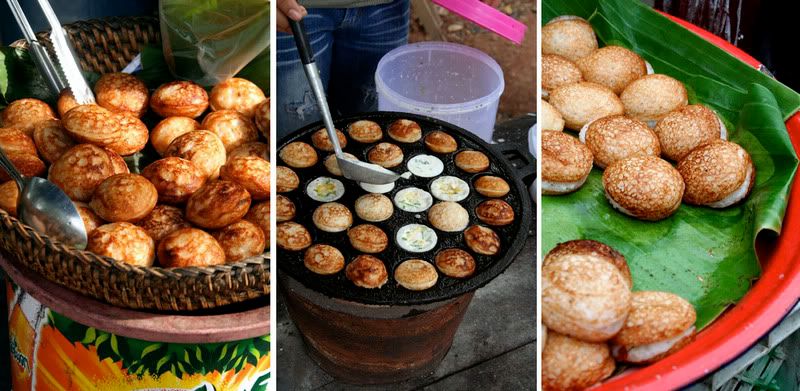
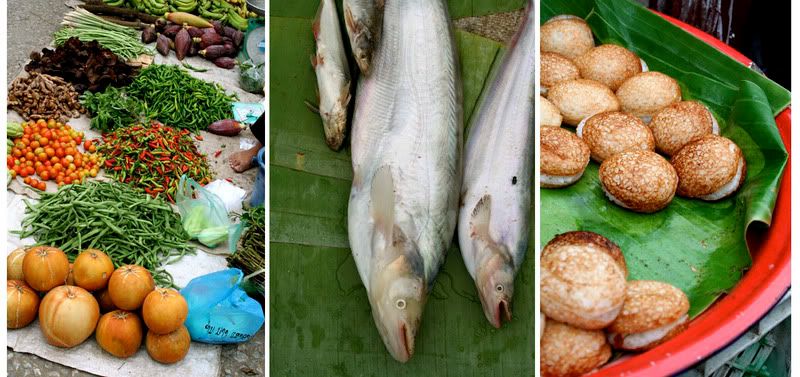
There were an amazing variety of snacks for sale at the morning markets, from fried crickets to while grilled chickens. One cheap street-food treat that I loved were the tiny rice-porridge tarts that were sold at markets all around Laos. I haven't been able to find out what they're called, and I can only guess what they're made of. They're poured as a batter into a sectional griddle, toasted brown, and served straight off the griddle. They're eaten piping hot, the creamy center able to burn the roof of your mouth. They usually have the flavor of a pancake, with hints of spring onion in the center. In southern Laos, I bought a batch that was made with sweet corn, and served with a coating of white sugar.
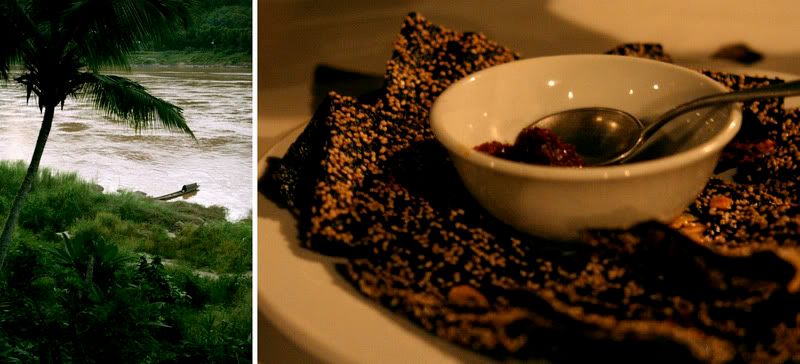
Considering that Laos is basically a long parcel of land stretch across the Mekong, it makes sense that a lot of food should come from the river. One of my favorite river treats was a Luang Prabang speciality called khai paen, fried river-weed chips. Bordeaux and I tried them at a cheap riverside restaurant in Luang Prabang, looking out over the Mekong. The riverweed was served in large, thin squares, and were so dark green as to be almost black. They had a soft seaweed taste, which was complimented by a coating of toasted sesame seeds. Perhaps best of all, the chips were served with jeowbong, a Luang Prabang chili paste. Though not particularly hot (the paste is made with 1/3 chili and 2/3 sugar), the paste added a sharp spicy-sweet flavor.
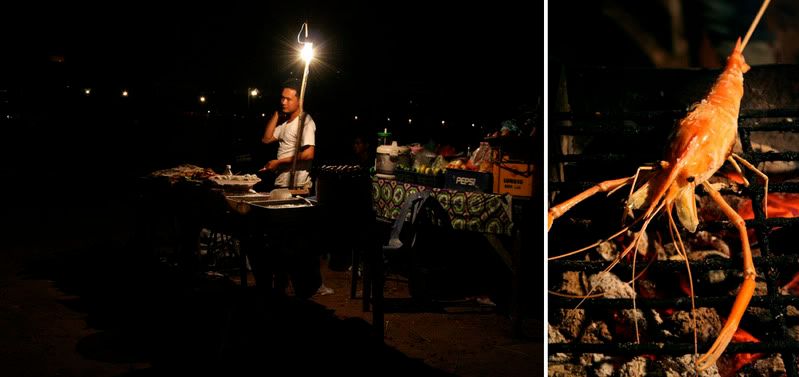
We happened to be in Laos during the season for river prawns, and we would often see the huge, blue prawns cooling in ice at foodstalls around Vientiane. Despite not really caring for prawns, I was curious to try one. I bought one in Vientienne, from what is likely Laos' least convincing transsexual (as Bordeaux said, Lao trannies just don't try very hard). The prawn was grilled over coals until it turned deep red, the shell just toasting black. It was tasty and surprisingly meaty, though as said, I don't really care for prawns. So what's the point of my review?
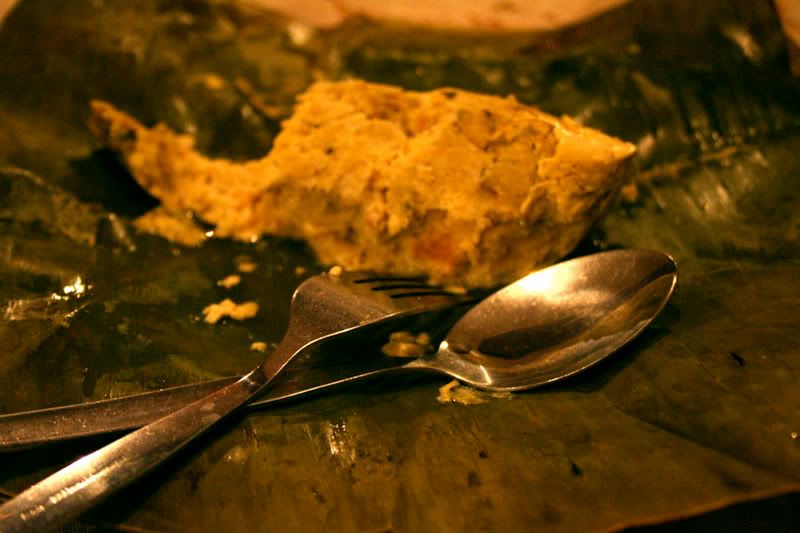
But by far, my favorite riverine meals was mok pa, a fish curry steamed in banana leaf. We ordered it at guesthouse in the 4000 Islands, in the tropical south of Laos. The fish is cooked in the banana leaf, turning it into a paste like consistency that is soft, delicate and full of flavor. It had a melting texture, and a strong, fresh lemon grass flavor, with sharp hints of kaffir-lime leaves.
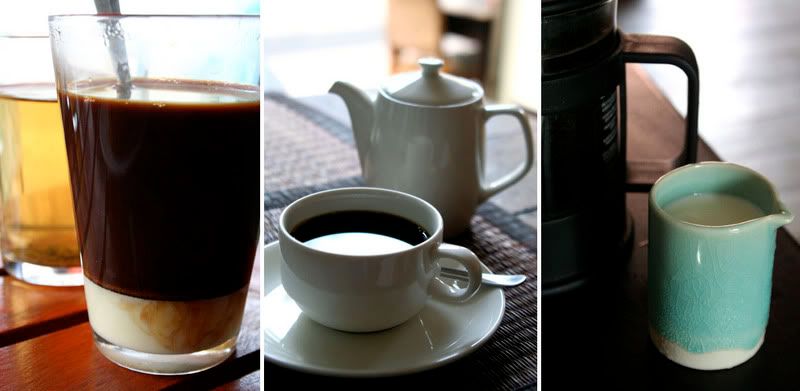
One of the things I was most curious to try (but found most disappointing) was Lao coffee. Unlike the hilltribe flavor of Thailand, which was naturally sweet and highly flavorful, most of the Lao coffee I had was too dark and bitter for my taste. While this is certainly due in part to the quality of the coffee beans themselves, it was likely in part a result of the way the coffee is prepared. Lao coffee is generally prepared in in a metal sieve, and then served in a small glass over an inch of condensed milk. Though occasionally it came out well, the bitterness and sweetness nicely mixing, it often was simply too bitter, and too mudlike. Certain Western style coffeeshops, most notably JoMa in Vientiane and Luang Prabang, used Lao coffee to make delicious, if not uniquely flavorful, lattes and americanos. Morning Glory, in Luang Prabang, served a nice Lao coffee in a french press, fitting of its euro-tropical cafe.

Friday, July 27, 2007

Ruins of Southern Laos.

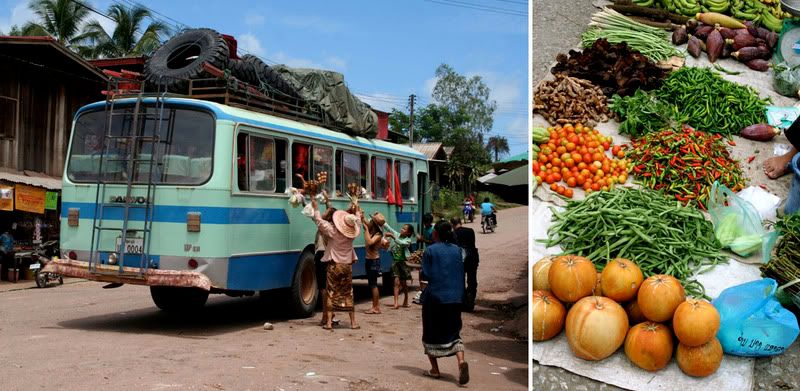
Departing from Vientiane, Bordeaux and I left behind the comforts of Northern Laos. The bus from Vientiane to Savannakhet should have been a good indication of what was to come: our bus turned out of the station, stopped directly across the street to load on more passengers, waited while they got settled on plastic stools in the aisle, started up, slowly crawled a block, then stopped again to let on vendors, who climbed in over everyone to sell grilled chicken, fried crickets, and bottles of coke. An hour after we were scheduled to leave, we were barely leaving the city.
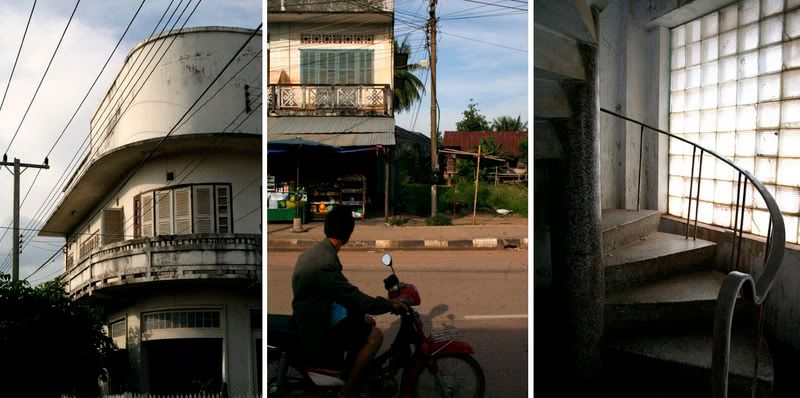
We reached Savannakhet in the late afternoon. Savannakhet is mostly notable for what it could be, or almost is. It's almost a charming city; it could be, as the guidebooks optimistically describe it, 'the Luang Phabang of the south.' And to be fair, it certainly has a lot going for it: a pleasant location on a bend on the Mekong, a white walled church set at the head of a large open square, and beautifully faded French architecture from the 1930s to the 1960s. But somehow it seems as if none of this is living up to its potential. The city lacks the cafes and restaurants of Louang Phabang or Vientiane, has little to offer for accommidation, and has few sites worth visiting. It would be nice place to relax if only there were a comfortable place to do so. At the time of our visit there was a new cafe opening up on the square, but even that looked like a generic import. Still, despite its lack of amenities, the charms of this rusted and aging city make it more than likable; I only wish there was more to reward that affection.
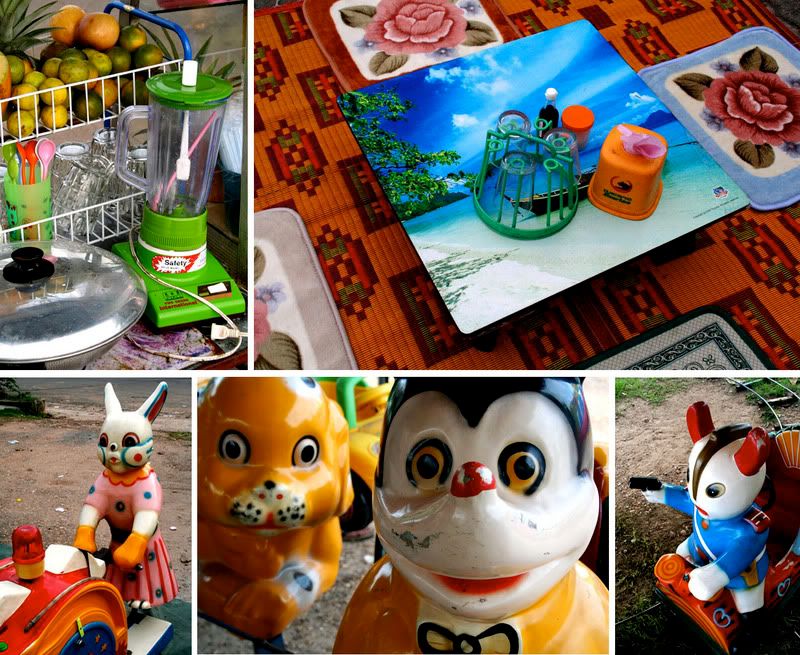
The major sign of modern life in Savannakhet was present in bright, lurid, plastic colors. Near the riverside noodle stalls and fruitshake stands we encountered a funfair in the process of being set up. They had already set up a small train, a merry go round, and a see-saw, and a massive bouncy playground was slowly plumping and growing. Though the entire fairground was populated by cartoon characters, none were recognizable, aside from a few minor look alikes; there was a rather jaundiced Mickey Mouse, and a nightmarish Donald Duck. Most of the other cartoon characters were simply creepy- most particularly the menacing Rabbit in a mini-skirt, who powered the seesaw with her brawny plastic arms while making a series of ambulance alarm noises. Some characters were simply incomprehensible, like the martian-rodent that wore a military uniform, rode a log covered in hearts, and pointed a gun; when a young girl rode the train sitting in front of him, it looked as though she were being held against her will.
Our bus ride to Pakxe was even worse than our ride to Savannakhet. Of six hours traveling, we spent at least 3 hours stopped, either loading on passengers and cargo, taking bathroom and smoking breaks, or sometimes stopping for no clear reason. One night in Pakxe was enough to take in the atmosphere, and we left early the next morning. From Pakxe we took a boat further south, to the quiet riverside town of Champasak. There wasn't much in Champasack- a row of houses and shops, a few dingy guesthouses, and a beautifully faded yellow villa. The quiet Mekong location was perfect for relaxing though, so Bordeaux and I spent time resting above the brown river, drinking banana and lao coffee shakes.
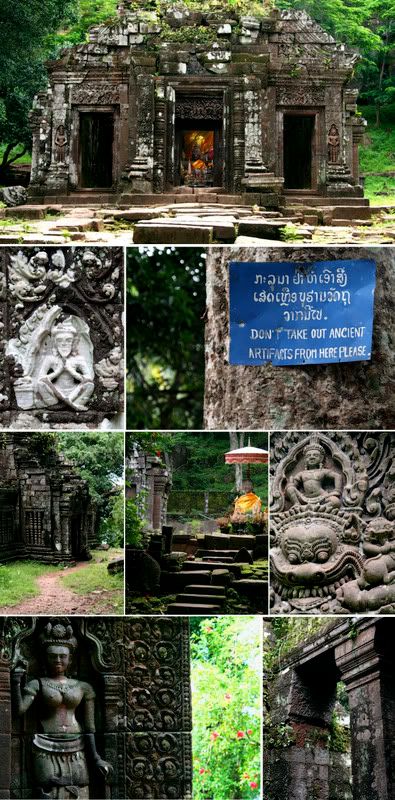
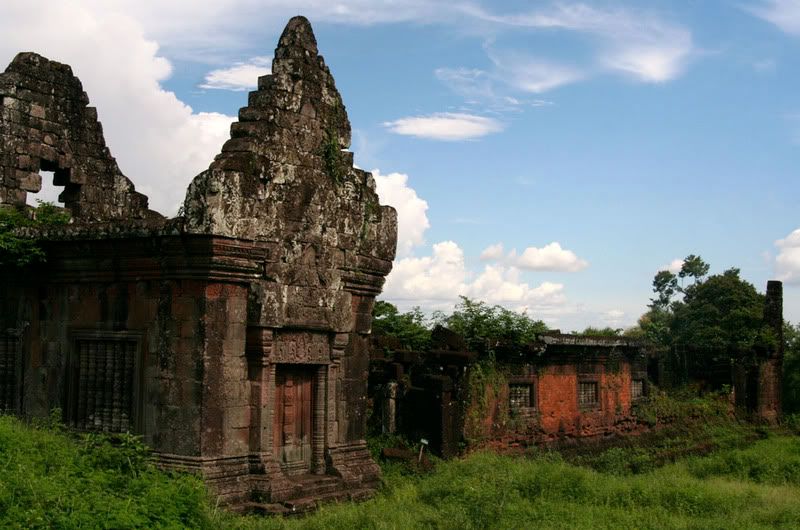
Southern Laos' major site is Wat Phou, an incredible hillside Khmer ruin. At the base of the hill were two large complexes known as the palaces. The artwork on the temples remaining was incredible, with fierce nagas and demons still guarding the corners of the ruins. Up a crumbling staircase, under a canopy of strangler figs, was the real wonder of Wat Phou. In a shady glade was a humble temple, a gold-sashed Buddha flashing from within its center. Carved guards and aspara dancers stood on the walls, curving bodies specked with moss. The wooden braces that held the temple up inside revealed the degree to which it was on the verge of crumbling, or being pulled down by vines and roots. The site was strange, dark, and perfectly mysterious. The quiet wonder of Wat Phou on its own makes the slow and uneasy trip through Southern Laos well worth it.

Wednesday, July 18, 2007

Vientiane Style.

It's not hard to enjoy the pleasures of Louang Phabang: the peaceful riverside atmosphere, the tastefully restored French architecture, and the Royalist history combine to make a refined yet relaxed town. Most travelers coming from the north thus find it easy to dismiss Vientiane, the capital of Laos. It's too concrete, not charming enough. However, Vientiane has its own pace and its own style.

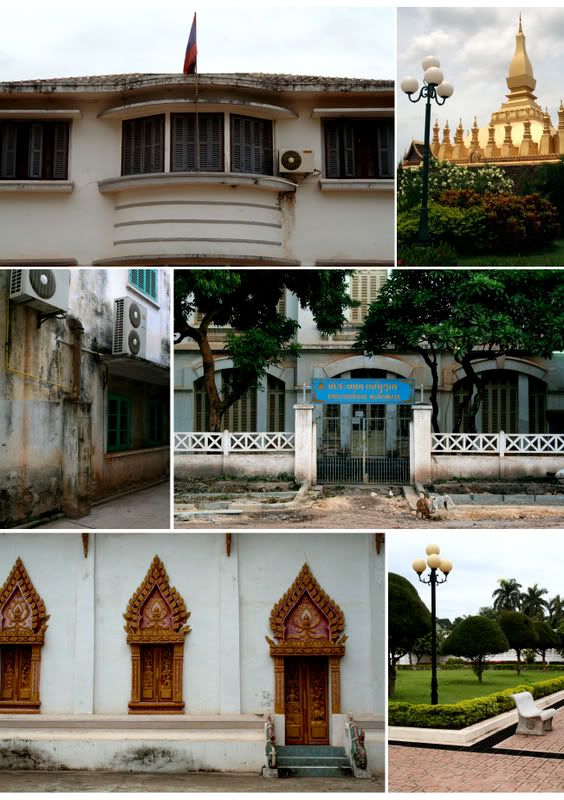
Like most good capitals, Vientiane has a taste for the monumental. Lane Xang avenue, designed to evoke the boulevards of Paris, runs through a neighborhood of office-parks and embassies, ending at the Patouxi arch. Built to resemble a Hindu arc de triomphe, the monument suffered from concrete shortages and socialist redecoration, and is now, by declaration of its own informational plaque, "a concrete monster." Further east from Patouxi is the That Louang, symbol of Laos. It's emblematic gold stupa, which is stunning enough on its own, is set in an oddly layed out park, accented by carved topiaries and ornate lampposts. Far more pleasant are the simple offices and shops of the city, many of which were designed in the 1960s in a French modernist style, and have been left to age gracefully. Where Louang Phabang feels like a colonial outpost, restored to recapture the 1930s, Vientiane feels like a sleepy but cosmopolitan capital, stuck languidly in the 1960s.
For travelers and expats, Vientiane's subtle cosmopolitanism also provides access to a number of Western luxuries unavailable elsewhere in Laos. A number of minimarts- thrilling, for the travel worn- sell bottles of wines, European cosmetics, and luxury chocolates. Vientiane also offers a wide range of options for eating out- from the cheap Lao noodleshops that crowd the promenade overlooking the Mekong, to the hip cafes and stuffy french restaurants centered around the city center. The best coffeeshop in town is JoMa, which also has a branch in Louang Phabang. Aside from serving the best lattes in Laos, JoMa has a good sandwich menu, an extensive array of baked goods, and an air-conditioned interior with an urban atmosphere. It provides the perfect atmosphere to relax with an out-of-date Vientiane Times, and soak up the charm of this backwater capital.

Thursday, July 12, 2007

Beautiful Luang Phabang.

Few legendary destinations live up to their reputations of romance and exoticism. Louang Phabang certainly comes close. Admittedly, part of its glamour must have been a result of our means of arrival; after two days traveling by slowboat through the jungle of the Mekong, Louang Phabang served as a very welcome port of call.
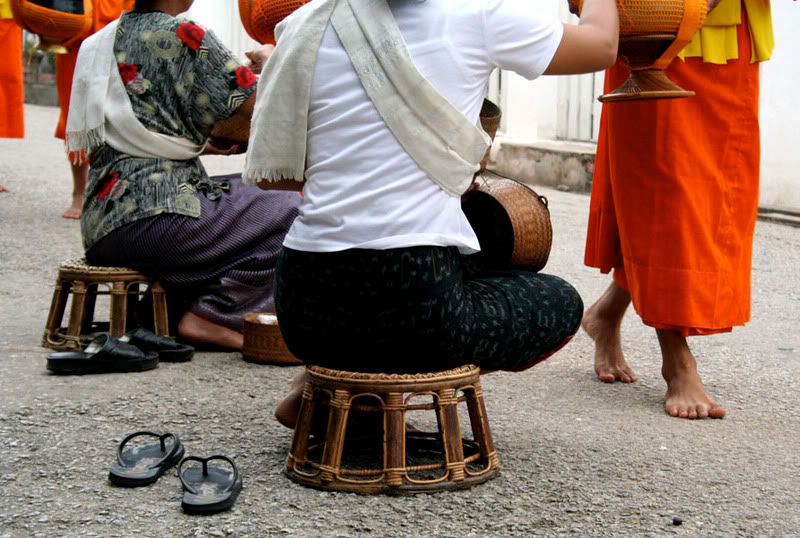
Apart from it's soothing views of the Mekong, the Nam Khan river, and the distant forested hills, Luang Phabang also boasts beautiful French architecture, numerous markets, and cafes brewing coffee grown in southern Laos. A city of cool white walls and blue-green shutters, Louang Phabang has a reputation for sophistication among the Lao. Unlike most of the country, which hasn't yet been able to fully emerge from years of economic isolation, there are few comforts or luxuries missing in Louang Phabang. Aside from a crumbling Socialist Mural perched above the Hmong market (Soclalist art always being recognizable by groups of united youth and the presence of a man holding a wrench), the only visible sign of communism is in the hammer and sickle t-shirts for sale. One could almost imagine that the city had gone smoothly from royal capital to French outpost to chic tourist destination.
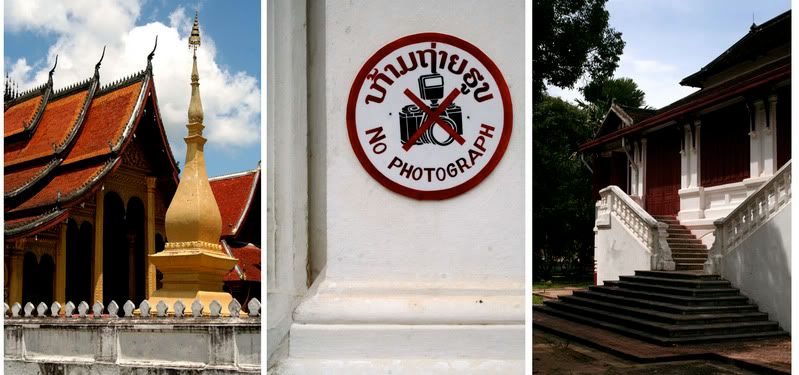
For being a relatively small city, Luang Phabang offers a few rather impressive sites. There are a number of wats, shimmering gold inbetween the gardens of neighboring villas. The most impressive is Wat Xiang Thong; the exterior walls of its pavillions and chapels are decorated in glass mosaic tile, depicting elephants, peacocks, and characters from Lao folktales. The premier site in town, however, is the Royal Palace, home of Laos' last king and queen. The entrance halls of the palace, which were redone in the late 1950s, feature colossal mosaics in metallic tile. Shards of colored glass create an entire universe of Lao folklore... In another chamber are a series of murals depicting the passage of one day in Louang Phabang. Painted in 1930 by Alex de Fautereau, the mural seems to have been an effort to mythologize Laos in the same way that Gauguin did for Tahiti. However, where Gauguin favored Polynesian women, it seems possible that Alex had a strong fondness for young Lao men; while the women in his mural are fully-clothed, often tucked away in shadows caring for childen, the men of Louang Phabang appear bare-chested in tight (and sometimes short) sarongs, standing in intimate conversation with one another. Beyond the entry halls are the royal residences, which are striking for their simplicity. Though they favored rather ostentatious ceremonial rooms, their own bedrooms have plain white walls and simple wooden furnishings. Behind the Royal Palace there are a number of galleries, which show surprisingly sophisticated work. In one old room there was even a show of work by Janine Antoni, featuring pieces she created in dialogue with several Hmong women.On our last morning in Luang Phabang, Bordeaux and I woke especially early. Starting at sunrise, the local monks walk through town, receiving alms from the local women. Since monks cannot cultivate their own food, they must be given it through this daily ritual. The woman sat patiently, often chatting and laughing with their friends, waiting for the procession of monks to arrive. At last they appeared, a long train of men, young and old, in orange robes. The woman would gather a handful of sticky rice from their basket, and give it to the monks. Once the last monks had passed by, the women would say a small prayer, and return to their homes. Leaving the morning ritual, Bordeaux and I headed to the morning market. Blankets were set out and small stands set up on a thin alley, where it seemed almost possible to find any kind of Laotian creature on offer. Plastic bags quivered with live crickets and crabs, water rodents tried to chew out of bamboo cages, and large birds lay dead on the ground, their splayed wings still covered in dark feathers. Bordeaux and I opted for a somewhat safer breakfast; rice porridge tarts, their edges browned to the flavor of a warm pancake, their insides still dripping hot.