Showing posts with label Viet Nam. Show all posts

Monday, August 31, 2009

National Restrooms.

In looking through the archives of photos I’ve taken, I often see recurring themes develop. Often I’m conscious of these trends; I like to take photographs of certain colours, say, or of modernist architecture in unusual places. Sometimes, however, strange themes occur within my work without my having been aware. Like, for instance, these images of National Park toilets. Looking over them individually, I can recall why I took each individual photo: I liked the offbeat composition of the outhouse and boulders in Joshua Tree; I was caught by the pattern of light inside men’s room at My Son; I was amused by the way the ablutions at Great Zimbabwe were made to mirror the historic architecture of the ruins—but looked at as a recurring theme, it comes off a little strange. This isn’t exactly a regularly recurring subject of mine (there are, after all, only five such photos between a period from 2003 to 2008)—yet still frequent enough to warrant notice. The best explanation I can provide is that one of the larger themes I explore in my photography is the more mundane aspects of travel and tourism—and thus these images of themed National Park restrooms have found their way into my collection. Does that make it seem any less odd?

Pictured (from top): Voortrekker Monument, Pretoria, South Africa; Joshua Tree NP, California, US; My Son, Vietnam; Tikal, Guatemala; Great Zimbabwe, Zimbabwe.


Thursday, August 13, 2009

Colors of Hanoi: Empire Red

Hanoi’s colour palette tends toward the discreet: a mix of smoky greys in the medieval old quarter, pastel sherbet hues on the new French boulevards. This makes the sudden bursts of vibrant red that dot the city all the more intense. Red in Hanoi is an imperial colour. It flashes in Chinese shrines, in paper lanterns and packets of incense, and on carved temple doors. The colour was used again more recently with another Empire; Soviet influence in the Communist capital sparked a revival of the hue, where it was used to bold effect for official signs, on government buildings, and in propaganda posters.

Friday, April 17, 2009

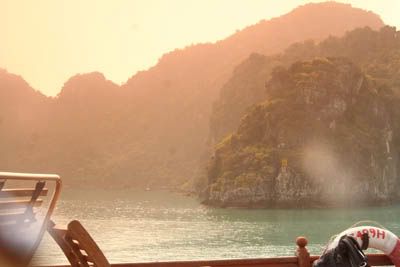
Bad Picture: Afternoon light on Halong Bay

My photography is certainly not of a level that most of my shots are a success—I generally take at least a dozen pictures of a single subject, then later edit and select the decent one or two. Often, many of my photographs come out very badly—they might be blurry, poorly framed, lacking a subject, or looking like I photographed them while dropping the camera. Yet every now and then, one of these ‘bad photographs,’ ends up being appealing to me in some way. While it may not get anything right photographically, it still manages to communicate something about the subject—sometimes even better than a good photograph can.

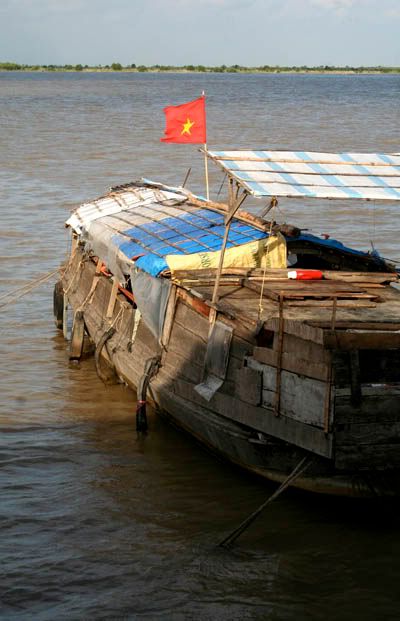
Like the above shot of Halong Bay, for example. It’s really not something you’d put in a frame—there’s no clear subject, the details of the boat are slipping right of the edge of the picture, and there’s something in the foreground that has been reduced to out-of-focus fuzz. But despite all of this, the picture somehow captures the mood of the afternoon cruise even better than my other pictures. The glowing colour of the light, the rolling forms of the karsts, even the total lack of focus is actually a benefit; it all somehow captures the sense of languidly enjoying the last warmth of an afternoon out on the beautiful green waters of Halong Bay.

Friday, March 20, 2009

Eating to the Mekong's end.

While Bordeaux zipped off on the back of a scooter, I retreated with my backpack into a tiny pocket of shade. The line of motorbikes and trucks in front of me growled impatiently, waiting for their turn to board the ferry. Feeling a tugging on the hem of my t-shirt, I looked down to find a child, who waved a stack of lottery tickets in my face. Her mother approached, and I assumed she would point out the obvious problem the girl—that I was a clueless foreigner, and didn’t know how to play the lottery—but she simply motioned to the child, and looked at me with her lips pursed in an insistent frown.
To feign being busy, I turned to browse at the snack stand behind me. Packets of candied fruit, bags of coconut taffy, boxes of dry biscuits; all coated in a thin veneer of red dust from the road. I was grateful I’d had a decent breakfast before leaving Saigon. I had come to Mekong Delta for a number of reasons, but the main reason, I reminded myself ironically, was to eat.

My desire to taste the Mekong Delta had been growing for some time, developing out of a vague collection of cravings into a refined and pressing hunger. It had started, perhaps, when my boyfriend Bordeaux and I first decided to move to Southeast Asia. After some deliberation, we had settled on Saigon as our ultimate destination. In retrospect, it’s hard to say why exactly. Bangkok seemed the more accessible option, but horror stories about the pollution, traffic, and urban chaos put me off. But why Saigon? Really, I knew nothing about the city, or about Vietnam in general. If I’m honest, I’ll admit that it was perhaps the idea of being so near to the Mekong Delta that drew me. Though I had no real knowledge of the river, I had assembled a mental pastiche of images, gleaned from travel brochures and old movies. Images of slim boats drifting over sluggish water through an arcade of palm fronds, and giant catfish sheltered just below the surface. Tropical and mysterious, the qualities that were drawing me to Asia to began with.

From our arrival in Bangkok to the culmination of our journey, we spent a solid three months traveling. And throughout that time, the Mekong River was a constant guide. We followed it from town to town, drifting downriver at only a slightly slower pace than its muddy brown water. And along the way, we came to know and love how the river tasted. We could feel its richness and fertility in the dripping golden papaya we savored on the banks of Chiang Khong, on the first morning that we saw the river itself; we grasped its salty aquatic flavor in the crisp squares of fried river-weed coated in sesame seeds and dabbed with chili sauce, which we sampled on the promenade in Luang Prabang; and we has tasted its history and culture in the sliver of green mango that garnished a French baguette sandwich in Phnom Penh. But, as close as we came, we didn’t get to taste the river to the end, to the delta.
We made it to Saigon, but only briefly. After only a week in Vietnam, Bordeaux and I boarded a plane and returned to Bangkok. Despite the misguided preconceptions I’d had, we had both turned out to adore the city, and were eager to try living there. So though Vietnam seemed fascinating, we left—never having made it anywhere near the delta. The river’s end remained unseen and untasted, as our plans of living near the Mekong Delta came to an end.

The hunger pangs, however, didn’t end quite so easily. Getting to the delta became a constant goal, a desire I nursed as we lived and traveled throughout the region. And so it happened that over a year later we finally made it there—and I found myself alone, waiting at the ferry port of Ben Tre.

Thankfully, our hotelier returned quickly, and instructed me to climb onto the back of his scooter. We zoomed off, leaving the sun-soaked chaos of the port behind, and slipped into shadow among the leafy gardens of a quiet neighborhood. We passed a string of sugary candy-coloured houses, clacked over a canal on a thin wooden bridge, and twisted into the gate of his guesthouse.

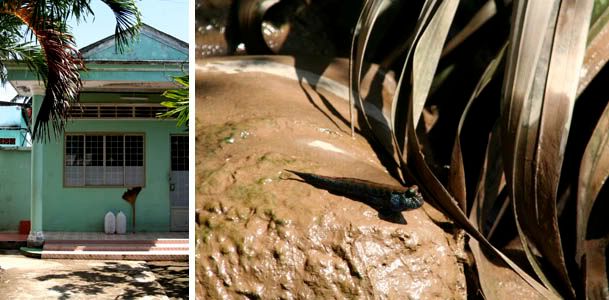
It wasn’t, as I had imagined when I made the booking, a charming boathouse tipped over the river itself, with a hammock slung on the verandah from which I could gaze into the flow of the water. Instead, it was an inland compound of modern mint-green buildings, surrounded by trees. But even though we weren’t on the river itself, there were signs of it everywhere. The air felt sticky with humidity, as if we’d just come on shore after a quick plunge. The garden was flourishing with fruit trees, with pomelos and papaya hanging heavily on straining tree limbs. And a network of shallow streams and canals criss-crossed the yard, giving the feeling that the earth may sink or be swallowed in a flood at any moment. As I climbed off the bike, I found Bordeaux peeking into one of these streams.

“Come, look here.”

All along the bank, there were tiny fish with cartoon eyes, hopping out of the water and onto land. Mudskippers. I’d seen them before in nature documentaries and wildlife books, but they were infinitely stranger in real life. Yet somehow, their amphibious lifestyle seemed to make sense here, where the dividing line between water and earth seemed so thin.
Looking into another patch of murky water, we spied the vague outline of a large fish. It came up to greet us, it’s lips barely breaking the surface of the water. We gazed around the lush garden, continuing our search for wildlife, and spotted a low metal cage partly obscured under some bushes. Looking in, we caught the glimmer of scales on a muscular snake.
“Cobra,” the guesthouse owner informed us. “Maybe you’ll have some for dinner?” We laughed politely, assuming he was joking—though we would later be corrected of this assumption as we looked over the menu for dinner.

We spent the afternoon strolling around town, peeking into coconut candy workshops, being hailed by men wanting us to witness a cockfight, and sipping iced drip coffee in a neighborhood joint. We returned to the guesthouse as the air was cooling down, just in time for dinner. We sat at a table outside, under a pitched canopy of dried palm leaves. After being presented with two icy green bottles of Saigon beer, we were handed a menu, though we had little reason to actually look at it. We’d booked this hotel with a purpose, to eat their specialty dish: elephant ear fish. The fish that had greeted us as we arrived, in fact.
We had only to order and we were immediately summoned to the same stream where we’d had that sighting. Gripping a long net, our waiter scooped into the water, and lifted out a massive silver fish. He dropped it onto the soil, and as it began to make desperate somersaults, commanded me to take a picture. I obligingly took one shot, though I wasn’t eager to document the last undignified moments of my dinner’s life. Satisfied that I’d captured the moment, he grabbed the fish, and disappeared into the kitchen.
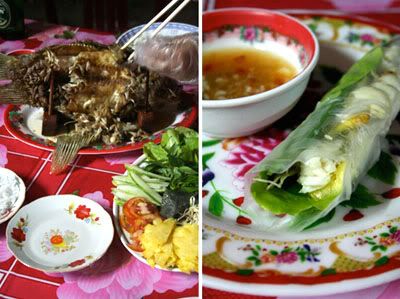
When we next saw the fish, it was in a much-altered state. Supported in a wooden frame, it was held upright, and was set on our table with fins splayed, looking almost as if it had swum there itself to join us. Its skin was now more golden than silver, its scales crisp and flaky. It’s tender meat seemed ready to melt away at the first jab of a chopstick. Accompanying it were a bowl of rice noodles, a stack of thin rice paper, and a plate crowded with piles of pineapple, bean sprouts, tomato, and fresh green vegetables and herbs.

I snipped off a morsel of the fish with my chopsticks, layered it on the rice paper, rolled it up, and bit in. The green vegetables tasted sharp, the pineapple exuded an acidic tang, and the well-fried fish was luxuriant fatty. The rice paper contained it all, holding it in for a moment before the flavors revealed themselves on my tongue. I dipped a second piece into the sauce of chili, garlic and fish sauce; it tasted even better.

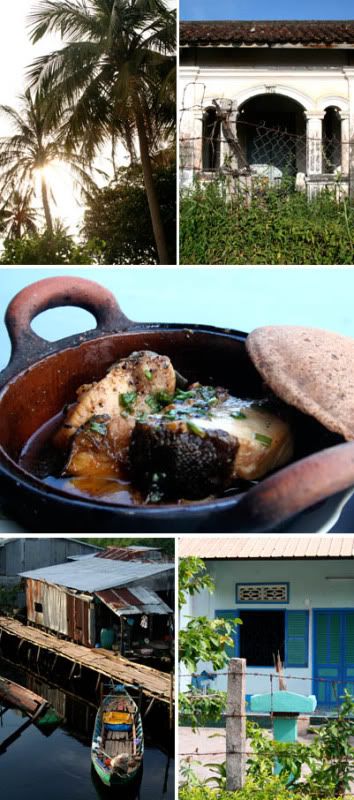
Over the next week, we crossed the entire delta, and continued our slow tour of Mekong flavors. We rode to the far Western border, past wide grassy expanses dotted with Khmer-style temples and pinnacles of limestone, to slurp on sour spoonfuls of canh chua ca. We rode over the waves to the pristine palm-fringed beaches of Phu Quoc, where we dined on salty caramel-sweet claypot fish. And in every meal, in every dish, and at the bottom of every bowl, we encountered the same flavors. Spicy, tangy, salty, sour, and fresh. The flavors that I had come to know as the taste of the Mekong River itself.

Thursday, January 15, 2009

Sugar cane.

Even though we've left Asia, we thankfully haven't left the food behind. Just after we got back to the US, we attended a Thai cooking demonstration at an Asian grocery store in Albuquerque. We've had good luck with local Vietnamese restaurants (though not Thai), and we've been experimenting in the kitchen, on meals like kaeng massman, green mango salad with crispy catfish, and canh chua. We even started the year by making a New Year's Eve feast of Cambodian catfish sandwiches, banana flower salad, and grilled beef salad rolls (the vodka fizzes Bordeaux mixed to drink and the glazed bananas and cinnamon ice cream my sister served for dessert weren't strictly Asian, but paired nicely). The past year and a half were spent mainly trying new dishes and experimenting with unfamiliar flavors; this next year will hopefully be about making some of those flavors our own.

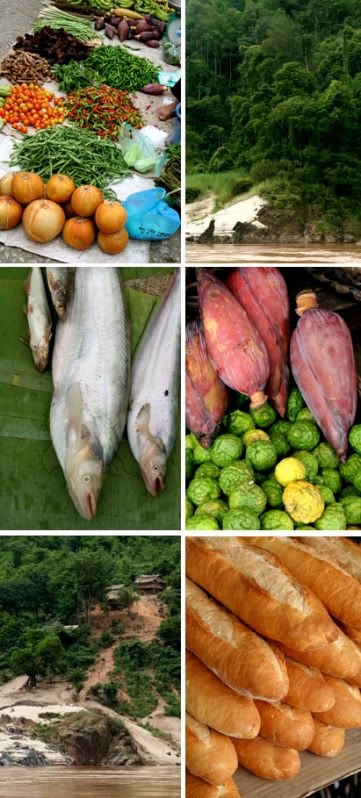
On the side, we've been pursuing some other food interests. I've been doing a lot more food-reading, and have been studying a diverse selection of cookbooks (including the Time Life volume on Southeast Asia, from which the above photograph was lifted). I've been enjoying breakfast, from simple bowls of muesli and fresh berries to decadent almond french toast. We've also been experimenting in baking: last weekend was a two-layer cinnamon and chile cake, this weekend will be homemade donuts.

What are you enjoying eating lately?
Thursday, January 01, 2009

Asia 2008.

I hope everyone had an incredible holiday-- around here, there were heaps of sweets baked, much time spent with my family, and numerous incredible meals enjoyed (both out and in). It's been fantastic and overwhelming, and only now is my mind starting to clear from all of it. And, it being New Year's Eve, the perfect time to look back over the past year as I start to plan the next.

Even though we squeezed in LA, northern New Mexico, and Puerto Vallarta in the last month, 2008 was really about one place-- Asia. We spent one half resident in Bangkok, one half living as itinerants, and en route visited some incredible places. Below are a few of the many locales we inhabited this past year that most deeply impressed me.

8. Trang Province, Thailand, October to November
It's hard for me not to look back at Trang with mixed feelings. The work I was doing was stressful, we had to spend an average of 4 to 5 hours a day on boats and buses getting around, we got trapped in several monsoonal showers (including once on a longtail boat-- not recommended) and I spent most of my time there feeling exhausted. But looking back at it from a comfortable distance (and in a drier locale), I'm able to appreciate what a spectacular chain of islands it is, and how lucky I am to have gotten to spend a week travelling among them. My favorites were was Ko Sukorn, with its pastoral rice fields and villages; Ko Libong, which had a subdued desert island appeal; and Ko Lao Liang, the isolated rock where we slept in tents, kayaked and snorkeled, and enjoyed fantastic seafood meals.

7. Mekong Delta, Vietnam, October
The year 2007 was centered around the Mekong, as Bordeaux and I traveled by slowboat, bus, and ferry along the route from Northern Thailand through Laos and Cambodia to Vietnam. We were missing one major part, however: the delta. So when work pointed us toward Phu Quoc island in southern Vietnam, I made sure we'd be getting to see the delta as well. The best night of our trip was in Ben Tre, where we sampled delicious Elephant Fish spring rolls, enjoyed a lazy afternoon drinking drip coffee, and cruised under palm-arches in a tiny canal. The glimpse I got of the rest of the area-- pastel colored houses, knotted waterways, and decadent Cao Dai temples, had me promising I'd return.

6. Kep, Cambodia, April
It came down to a choice between Kep and Sihanoukville, and I think we chose wisely. It wasn't the waves that drew us to this seaside Cambodian town, it was a meal-- pepper crab. Thankfully, the dish-- freshly caught crab covered in an oily curry powder sauce, exploding with the bite of green Kampot peppercorns-- justified the trip from Phnom Penh. The incredible atmosphere didn't hurt either-- we slept outdoors in a four-poster bed, that looked down from its balcony perch over lush tropical forest, ruined modernist villas, and the distant sea.

5. Central Vietnam, September
The cities of Hue, Danang, and Hoi An are often used to break up the long trip between Hanoi and Saigon, but the region is a deserving destination in its own right. It's certainly one of the best places to see traditional Vietnamese architecture-- like the ornate ruins of Hue's citadel, and the lanes of traders' houses in Hoi An. And while we didn't have too much luck with the regional cuisine, despite it being so widely touted, we did stumble across a few incredible dishes-- like grilled pork and starfruit wrapped in rice paper, avocado shakes, and crispy banh khoai pancakes.

4. Khao Sok, Thailand, May
I don't know if there are many places in the world that can compete with Khao Sok-- a tangled jungle inhabited by tapirs, sunbears, and tigers, stretched along a spine of limestone karsts. The highlight of our visit was a night on the emerald green Cheow Lan reservoir, a flooded forest where we slept on a floating bamboo hut. We were taken on guided boat trips to see otters and hornbills, but the real highlight was spending hours kayaking under the shade of the forest, as gibbons and langurs looked down at us with curiosity.

3. Penang, Malaysia, October
Penang was more necessity than vacation-- we had to do a visa run-- but it was without question one of my favorite places we visited in Asia. The city of Georgetown is gorgeous, the people were friendly, and the multicultural cuisine -- Indian banana leaf curries, Hainanese Chicken Rice, Nonya desserts-- was spectacular. Our visit came toward the end of our time in Asia, when we were starting to feel worn out, but in Penang I felt (temporarly) revived, with my curiosity renewed. Next time we return to Asia, Malaysia is at the top of my list for places to visit.


2. Hanoi, Vietnam, March
Bangkok will always have a place in my heart, but it's got serious competition from Hanoi. The city's sense of style is bipolar, with European avenues, Chinese temples, and Socialist monuments all battling it out, but it gives the city a unique energy and feel. We enjoyed some of the best coffee we'd had in all of Asia, and sampled some of the best street food-- like greasy binh my trung heaped with fresh cilantro. If I were to move back to Asia-- I'm sorry BKK-- it would likely be to Hanoi.

1. Taiwan, June to August
Was Taiwan my favorite place in Asia? Well, no-- but it was definitely the most surprising. I went there for work, for Bordeaux, and I went with low expectations-- which were quickly blown away. Taiwan has a gorgeous natural landscape of dramatic rocky shores, towering peaks (including the highest in East Asia), and verdant bamboo forests. It also has some of the most fascinating urban spaces I've visited in Asia, from the glamorous monuments of Taipei, to the intellectual museums and teashops of Taichung, to the hip nightmarkets of Kaoshuing. The food was incredible, and nearly every day involved sampling a new treat, like fiery gongbau chicken, peppery scallion pancakes, and creamy coffin bread. Really, I don't know why more people don't visit Taiwan-- but I'm sure I will again in the future.

Wednesday, October 22, 2008

One day of eating in Saigon.

Even though I've managed life in Bangkok for over a year, the city of Saigon still intimidates me. I am, however, fascinated by it-- it's a colorful town with a tropical atmosphere, and its streets and sidewalks teem with activity. I almost chose to live there, rather than in Thailand, and I'm still curious about what life would have been like. Despite, I feel as though I can barely began to comprehend the city, can barely see over the traffic of whirring motorbikes-- making eating, in a sense, a challenge. Searching out a distant market seems daunting, seeking specific street-snacks seems impossible. Thankfully, there are enough good flavors and tastes in the city that I was well-fed on my last visit, despite my lack of adventurousness.

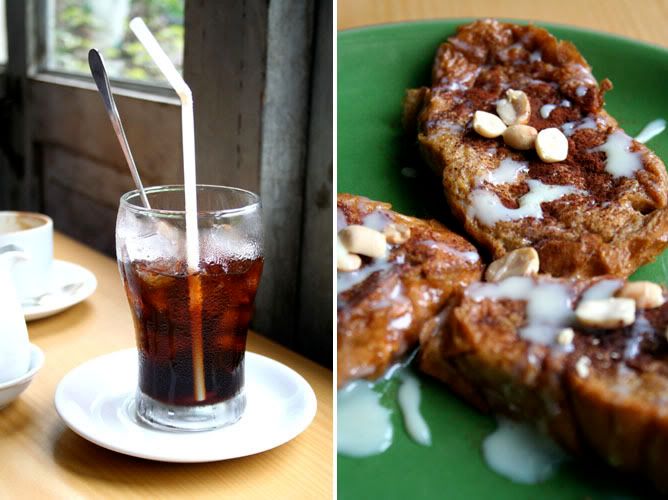
On our last full day in Saigon, Bordeaux and I took a leisurely breakfast at La Fenetre Soleil, an inviting upstairs cafe. Though it's located up a dingy staircase and down a dark hallway, it manages to attract it's fair share of fans (including a fellow blogger). My breakfast was a double dose of rich Vietnamse coffee: an iced black drip coffee, and Vietnamese coffee french toast. The latter was particularly spectacular: smooth and well-flavoured, and drizzled with sweetened milk (though I don't know what peanuts have to do with Vietnamese coffee, they added a nice crunchy texture).

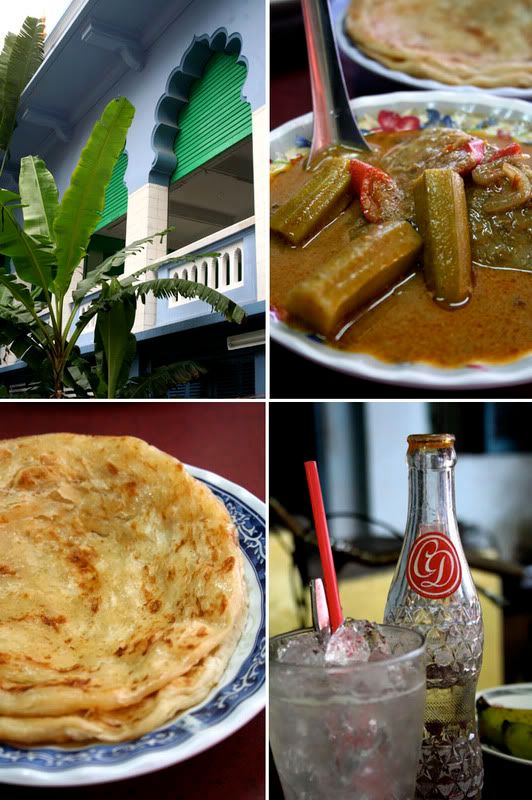
For lunch, we ducked behind a downtown mosque, to a shady courtyard curry shop. The richly spiced dishes were excellent- particularly a beef curry with tender strips of okra. It was eaten with roti, which were crisped golden brown. The beverage, though simple, should be noted- bubbling soda water with two wedges of lime, and a little white sugar. After drip coffee and avocado shakes, it's my favorite Vietnamese drink-- perfect for the steamy tropical heat.

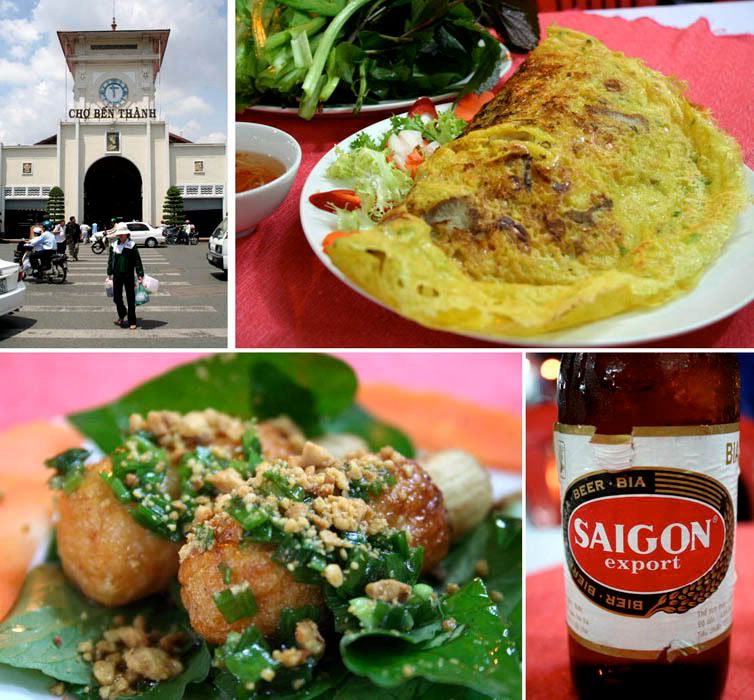
For dinner, we chose an outdoor restaurant near the central Ben Thanh market. Among our dishes were grilled shrimp on sugarcane, and a crunchy banh xeo pancake. We have another restaurant there that we favor, and we should have gone there again-- they didn't live up to the quality of their neighbor. At least the Saigon beer was cold.

Hopefully next time I'm in town I'll be better prepared, and feeling a little more adventurous. In the mean time, for an expert's guide to eating in the city, cruise Robyn's Saigon articles on Eating Asia.

Friday, October 17, 2008

Red Bridge Cooking Class in Hoi An.

Back in March, when Bordeaux and I went to Hanoi, we briefly considered taking the long train trip down to Hoi An. Thankfully, we stuck around Hanoi-- at the time, we of course didn't know that we would get to return to Vietnam, and have the chance to spend almost a week in Hoi An. While doing a little online research in Hoi An back then, I encountered the Red Bridge Cooking Class. It sounded great- a chance to cook some local Hoi An dishes in an attractive riverside setting. I bookmarked the page, setting aside just in case.

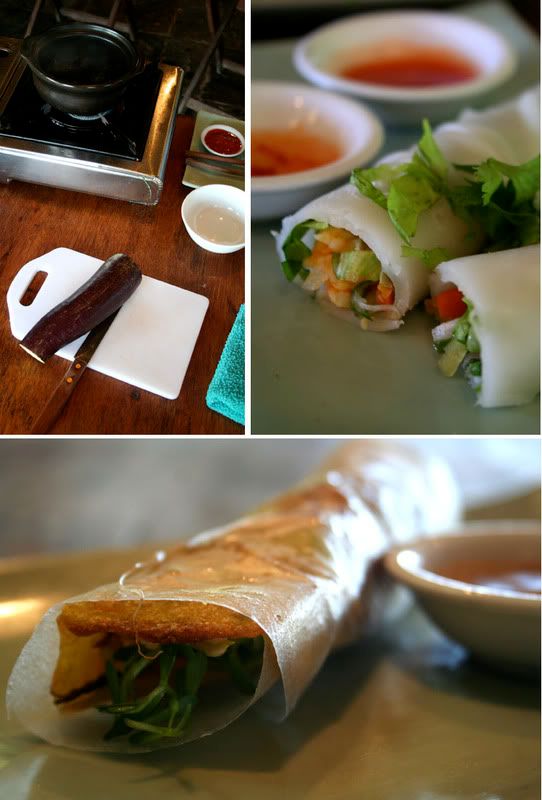
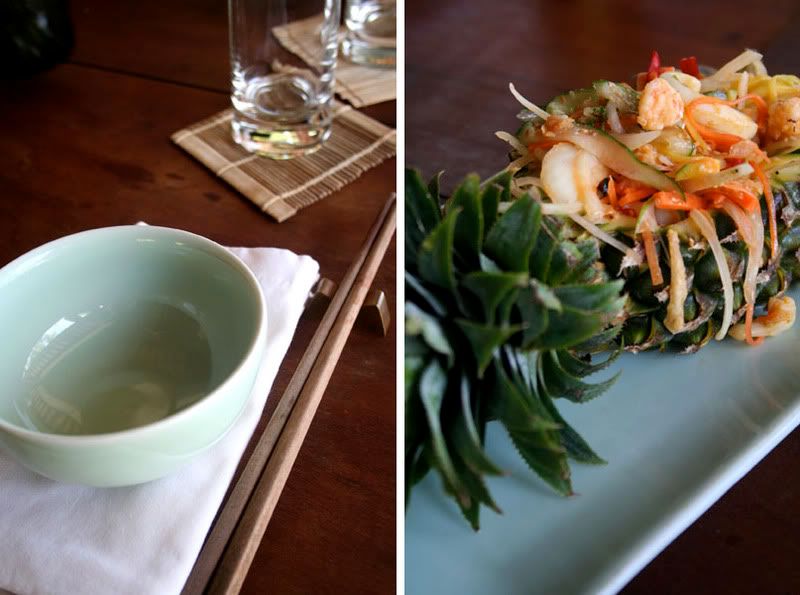
As we prepared to visit Hoi An, the cooking class at Red Bridge was on the top of our must do list. Upon arriving in town, we stopped by Hai Cafe, where the classes are organized. Two classes were offered at Red Bridge- a half day class and a full day class, each with only one menu available. The full day class offered the chance to make pho bo (beef noodle soup), cha ca (grilled fish) with dill, lemongrass shrimp in banana leaves, and chicken and banana flower salad. Though we love all of these dishes, the menu didn't sound right to us- both pho and cha ca with dill are more associated with Hanoi, and we know how to make banana flower salad. Instead, we chose the half-day class, which seemed to focus more on Central Vietnamese cooking, and had some dishes we wanted to know how to make- eggplant cooked in a claypot, seafood and pineapple salad with fresh herbs, rice paper rolls with freshly made rice paper, and banh xeo, 'Happy pancakes.'

We met the other students at the Hai Cafe, in Hoi An's old town. There, we got the first sign of a major difference between other cooking classes we'd taken-- the number of students was much larger. As we waited for the class to depart, more and more people came, and the class quickly grew to around 20 people- massive, compared to the five person average we'd had at other cooking classes. Thankfully, multiple guides appeared, and we broke up into small six-person groups.

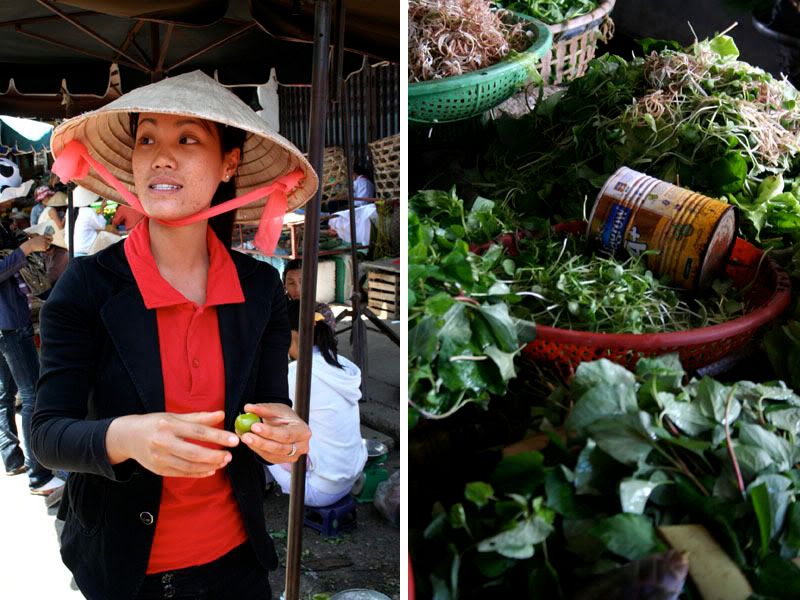
Like most cooking classes, this one began with a market tour. Hoi An has a great central market, and the tour took great advantage of it-- introducing us to local flavors and herbs, strange vegetables and fruits, and interesting utensils that revealed local cooking techniques. Our guide was great- informative, engaging, and funny.

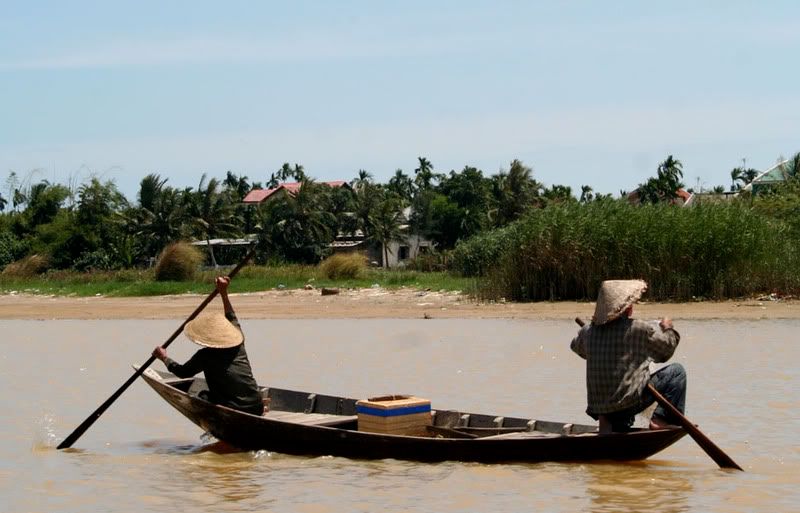
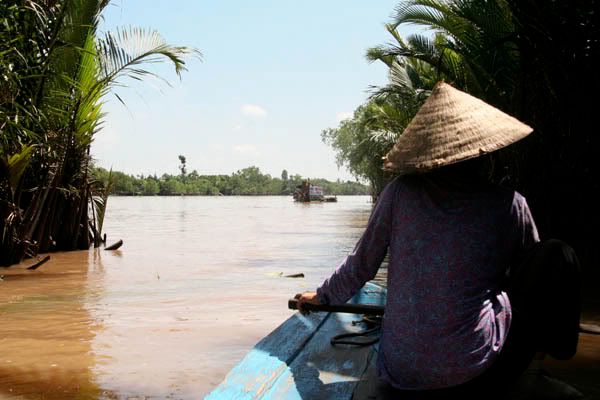
She dropped us at the pier, where we boarded the boat to the cooking school. The trip was a definite highlight- a twenty minute float down the muddy river, past fishing traps and under arching palm leavess. Along the way, an old woman in a canoe, smiling between chomps of betel-nut, motioned our boat over. When we got close, she lassoed us, and hitched a lift off us.

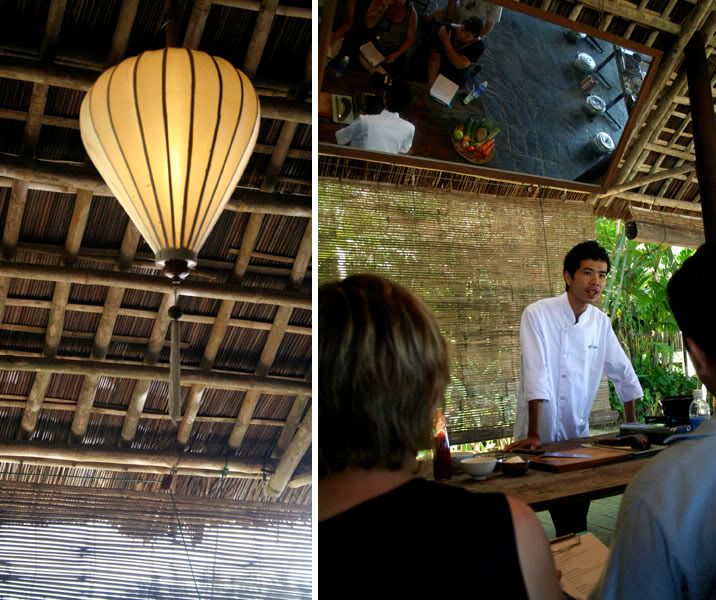
We arrived at Red Bridge Restaurant, easily the most attractive setting for any cooking class we'd taken. Set right on the river, the kitchen was surrounded by lush tropical greenery, and decorated with bamboo blinds and white silk lanterns. After a quick tour of the herb gardens, our guides wished us a good class, and departed-- and we were left to merge the mini groups into one massive class.

We took seats in classroom like rows of chairs, and after a twenty minute wait, our cooking teacher emerged. He seemed tired, bored, and a little disinterested in the class-- fair enough, if he has to teach multiple 20 person classes a week. There were some weak jokes in his script, but he seemed so lifeless that they passed by without him changing the tone or speed of his reading. He proceeded to make the first dish, the seafood salad, completely on his own-- simply showing it to us. The dish was whisked away by one of the many assistants, and he proceeded on to the claypot eggplant. For this, we got our first taste of 'cooking'- we were shown to our stations, told to slice the eggplants, plop it in the boiling water, and add a cup of tomato sauce. We then returned to our seats, and the claypot eggplant was taken away by the staff. It proceeded basically like that for the rest of the class- we made fresh rice paper, but not the filling for the rolls; we quickly made the banh xeo, being prodded to hurry up the whole time by roaming cooking assistants. If any students made a mistake (which I, of course, made several) the assistants became vaguely annoyed, and either corrected them sharply, or simply did it themselves.

Having spent about an hour watching a cooking demonstration, and maybe fifteen minutes actually cooking, we were lead to the dining room for a late lunch. The lunch, at least, was fantastic. The seafood salad was tangy and spicy, the claypot eggplant rich and flavorful (made with, I suspect, more than just a cup of tomato sauce), and an extra dish, steamed ocean fish, was fantastic.

So now, some thoughts.

Good: The class was well-organized, and aside from the way too long wait for our chef to show up, ran smoothly. The market tour was informative, the boat trip was enjoyable, and the lunch was spectacular.

Bad: Maybe I'm hard to please, but the class was run too smoothly. It felt a little like a Theme Park of cookery-- fair enough, this is Hoi An, after all. But there was nothing personal, no individual character to much of it. We were rushed along an assembly line, getting to slice a vegetable here, and roll a salad roll there. Our cooking instructor was clearly bored, and it affected the atmosphere of the class. And really, aside from the discussion on the market tour, we learned nothing about Vietnamese cuisine and culture, or about what makes the cooking of Hoi An and Central Vietnam unique.

Verdict: Would I recommend it? It's complicated. As Bordeaux pointed out, this was the least enjoyable cooking class we've taken. At all of the others, we enjoyed a connection with our instructor and felt like we really got to try our hands at making some local dishes. At the best classes- like Hidden Hanoi- we actually learned about the culture through learning about their cooking.

And yet, I get the sense that almost everyone at the class had a great time. It was, all in all, a pretty fun day-- there were certainly more activities than at any of the other cooking classes I've taken. And we got an outstanding lunch in an incredible setting. And the price- $18- means that it was actually incredibly inexpensive.

So I think for a visitor to Hoi An looking for a fun day out, it's actually a great activity. It gets you beyond the old town to see some of the surrounding countryside, and you get a great lunch out of it. But for someone really interested in cooking, and in the cuisine of Central Vietnam- I think it's kind of disappointing. The full day class, I read later, is done in smaller groups, and is more geared towards this category of student- but it's a shame that the menu doesn't focus more on regional dishes, or offer some variety or choice. Numerous restaurants throughout Hoi An offer private cooking classes, where you have the choice of what to make-- and that may be the better option.

Monday, October 13, 2008

Will resurface soon.

I think this is the longest I've been quiet since I started PrimitiveCulture (hopefully I've still got one or two readers checking in), but I'll try to start posting regularly again. At the moment I'm at the Ho Chi Minh City airport, preparing to return to Thailand. The past month here has been incredible, and though we've been busy working, Bordeaux and I had a great time traveling from Hoi An to Phu Quoc via Saigon. Even though we covered a bit more of the country, I still feel as though I barely know it-- but as always, I got enough of a taste to make me want to come back for much longer some day.

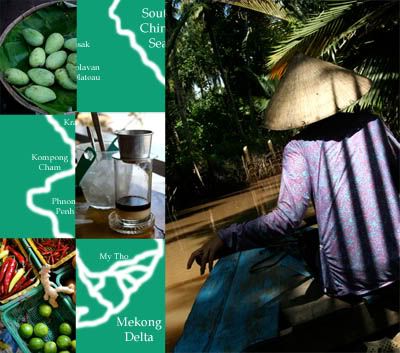
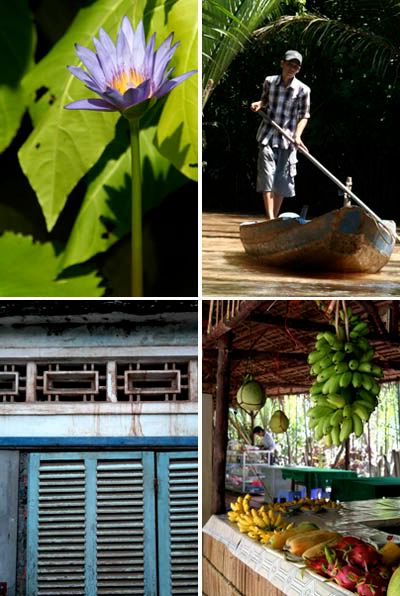
There's a lot I still want to write about- delicious market treats, another cooking course, and --possibly the highlight of the trip-- a too-quick trip across the Mekong Delta (pictured above). But more on all of that soon...

Thursday, October 02, 2008

eating culture/eaten: Candied Ginger.

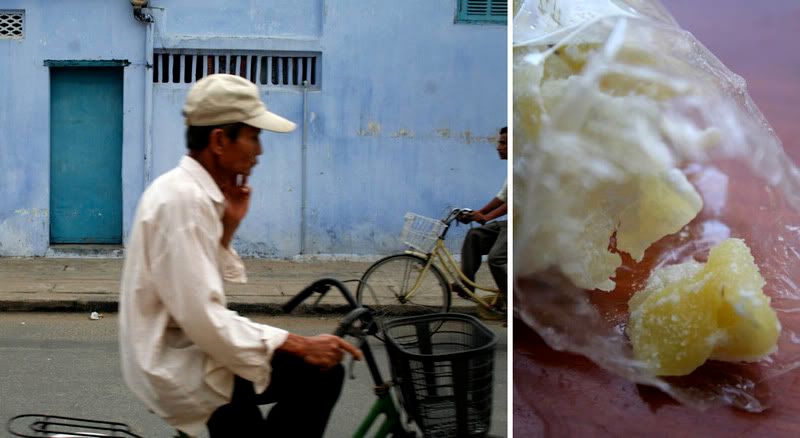
It's undoubtedly very touristy, but I love the sugared ginger sold by street-vendors in Hoi An. It's crunchy/stringy texture and sharp flavor make it the perfect snack after a mellow meal or during a stroll through the market.

Tuesday, September 30, 2008

Scenes from a Hoi An market.

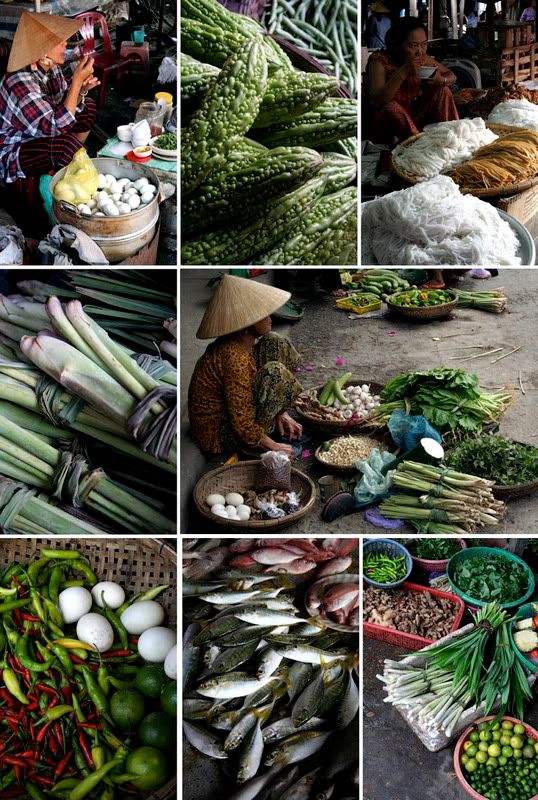
Perched at the edge of Hoi An's old town, it's crowded stands almost pressing over the Thu Bon river, sits Hoi An's central market. Though the market's entrance is guarded by stands trying to lure tourists with Tiger Balm and ceramic pagodas, push through and you'll find the darkened interior contains a busy working market.

The ground leading inside is a mountainous landscape of herb and vegetable peaks, giving way as you enter to sloping white hills of noodles. Shoppers pause at eight-inch high stools, to sip rich drip coffee or crunch on snacks, like crispy banh khoai or fertilized duck eggs. And at the very edge, where sunlight slices the market open, fresh fish are unloaded from boats coming off the river.

Monday, September 29, 2008

Sinh to bo.

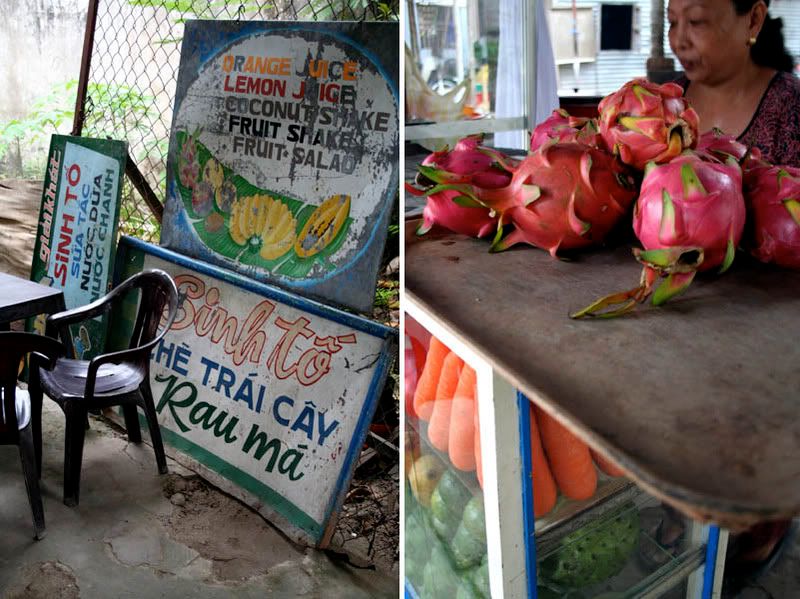
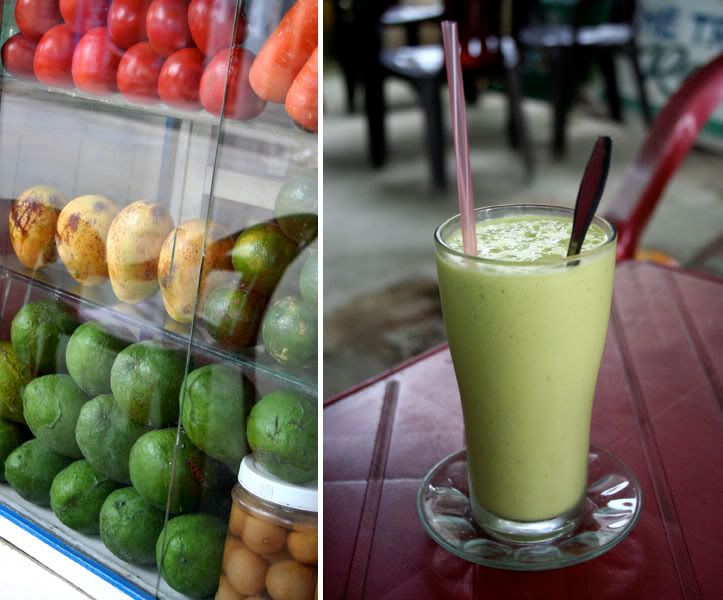
The avenues of Vietnam are dotted with shops and stands offering an incredible variety of sweets, from chewy mung bean parcels, to creamy ice creams, to buttery pastries, to colorful glasses of che'. As plentiful as the options are, however, nothing can compete with sinh to- the simple fruit and milk shake.

It's hard to choose a favorite- dragonfruit is refreshing, and ripe mango is pretty hard to beat- but lately I'm really fond of sinh to bo, avocado shakes. I first tried a variant in Taiwan, which was made with creme caramel pudding. Though the Vietnamese version is sans pudding, it's still relatively sweet, as its often made with condensed milk. When the balance is right though, the earthy flavor of the avo melts through, lending an offbeat nuance to the rich creamy shake.

Friday, September 26, 2008

Beachside Banh Mi.

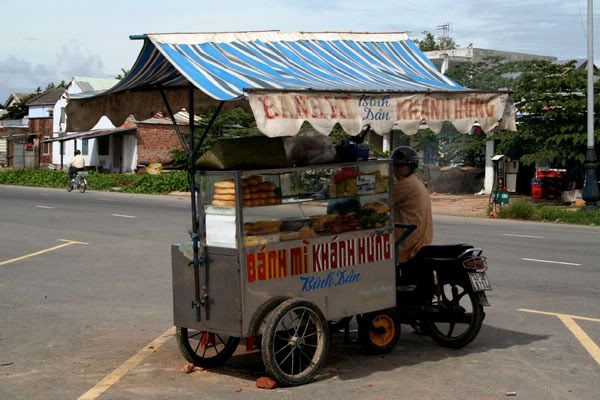
Beachside banh mi stand at Danang's China Beach. I don't think drive-up was ever this good at home...

Wednesday, September 24, 2008

Hello, Danang.

An hour and a half after leaving Bangkok's Suvarnabhumi Airport, our tiny plane touched in Vietnam. We arrived in Danang, our gateway to central Vietnam, and the city where we would begin the next phase of our travels.

Though it's Vietnam's fourth largest city, the leafy avenues move at a sluggish, leisurely pace. Since Bordeaux and I had previously spent most of our time in Hanoi and Saigon, it was strange to see a Vietnamese city that wasn't constantly swirling with activity.

Thankfully, even though we were somewhere new, there were a few comfortingly familiar sights (and flavors) to remind us of why we'd come. More on that coming soon, of course...

Monday, April 28, 2008

Vietnamese drip.

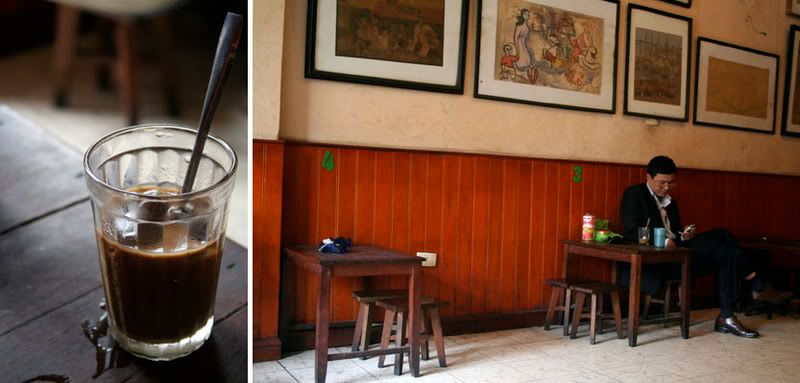
Sitting on low wooden stools in a smoky interior, we watch the door for our waitress. Across from us, two college students play chess, alternating moves on the board with long slow sips from the glasses perched on the edge of the table. Next to us, a young mother chats happily with her friends, pausing briefly to mind her young daughter as she buzzes around them in boredom. Finally, our waitress climbs over the threshold of the stairs, a tray held firmly level in her hands. She lowers down to our table, and sets out our order. Two short glasses of dark, rich Vietnamese drip coffee, resting on a cushion of creamy condensed milk. We stir it together, the viscous milk hesitating before swirling lethargically into dark brew.

Now, I’m sorry, Thailand. I know you have great bag coffee, and hill-tribe grown arabica, and even a fairly decent local chain in Black Canyon- but the best coffee in Southeast Asia is undoubtedly in Vietnam.

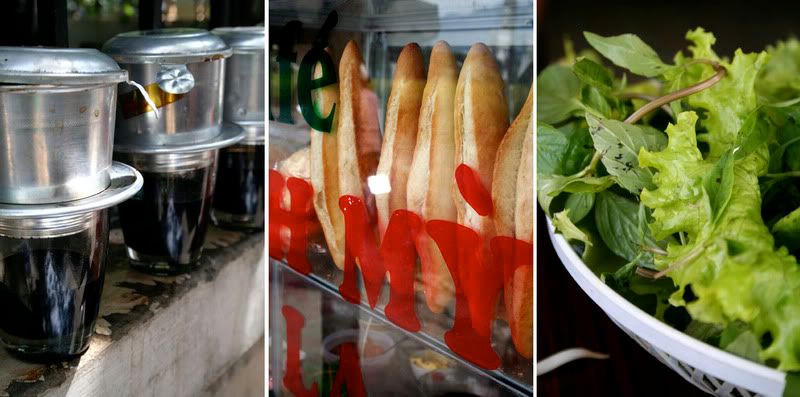
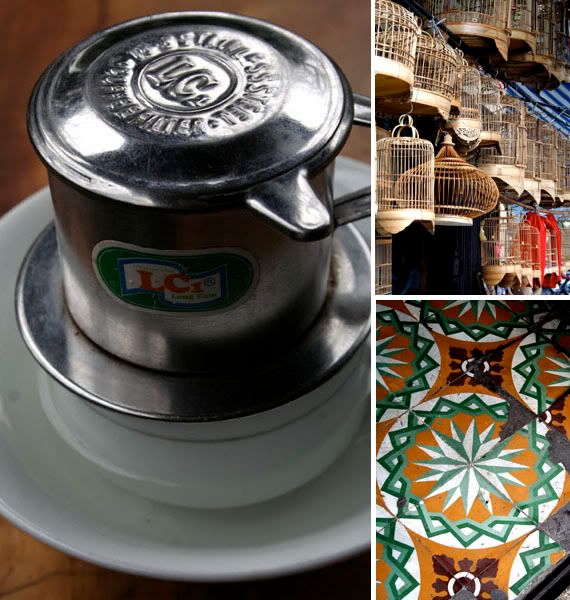
Vietnamese coffee is well known, not just for the quality of its French-introduced beans, but also for its unique form of preparation. Ground coffee is spooned into a tin filter, which is placed on top of a short mug or glass. Hot water is poured into the filter, and the coffee slowly drips into the cup below, usually onto a soft bed of condensed milk. It can be served hot- the thick brown coffee practically melting the sweet milk- or cold, with cubes of ice chilling it into the perfect refreshment for a steamy afternoon. The filter works slowly, as the coffee drip drip drips into the glass below- forcing the drinker to wait and unwind, and fostering a subdued atmosphere for relaxation. Vietnamese drip coffee can be enjoyed all over Hanoi- in settings as diverse as smoky alcove shops, and stylish European style cafes.

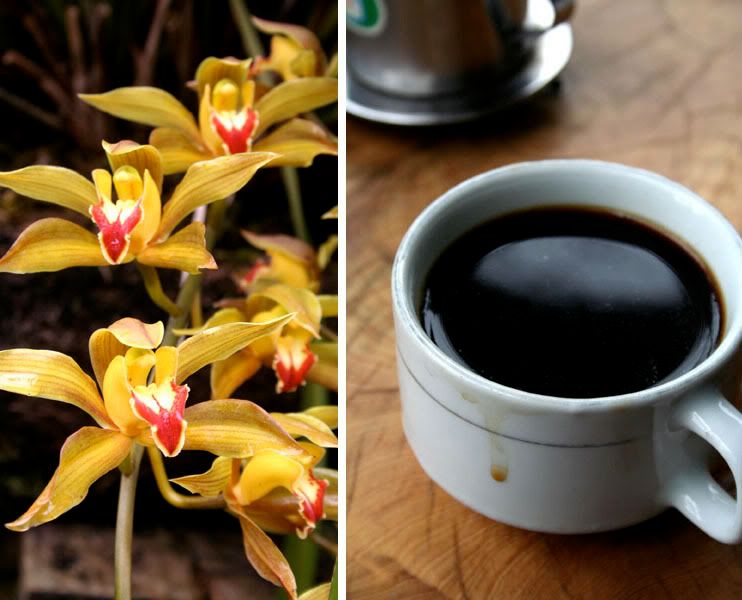
Even outside of Hanoi, coffee in Vietnam can bring some surprises. Looking over a menu in an orchid filled coffee garden in Sapa, we were confused by the listing of drip coffees identified only by the numbers 1 through 9. We enquired, and were informed that they were grades of coffee- Coffee #1 being the cheapest and also the most inferior, Coffee #9 being the best. We ordered two glasses of #9, and we weren’t disappointed. We were treated to two short mugs of unbelievably rich coffee. Blended with the sweet milk, it had a strong flavor of delicious dark chocolate.

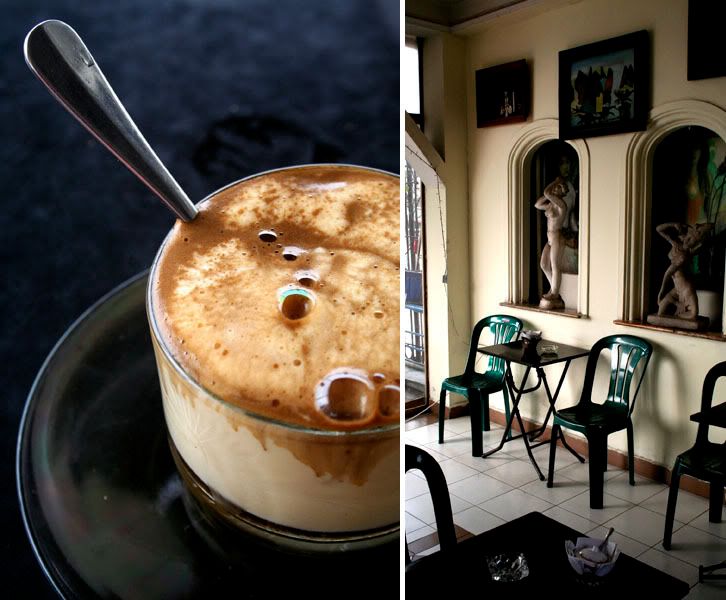
But drip coffee isn’t the only Vietnamese specialty. At Café Pho Co, a well-known Hanoi hole-in-the-wall with great views of the old quarter, Bordeaux ordered a mug of café trung. Its name, meaning ‘egg coffee,’ comes from the fact that it’s topped with a cap of whipped egg; it’s a local take on a cappuccino. Not only does the egg give the foam an impressively thick texture, it also adds an unbelievably rich creaminess, making every spoonful taste like an airy, coffee-tinted custard.

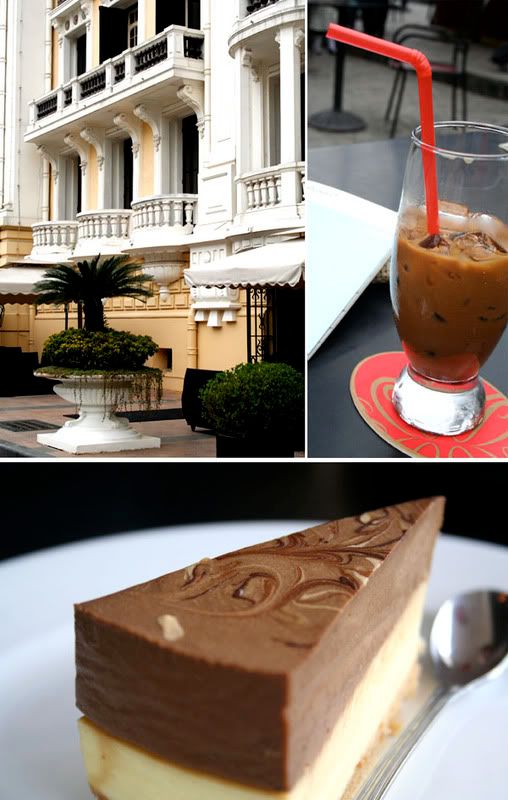
Perhaps best of all is the incredible variety of places in which to enjoy the flavorful local brew. With no Starbucks in the country, a local Vietnamese chain, Highlands coffee, has been able to flourish. Among the lattes and espressos on the menu, local drip coffee receives a prominent place. It also features in their pastry case, in the form of a Vietnamese coffee cheesecake. The bottom layer emulates the sweet condensed milk, while the top layer evokes the dark flavor of strong coffee. And best of all, these treats can be enjoyed in some outstanding locations. In Hanoi, you can sip Highlands coffee in a hip patio below the Opera House, among potted palms on a graceful deck looking over Hoan Kiem lake, or in a lush bamboo garden under the flag tower.

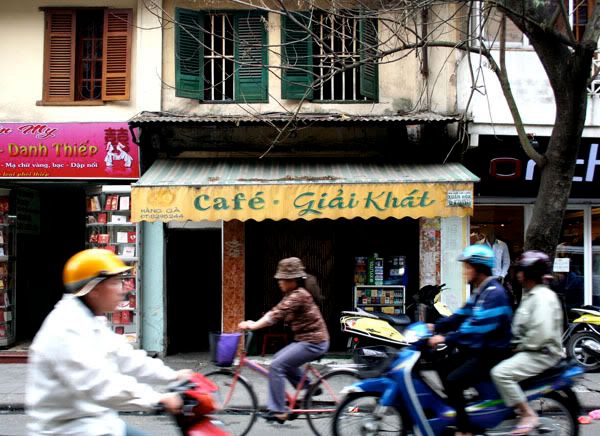
For a more distinctly Vietnamese experience, there are local cafes and coffee stands spilling onto most city sidewalks. Hanoi is packed with independent cafes, their names advertised in pastel hued awnings. They’re often very informal, with low tables on the edging out the door, and a few oil paintings scattered on bare white walls. Some, like Café Lam and Café Pho Co, have become institutions. However, you can get coffee that’s just as rich and flavorful at many of the lesser-known establishments.

Is it worth traveling abroad simply for the coffee? When the brew is as good as Vietnamese drip, the coffee shops as elegant as Highlands Coffee, and the streets as packed with independent cafes as Hanoi: certainly so.

Thursday, March 20, 2008

culturedPRIMITIVE/style: Souvenirs of Indochine.

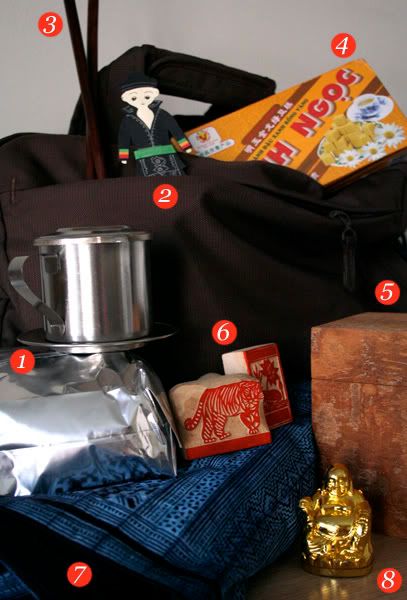
And so, with more than a little regret, we left Vietnam. We really had an awesome time in Hanoi- it's such an amazing city, with incredible food, intriguing architecture, and an engagingly artistic atmosphere. To console ourselves, we took a few things with us from Vietnam. Here are a few of the more interesting items that we brought back with us.

1. Highland Coffee and a Vietnamese Drip. The memory of Vietnam I most wanted to retain was of the delicious coffee. So the first essential souvenir we tracked down were the small metal Vietnamese drips. Later, we sought out the best coffee beans. After sampling several blends at an outlet in the Old Quarter, we chose the Highlands coffee (not connected to the same-named coffee chain). It had a particularly rich flavor, with strong hints of chocolate.
2. Hmong Boy bookmark. The beautifully sewn clothing worn by the Hmong appear in countless postcards and paintings in Northern Vietnam. For some reason, however, these images tend to focus only on the women. Despite being largely ignored, Hmong men actually wear a very intriguing outfit- boots, black shorts, a long jacket, and cap. So when we finally found a paper bookmark featuring one of the Hmong men, we had to get it.
3. Cooking chopsticks. At the end of our cooking course at Hidden Hanoi, Bordeaux and I were each given a set of these extra-long wooden chopsticks, which are perfect for turning spring-rolls in a frying pan.
4. Green pea cakes. It's hard to say what's so addictive about these little green pea cakes. Certainly it's not the chalky texture, or the vague flavor of dry peanut butter. Perhaps its simply the wonderfully unhip graphics on the box.
5. Cinnamon wood box. Our second hotel in Hanoi was located right next door to Marena Hanoi, a wonderful little homewares store that specialized in chic ceramics and elegant lacquerware. There, we found this square box of cinnamon wood, which gives off a deliciously spicy scent. It is currently at use in our kitchen, imbuing the coffee stored within with a cinnamon aroma.
6. Rubber stamps. On our last night in Hanoi, Bordeaux and I encountered an alley in the old quarter that specialized in rubber stamps. We couldn't help but pick up a few of the more intriguing ones, which had some iconic Vietnamese images: tigers, lotus ponds, and hooded cobras among them.
7. Hmong blanket. Leaving our hotel in Sapa, we were constantly hounded by Hmong women selling beautiful hand-sewn blankets. Though they came in many colors, from rust to electric green, the ones that most caught my eye were the blankets in deep shades of indigo. I finally found the perfect one, sold by a woman in thick-eyeglasses.
8. Golden Buddha. In the candy markets of the Old Quarter, Bordeaux and I encountered boxes and boxes loaded with sweets, wrapped candies, and boxes of green bean cakes. We also found containers overfilled with tiny gold Buddhas. We purchased one to investigate, and found that it was filled with an unusual gummy treat.

***
Editor's Note: Though this ends my sequential entries on Vietnam, I have much more to write about Hanoi. Look out for essays on Vietnamese coffee and the Colors of Hanoi in the near future.

Cha ca.

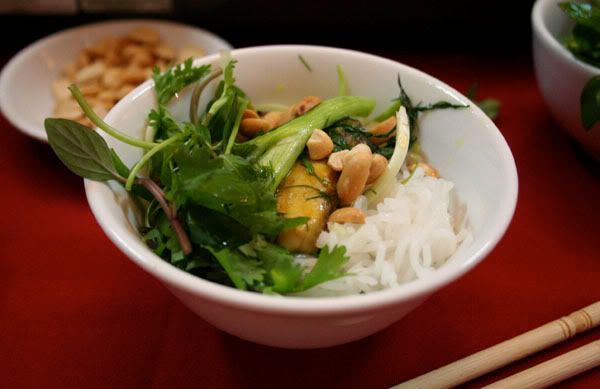
I had planned to take Bordeaux out on our last night in Hanoi, but things didn't go exactly as I planned. The first restaurant I had considered had closed down, and the second was booked for a private event. So with some hesitation, we booked a table at a distant third choice. As the dinner hour approached, I felt more and more uncomfortable with the decision. Considering how great the food in Hanoi is, it seemed wrong to go somewhere that didn't seem perfect for our last night. So at the last moment, we ditched our reservations and sought out a dish we'd been curious about: cha ca.

In Hanoi, cha ca is most famously served at the century-old restaurant Cha Ca La Vong, but after comparing reviews, we decided to instead try Cha Ca Thanh Long. The smart but simple restaurant was packed, but thankfully they found a table for us. 'We only serve one dish,' our waitress explained, as a waiter set out a gas cooker on our table. Igniting the flame, he set to work: he sautéed fish, along with spring onion, tumeric, and large handfuls of fresh dill. He served us each a portion, and left the rest to simmer on our table. The resulting dish, eaten with crunchy peanuts on a pillow of cold noodles, was fresh, sharply flavored, and extremely tasty- a combination that reflected all that we love about Vietnamese food. It was one of those great nights when you're grateful that nothing worked out as planned.

Tuesday, March 18, 2008

Hanoi Street Food.

I live in Bangkok, so I'm no stranger to street-side food and sidewalk kitchens. But even so, I was amazed by the variety of delicious food available on the streets of Hanoi. From sour soups of bamboo and duck, to steaming bowls of pho, to baguettes filled with egg and pate, the problem was never finding a good meal, it was choosing what to eat. On our last days in Hanoi, Bordeaux and I weren't only conflicted with how to do everything we wanted, we also struggled to figure out how to eat everything we wanted.

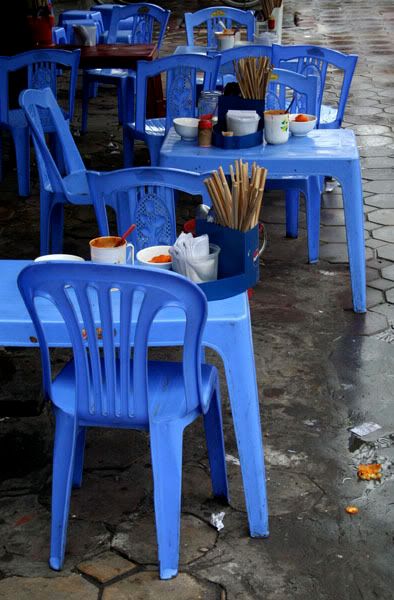
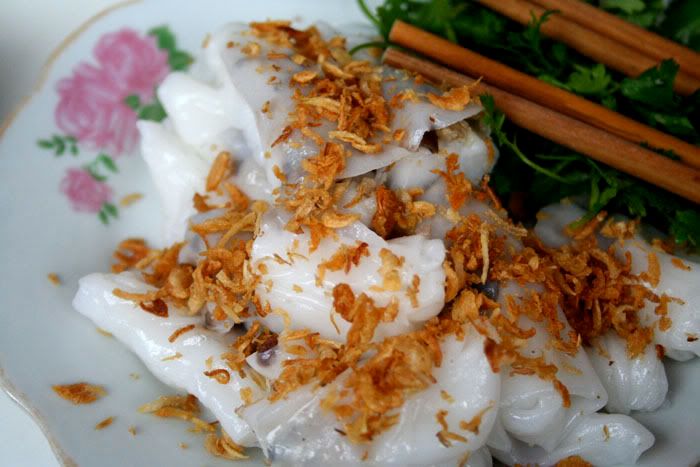
In Vietnam, the primary meal people eat on the street is breakfast. In the early hours of the day, the sidewalks are crowded with people lowered onto plastic stools, tucking into bowls of soup and glasses of strong coffee or powerful rice wine. On an early morning out, Bordeaux and I encountered a woman making banh cuon. She spread rice batter out on the taut surface of a steamer drum, smoothed it like a crepe, dropped in some minced pork and shallots, then gathered it all up into loose rolls. She piled these generously onto a plate, then covered the whole pile with fried garlic and shallots. The dish was so much more amazing than its parts- a crunchy, slippery and very flavorful dish to start the day with.

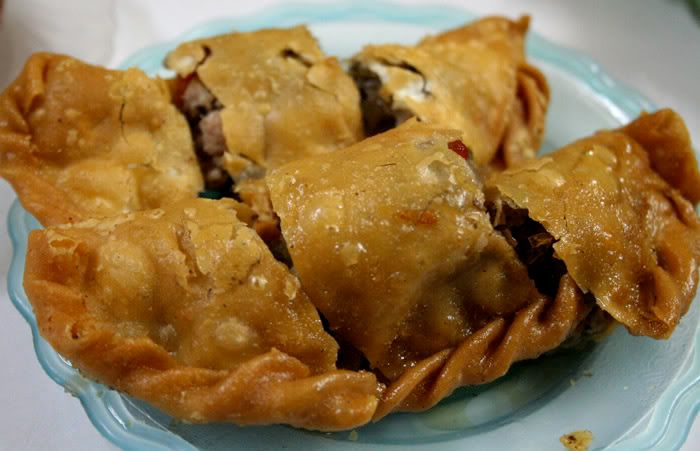
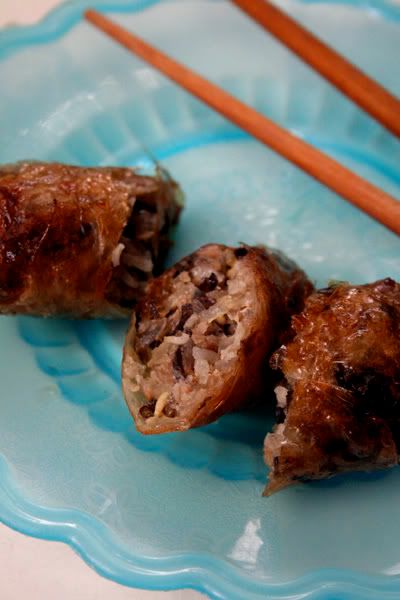
Like in Bangkok, good street food can be found almost everywhere in Hanoi. For example, though the elegant Cathedral district is known primarily for its chic espresso cafes and hip designer boutiques, it also boasts a good range of informal sidewalk kitchens. Just up from the Cathedral square, we visited a little fry-shop that featured a range of simple snacks. Though everything we ate there was good, the tastiest treat was banh ghoi (also: banh goi). It's a small fried pastry with a golden flaky crust that broke open to reveal delicious seasoned pork and mushrooms.

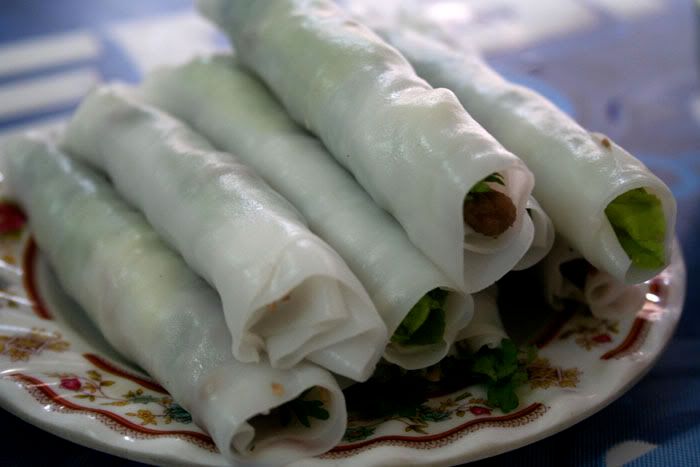
After exploring the neighborhood around West Lake, Bordeaux and I stopped for a snack on the little island of Ngu Xa. The local specialty is pho cuon, and though we weren't sure if we'd be able to find any, we quickly discovered that nearly every shop in the area was advertising them. It thus became not a matter of finding them, but a question of deciding which one to try. We searched out the shop that appeared the most popular, where a group of high-school age girls were busy packing up boxes of the snack for a line of to-go customers. We took a table, and one of the friendly girls brought us a plate. The smooth white wrapping was tightly packed around delicious strips of beef, which were seasoned with a sprinkling of fresh green herbs.

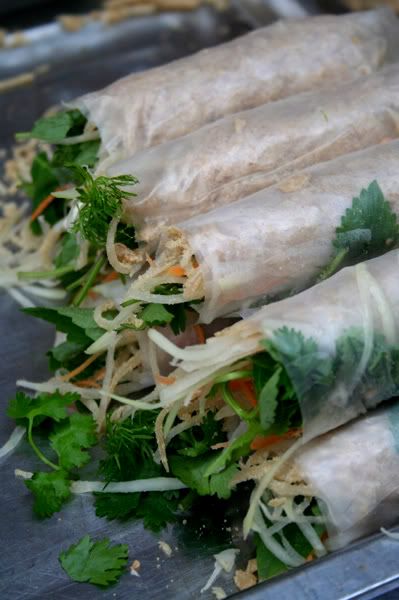
Spring rolls and salad rolls are among the dishes most connected in people's minds with Vietnam, and we did take the chance to sample a few varieities. A tiny stand next to our hotel sold these tasty rolls, made with fresh vegetables, shredded pork skin, and of course, tons of cilantro. The shredded pork skin had an unexpected flavor and texture (salty, with a frayed surface that could almost be described as feeling "furry"), but they added an interesting element to the salad rolls.

Another popular version of the spring roll is nem cua be, often sold at the same stands that make bun cha. These crunchy rolls of crab meat and glass noodles paired perfectly with the smoky pork and fish sauce soup.

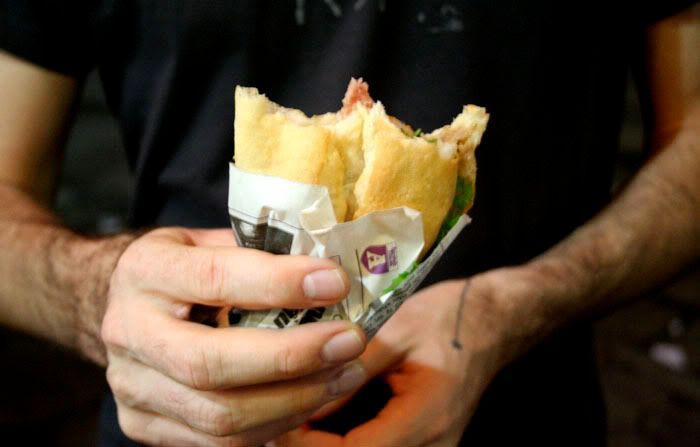
And, ok, I know I've already written about binh my pate twice (here and here), but few dishes can match it. On our last night in Hanoi, Bordeaux and I stopped to pick up one final baguette. Even though we'd had it several times already that week, this one somehow stood out above all the others. It was laced with a deliciously spicy chili sauce that contrasted perfectly with the salty pate and sharp cilantro leaves.

*PS- This is my 100th entry written about Southeast Asia! Rather fitting that it's about street-food, I think.