Showing posts with label Cambodian food and coffee. Show all posts

Monday, June 16, 2008

Durian shakes.

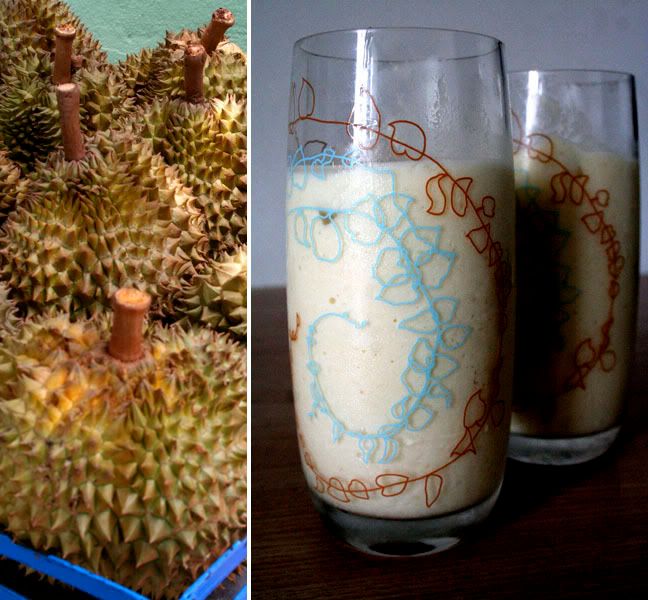
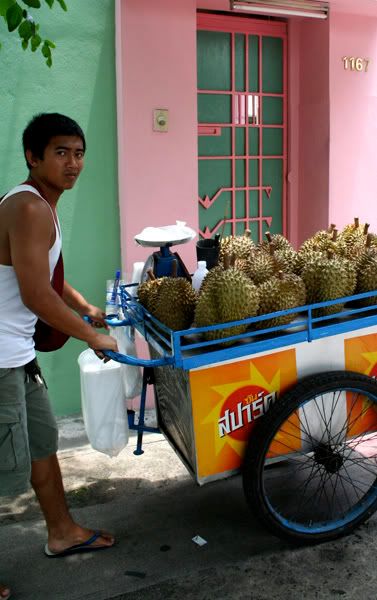
We're approaching the end of durian season in Bangkok, and soon the sidewalks will no longer be crowded with their giant, spiny shells. Though I was rather put off the first time I tried it, I've since developed a taste for it. So on the way home from the market, I picked up two pods of the durian's fruit.

On the way out of Cambodia, Bordeaux and I had picked up a copy of From Spiders to Water Lilies at the Phnom Penh airport. A cookbook from the chef's behind Romdeng restaurant, it features regional recipes from all over Cambodia. We bought the book partly for its beautiful photos and partly because Cambodian cookbooks are rather hard to come by, but I think neither of us expected what a great cookbook it would be. We've already more than half a dozen dishes from it: soups, curries, salads and stir-fries that have all come out brilliantly. One of the recipes that looked the most intriguing to me was for a durian shake. So when I got home, I blended the durian with palm sugar syrup, condensed milk and ice, and made two durian shakes.

It was perfect. Somehow, the shake emphasized only the best aspects of durian: its smooth texture and sweet creamy flavor, with only the slightest undertone of an overripeness, which gave it a subtle complexity. Anyone want to try?

Tuesday, June 03, 2008

Khmer things I ate.

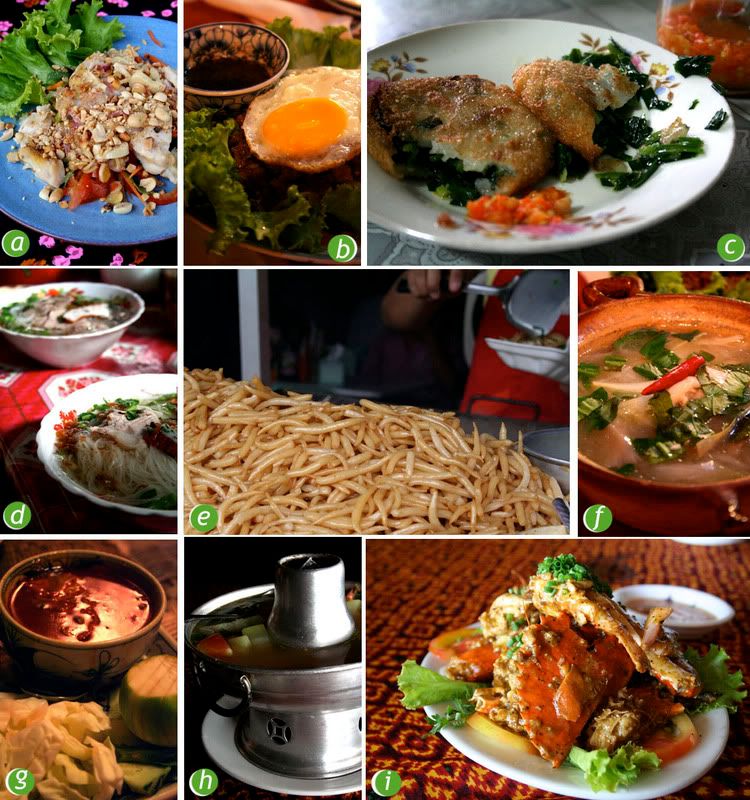
The awkwardness of this entry's title was intentional, as it was meant to evoke the haphazard nature of my food 'researches' on this trip to Cambodia. Though I had really looked forward to exploring the nuanced flavors of Khmer cooking, we traveled at such breakneck speed that there wasn't much time for culinary exploration. More often than not, meals had to be worked into the schedule, either between seeing the sights or after a long day of temple gazing. In the end, many of our meals were at tourist-oriented restaurants serving Khmer food. Even so, I did have some amazing meals and a few dishes that really made me consider making the move across the border. At the very least, my un-sated curiosity provides more than enough reason to return some day. So, I now end my series of post on Cambodia with a few of the dishes that I tried over this visit to Cambodia.
a. This dish really was one of the best things I ate in Cambodia- so good, I completely forgot to write down its name. It was notable for being one of the freshest, healthiest meals I had: a salad of white fish, peanuts, raw herbs, and lime juice.
b. Beef lok lak, a stir-fry of beef served over a salad of tomato and onions and topped with a fried egg. It was tasty, but greatly enhanced by the peppery sauce it was served with.
c. Very similar to some vegetable cakes I've had in Bangkok, these golden fried discs of fatty noodle were filled with dark green chives.
d. Though I originally thought it gave me food poisoning, the only fault of this tasty bowl of chicken pho was that it didn't stave off a wicked flu.
e. One of the simplest dishes I ate, Khmer noodles, tasted great with the addition of a little chili sauce.
f. How traditional was this samlor? I couldn't tell- I knew only that it tasted like a cousin to Thailand's tom yum.
g. One of the most interesting dishes I had was a small bowl of prahok, a fermented curry paste. Eaten off the edge of crisp lettuce and bitter eggplant, it had a deep, salty flavour.
h. Sitting by a seaside window, getting splashed by the waves, I sampled this tasty vietnamese soup. Though partly sour, it was given a nice sweetness thanks to chunks of golden pineapple.
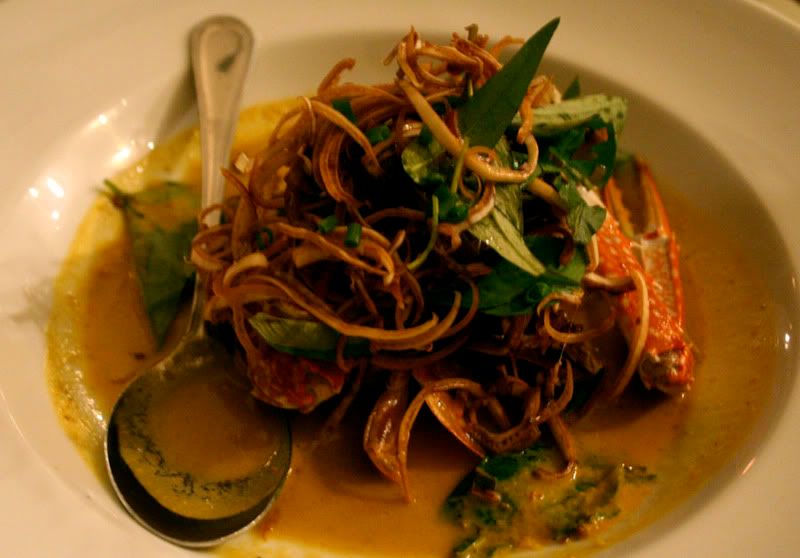
i. The last dish, a plate of yellow curry crab with fresh green pepper, was so delicious that I intend to devote a full entry to it sometime in the near future.

Monday, June 02, 2008

Cafes of Phnom Penh.

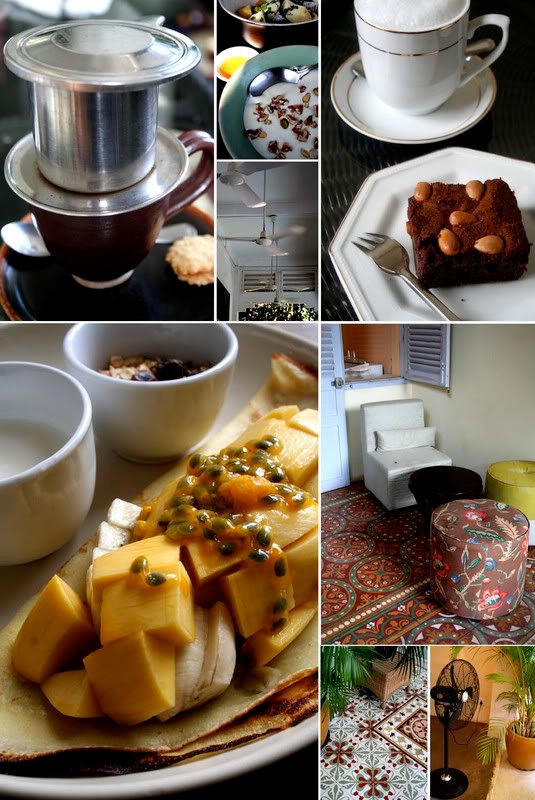
One of the worst things about only having a few days in Phnom Penh was that there was not nearly enough time to get to all of the cafes and coffeeshops that we wanted to. When Bordeaux and I first visited Phnom Penh, we had been traveling for the two months previous, and we were thrilled to be able to recharge in so many different wonderful cafes. But more than just relief from homesickness, Phnom Penh's elegant cafes offer delicious baked goods, well executed meals, and, most importantly, excellent coffee. On this visit, we nostalgically visited a few we'd made it to last time. We had breakfast at Java, a second floor art gallery/cafe that makes strong Vietnamese drip coffee and serves an excellent bowl of muesli, yogurt, and locally sourced honey. We made it back to The Shop, a bakery and deli where I tried the decadent crepe with mango, banana, and passion fruit. We also made time to try a new place, Chocolate, where we paired a dark chocolate brownie with equally dark coffee.

Friday, May 30, 2008

Sweet sugar cane.

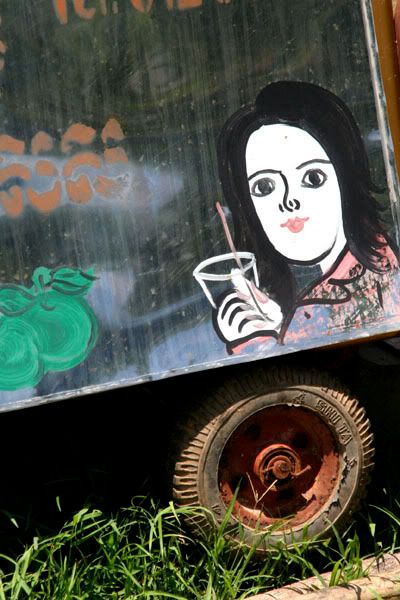
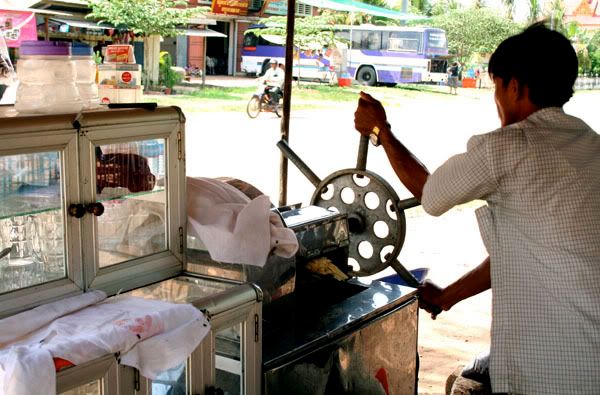
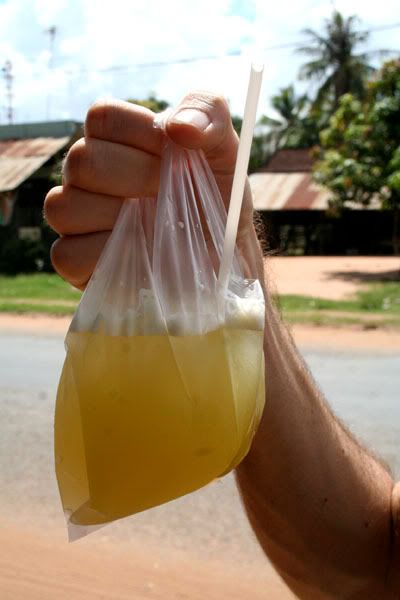
Sugar-cane juice may be the ideal drink for a scorching Cambodian day. Served in frosty mugs or plastic-bags, the pale golden liquid has a refreshingly citric sweetness. Though it's available throughout much of Southeast Asia, I'd never seen as many sugar-cane juice stands as I encountered in Cambodia. It seemed that every street, market, and noodle-shop had its own sugar-cane grinder at work. So in the interest of doing as the locals do, I ordered a bag.

The vendor grabbed some stalks of sugar-cane that were chilling in water, and placed them in his grinder. Leaning his whole body into the wheel, he turned them through one, two, three times. He threw some of the mushy pulp into the bottom of a plastic bag, and then poured in the lemon-yellow juice. Dipping a straw in, I took a sip. It was not as sweet as I expected, but nicely tart. And it certainly took the edge off the midday heat.

Monday, May 26, 2008

Cambodia Cooking Class.

After fifteen minutes of waiting outside locked doors, we started to worry we were in the wrong place. The sign advertising The Cambodia Cooking Class suggested that we were in the right place, but there was no on there to greet us and no where to sit and wait. Finally the doors opened, and we were greeted by a man rubbing sleep out of his eyes. “I just woke up,” he explained. We moved inside to continue waiting in the darkened shop interior. The man who greeted us disappeared out the front door, while another man, our cooking teacher, came downstairs yawning. He began sweeping out the shop and cleaning up empty beer bottles, giving us no sign of what was going on.

When Bordeaux and I first came to Southeast Asia a year ago, we set as a goal to take a cooking class in every country we visited. We easily accomplished that in Thailand and Laos, and eventually we managed to take a class in Hanoi. The classes had all been wonderful. We got to prepare some good dishes, learned a little about Asian cooking, and got to learn a little about different culinary cultures. But as this class got off to its rough start, I was wondering if I was going to have to right my first bad review.

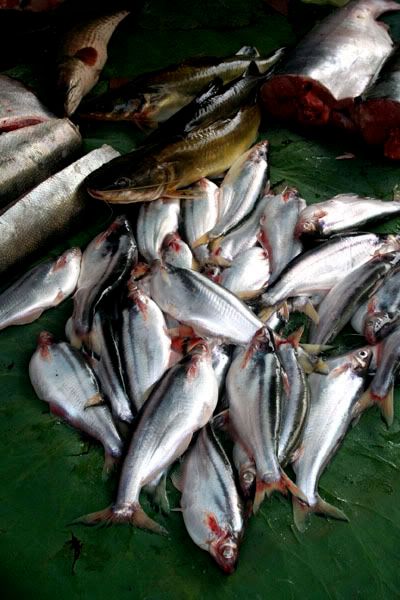
Close to fifteen minutes later, the other guy returned with a tuk tuk. We piled in, and headed for the market. Most cooking classes begin with a tour of a local wet market as a way to introduce some local foods, ingredients, and cooking methods. At the Thai Farm Cooking School, we were shown different qualities of rice, given a demonstration on making coconut milk and coconut cream, and lectured on the differences between different kinds of curry powder. In Luang Phrabang, we were shown a variety of fresh herbs and spices. In this cooking class, we walked through the market in a hurried single file.

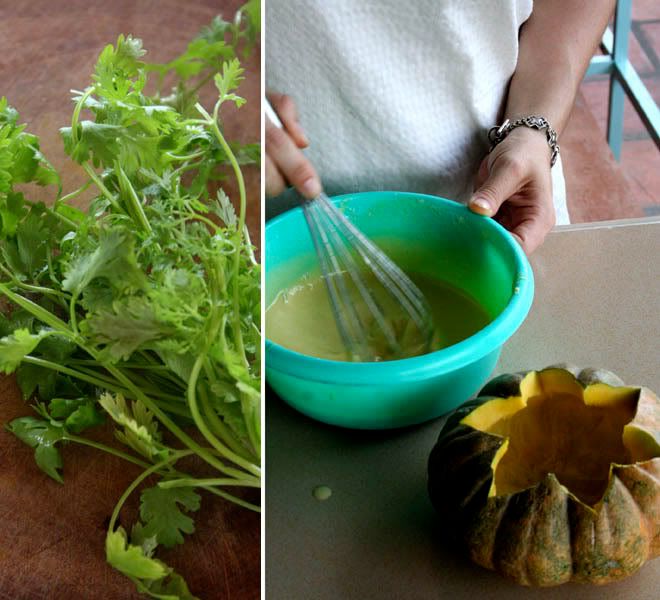
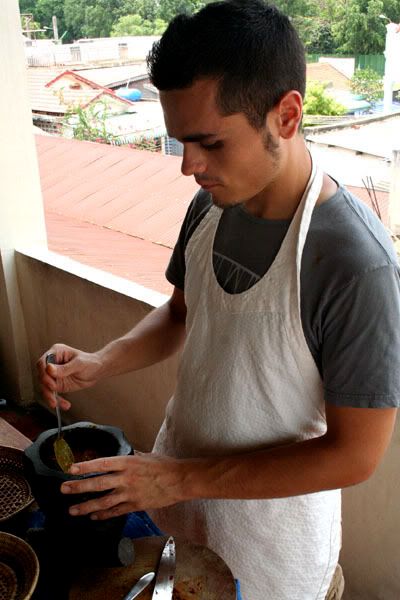
Thankfully, the tone of the class shifted rapidly once we got to the cooking school. This was no doubt helped by the setting of the kitchen, which was as relaxed as the market was hectic: a quiet top-floor patio, where we looked out over a busy baguette bakery and the lush garden of the Royal Palace. As we settled into the open-air surroundings, out teacher apologized for giving such a rushed tour of the market, and explained that the setting there is so crowded and busy that he wasn’t able to give any explanation. Instead, he took a selection of fresh herbs and vegetables out of the refrigerator, and talked us through them.

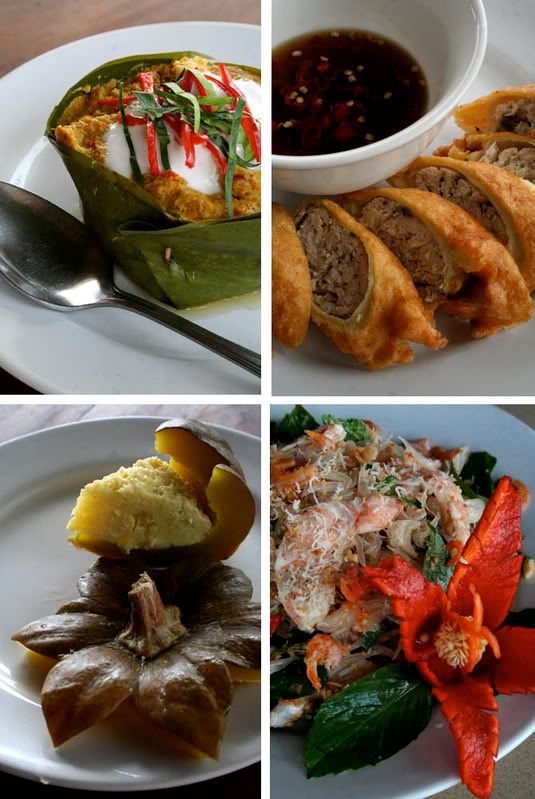
Over the course of the day, we each made (clockwise, from upper left corner): fish amok, a delicious custard-like curry that's steamed in a banana leaf cup; saing jayk, peppery pork and chicken 'sausages' that are fried in a banana flower roll; a citrusy prawn and pomelo salad made two ways- one with the prawns cooked, the other cured in a lime dressing; and for dessert, a creamy durian custard steamed in a pumpkin. We ate these dishes as we prepared them throughout the day, which gave the class a nicely languid atmosphere that fit with Phnom Penh's tropical heat. In between, we were given tastes of banana flower soup, and bites of fresh durian.

In the end, the class really was wonderful- enough so to make the rocky start totally irrelevant. Every class we’ve taken has had its strengths- whether it was the atmosphere of the class, the setting of the kitchen, or the glimpse into local culture afforded by the lesson. In this class, our guide was a trained chef, and there was a strong focus on food presentation. He gave us great tips on how to make our food look its best, and as a result, these were some of the most professional looking dishes I’ve ever made in a cooking class. He was an outstanding teacher, who helped us to make the cooking as effortless as he made it look. And most importantly of all, I left the class with the strong desire (and ability) to make some delicious Khmer dishes at home.

Wednesday, May 14, 2008

eating culture/eaten: Mystery Cambodian Ice Cream.

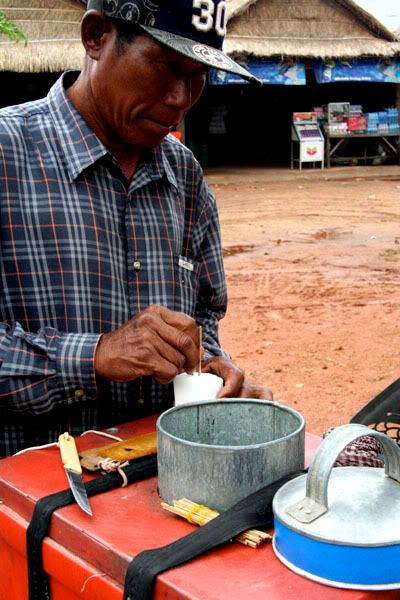
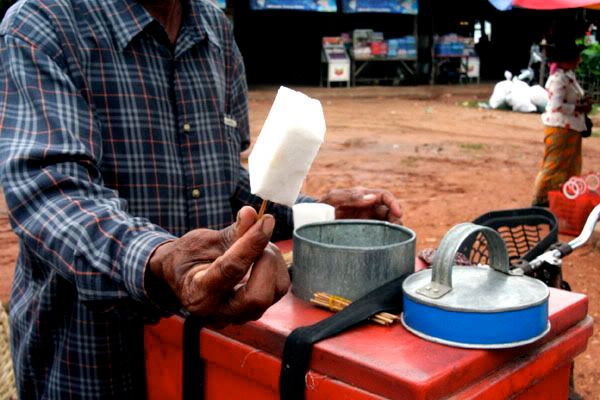
After a lunch in the seaside town of Kep, we were passed by a man on a bike. Our attention drawn by the clinging of his bell, we noticed that he had a blocky orange cooler strapped onto the back of his bike. We stopped him, and ordered one ice-cream each. Instead of the frozen popsicles we had been expecting, he took out a long white block, set it onto a small wooden cutting board, and sliced it neatly into sections. Sliding each one onto a bamboo skewer, he handed them to us.

As he chimed off on his way into town, we walked back to our guesthouse, taking licks of the ice cream as it melted in the afternoon heat. We had assumed it was just coconut ice cream, but we instantly detected a strange, subtle flavor. After a minute, we realized what it is: the infamous durian, which is currently in season. Though the fruit has a flavor most visitors find abhorrent, when mixed with the creamy ice cream, it offered just enough of an unusual, exotic flavor.

Monday, May 12, 2008

Siem Reap Treats.

Long a gateway for visitors to the ruins of Angkor, the town of Siem Reap has in recent years been seeking to promote itself as a destination its own right. It now boasts hip hotels, attractive art galleries, and inviting coffee shops. Bordeaux and I visited Siem Reap last August; after a bit of rough traveling through Southern Laos, Siem Reap offered some wonderful comforts. We could have well-prepared espresso drinks, eat delicious baked goods, and find some other hard-to-find treats from home (this may be the only city in the Mekong Delta where you can buy Dr. Pepper). On this return trip, we enjoyed being able to resample some of these treats.

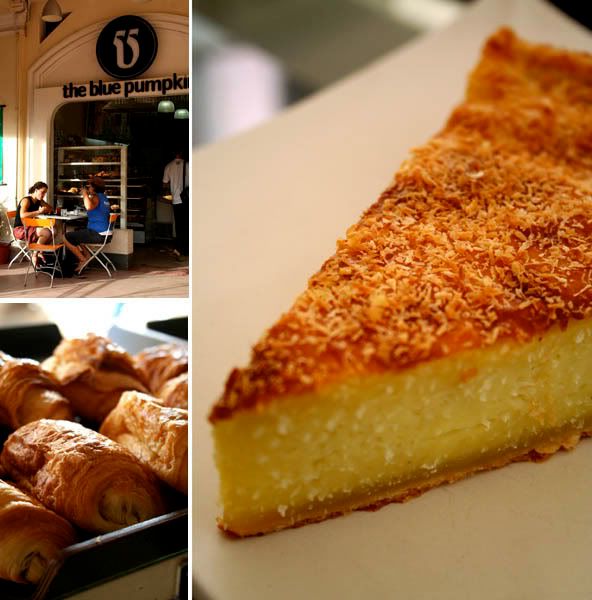
For coffee and cake, we headed directly for The Blue Pumpkin. Located across from the Old Market, their kitchen bakes up treats that strike a good balance between East and West. I tried the milky Coconut Flan, while Bordeaux had the tasty Pandan Coconut Cake. With its spare white walls and stark furnishings, the upstairs lounge may be a little too Bed Supperclub, but with comfy lounging space and strong air-con, it's hard to complain.

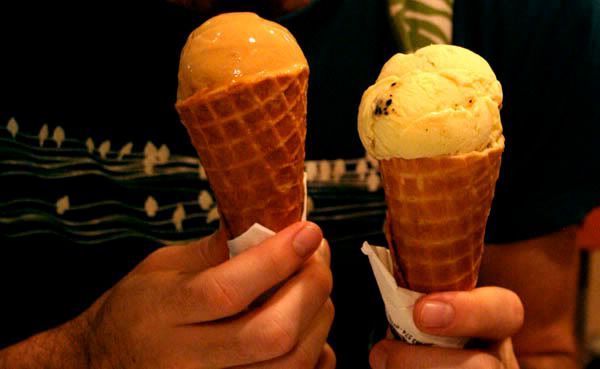
Blue Pumpkin also deserves mention for making what may be the most delicious ice cream in Southeast Asia. In addition to perfectly executed Western standards like mint or strawberry, or superb Asian options like durian and coconut, they make a few more unique flavors. During our first visit, Bordeaux developed a very strange affection for their cashew and caramel flavor, which he nurtured on this return trip. I opted instead for the ginger and black sesame. It was sharp and flavorful, but still creamy enough to offer refreshment on a balmy tropical evening.

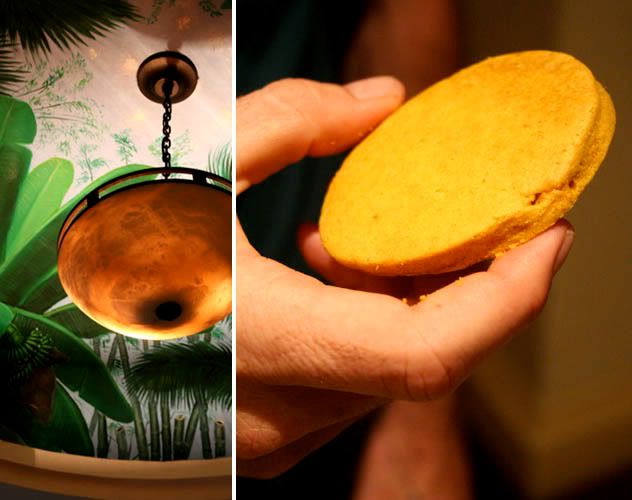
We visited the Raffle's Grande Hotel d'Angkor primarily to check out the retro '30s style, but I was also tempted by the glass jars of cookies in their tea shop. The most interesting was a turmeric cookie, which had the crumb crunch of buttery shortbread, with a softly spicy taste.

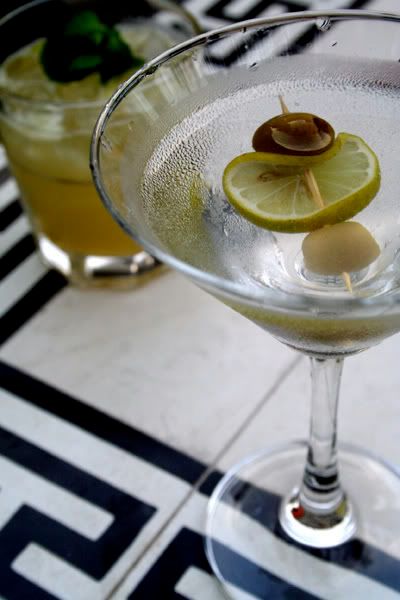
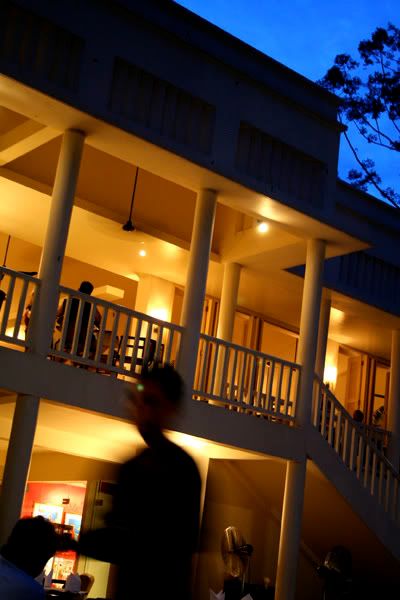
And to end our evenings, we headed to the FCC Angkor for cocktails. The FCC is housed in the former Governer's Mansion, a two-story art deco pile with swirling fans and delicate columns. On a rainy evening, we sat upstairs, listening to the sound of the monsoon downpour as it splashed onto the garden. On a clearer night, we sat on the patio downstairs while overhead giant fruit bats stretched their wings in the sticky night air.

*These sweet treats and dry drinks aren't the only reasons to linger in Siem Reap. For more ideas on things to do, eat, or buy in Cambodia, check out the listing at Stay Another Day. They seek to connect interested travellers with organizations, shops and restaurants that are helping to preserve local culture, and benefit local communities. A few examples they suggest in Siem Reap include Singing Tree Cafe, which offers healthy Khmer dishes in a relaxed garden setting, and Senteurs d'Angkor, a shop that stocks local spices and handsome silk scarves.

Tuesday, May 06, 2008

Brunch in the shadows of gods.

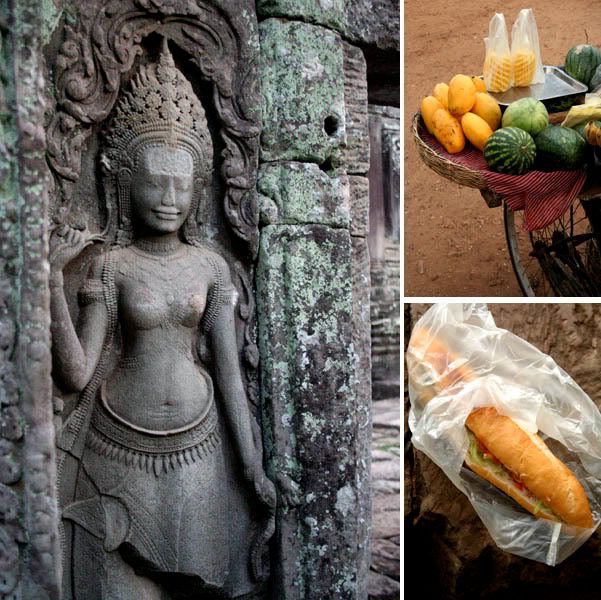
For our day in Angkor, we scheduled sunrise in Angkor Thom. We scaled the crumbling steps of the Bayon as the first breath of pale-indigo sunlight drifted over the forest. We’d planned ahead, and as we watched the giant stone faces brighten in the morning light, we had a breakfast of Earl Grey muffins and slices of banana bread that we’d purchased at a café in Siem Reap the night before.

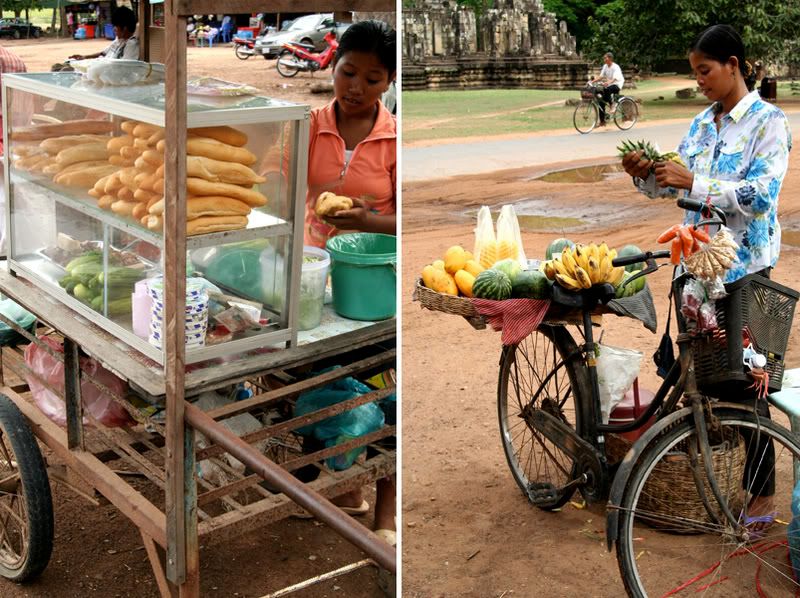
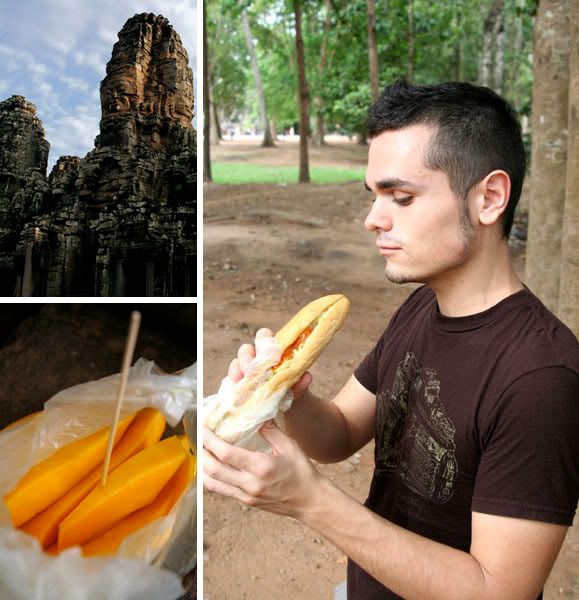
By the time we finished exploring some of Angkor Thom’s more overgrown temples several hours later, the muffins were starting to feel a little insufficient. We scanned the open dirt centre for food, not expecting to find much other than touristy Khmer food stands. Thankfully, we spotted a woman selling one of my favorite Indochine foods, baguette sandwiches. While Bordeaux waited for our order, I picked out a ripe mango from a bicycle fruit shop.

With our brunch in hand, we found a shaded spot among a ruined wall. A stone face smiled up at us, it’s eyes worn away with age and its jaw trimmed with moss. The sandwich was just what I had been craving. The crusty baguette had a nice crunch that complemented the soft filling inside. Compared to the sandwiches I’d enjoyed recently in Vietnam, this one was less salty, and quite a bit sweeter. Rather than a combination of pate and cold cuts, it had chunks of fatty pork and a dressing of sweet chili sauce. In place of cilantro, it had strips of green papaya, which added a nice crispness. The mango too was steller- so soft that it slid off the bamboo skewer as we pierced it, so rich and melting that it tasted like ice cream. It was the perfect brunch for Angkor; as exotic and engaging as the ruined city itself.

Wednesday, January 30, 2008

Five Plates of Yellow Crab Curry.

Since coming to Southeast Asia, I've been introduced to many new flavors and exciting dishes. As a result, the position of "favorite food" has gone through a lot of contenders. Massaman curry, haw mok, meang kham, dragonfruit, and squid with cashew nut have all held the top spot. My current favorite food is poo phat phong karii, yellow crab curry. It's an unbelievably tasty dish, and with its roots in Chinese cooking and Indian ingredients, it perfectly reflects Southeast Asia's diverse influences. Unlike most Thai curries, this dish uses curry powder- the result is a slightly lighter, though still rich dish.

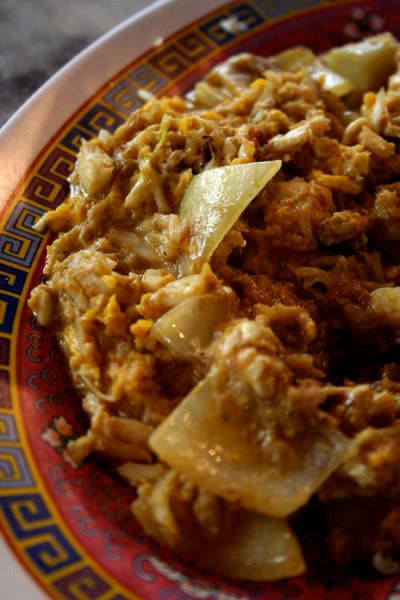
1. I ate my first bowl of yellow crab curry for dinner on my 25th birthday, perhaps foreshadowing to the degree to which I would grow to love this dish. I was in Phnom Penh, and my boyfriend took me to the FCC for dinner. Though delicious, the dish didn't immediately get me hooked. The emphasis on their version (pictured at top of page) was more on the spicy leaves, which to some degree dominated the flavor of the meal.

2. My second dish came just a few weeks ago, at our beach-side hotel in Prachuap Khiri Khan. We had initially shrugged off the idea of eating dinner at our guesthouse, but once on the beach we decided that it might just be the easiest way to relax. The hotel's manager arranged for dinner to be delivered from a nearby restaurant, and when we arrived at the dinner table we were amazed by the spread. There was a whole crispy fried fish, a rich and spicy tom yum koong, a sweet and savory seafood stir-fryed cashew nuts, and a platter of yellow crab curry. Everything was delicious- the tum yum koong was the most flavorful I've ever had, and the seafood stir-fry had a number of creative ingredients, like sweet dates and crisp water chestnuts. But it was the yellow crab curry that left me stunned- fitting, since Prachuap Khiri Khan is famous for their crab.


3. A few weeks later, Bordeaux took me for Sunday lunch at a dark corner restaurant here in Bangkok. The dish (pictured above) wasn't much to look at, but it was extremely rich and flavorful, with more emphasis on the curry sauce than on the flavor of the vegetables.

4. Some friends of Bordeaux's came to town, and for dinner they decided to go to the Mango Tree- an attractive outdoor restaurant near Silom that caters to a mix of gay and straight tourists. The tables were strewn around an open house and a large garden, which was cluttered with Thai antiques. After reading some reviews of the restaurant online that stated that the kitchen staff tone down the spiciness of their dishes, I had come prepared for bland food and high prices. The prices were certainly high, but thankfully the food wasn't bland at all. The huge menu had a wide range of interesting Thai dishes- and though I came close to ordering a salad that was within my teacher's salary range, thankfully I eventually splurged on the yellow crab curry. The dish was unbelievable- by far the best I've had. The crab was tender, and the herbs and Chinese celery added a nice sharp note to the otherwise creamy curry.

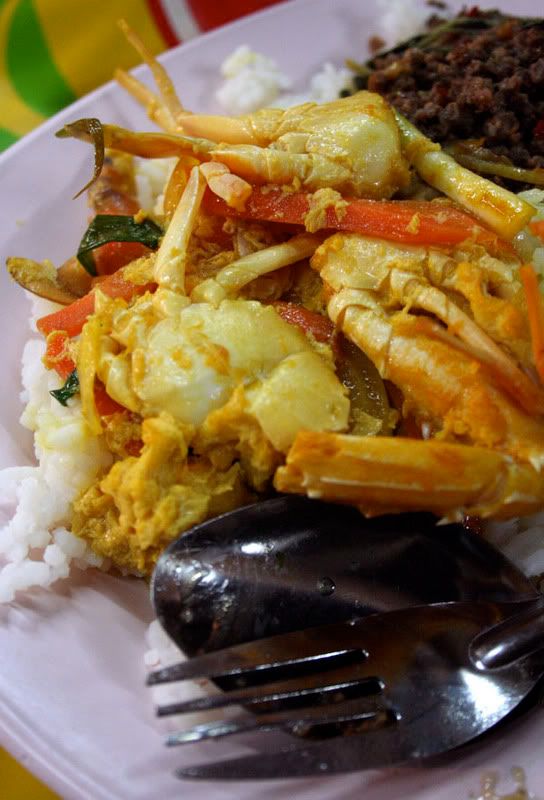
5. The next day, I was looking for lunch on a market soi near my school when I came across a large pot of yellow crab curry (pictured below). The dish looked beautiful: red-and-white pebbled crabs and fresh vegetables, bathed in a creamy yellow sauce. The flavor, however, was unbelievably bland. To some degree, I was relieved- I might have had some regret had I paid several times more for the same dish the night before. Though I think finding a cheap, delicious yellow crab with curry three minutes walk from my schol would have made up for that.

Anyone else know where I can get a good dish of yellow crab curry?

Sunday, August 05, 2007

eating culture/eaten: Grolan.

While in Cambodia, there was one street-side snack food that I became rather fond of. And no, it wasn't the giant black spiders fried in oil and chili, shown above.
My Khmer snack of choice was grolan, the sticky-rice equivalent of Gogurt. It's naturally pre-packaged, easy to transport, and fun to eat. I first encountered it along the riverside in Kratie. Bordeaux and I bought one for the bus ride, though we ended up forgetting about it until we got to Kampong Cham. Grolan is sticky-rice, mixed with coconut milk and blackbeans, and steamed in a bamboo tube. The bamboo is broken away, and it is served in just a thin bamboo sheath. To eat it, you peel that away, revealing the thick tube of sticky rice. The texture is a little like a hardened porridge, with occasional black beans adding a little sweetness. As one might expect of a steamed rice and coconut milk treat, grolan is extremely filling. On our last night in Angkor, Bordeaux and I bought one to take with us as we watched the sunset. It was the perfect treat for the trip- easy to take up the hilltop, and more than filling enough to tide us over until dinnertime.