 Cape Town’s Milnerton Market is not only a fantastic place to look for second hand kitchenware and used books; it’s also a great place to sample some simple South African foods. On our last visit, we went specifically with one food in mind: vetkoek. With a name that literally means fat cake, you shouldn’t be surprised by the bread’s somewhat greasy texture and flavour-- it’s a little like a savoury donut. We had ours filled with ‘mince’ (ground meat), for a rich and nicely greasy snack—a filling antidote to the cold rainy weather.

Showing posts with label markets. Show all posts
Showing posts with label markets. Show all posts
Wednesday, September 09, 2009
eatingCULTURE/eaten: Vetkoek.
Eating the world, one bite at a time.
 Cape Town’s Milnerton Market is not only a fantastic place to look for second hand kitchenware and used books; it’s also a great place to sample some simple South African foods. On our last visit, we went specifically with one food in mind: vetkoek. With a name that literally means fat cake, you shouldn’t be surprised by the bread’s somewhat greasy texture and flavour-- it’s a little like a savoury donut. We had ours filled with ‘mince’ (ground meat), for a rich and nicely greasy snack—a filling antidote to the cold rainy weather.
Cape Town’s Milnerton Market is not only a fantastic place to look for second hand kitchenware and used books; it’s also a great place to sample some simple South African foods. On our last visit, we went specifically with one food in mind: vetkoek. With a name that literally means fat cake, you shouldn’t be surprised by the bread’s somewhat greasy texture and flavour-- it’s a little like a savoury donut. We had ours filled with ‘mince’ (ground meat), for a rich and nicely greasy snack—a filling antidote to the cold rainy weather.

Tuesday, September 30, 2008
Scenes from a Hoi An market.
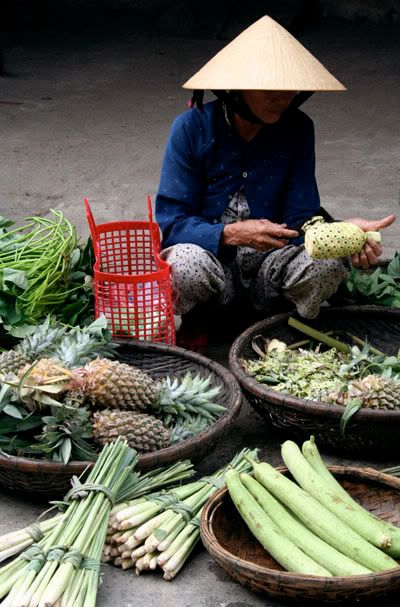 Perched at the edge of Hoi An's old town, it's crowded stands almost pressing over the Thu Bon river, sits Hoi An's central market. Though the market's entrance is guarded by stands trying to lure tourists with Tiger Balm and ceramic pagodas, push through and you'll find the darkened interior contains a busy working market.
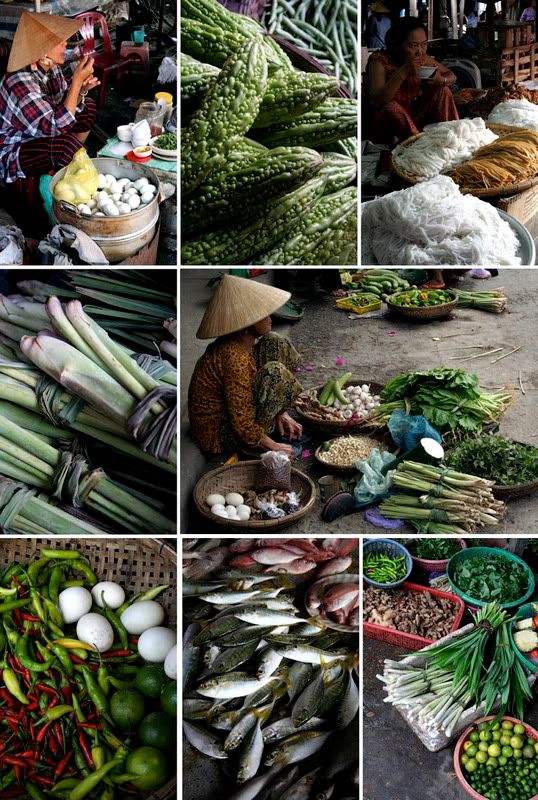 The ground leading inside is a mountainous landscape of herb and vegetable peaks, giving way as you enter to sloping white hills of noodles. Shoppers pause at eight-inch high stools, to sip rich drip coffee or crunch on snacks, like crispy banh khoai or fertilized duck eggs. And at the very edge, where sunlight slices the market open, fresh fish are unloaded from boats coming off the river.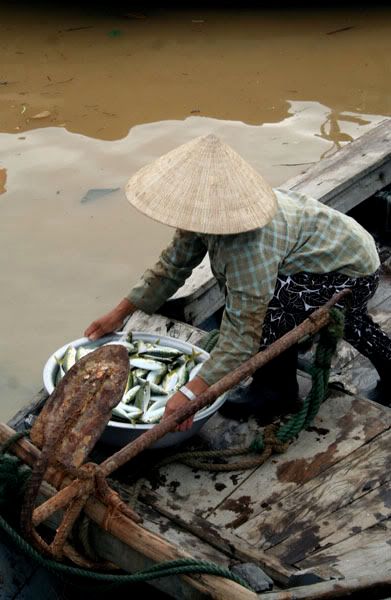
Tuesday, July 08, 2008
Taiwan Treats: WOW Frog Eggs.
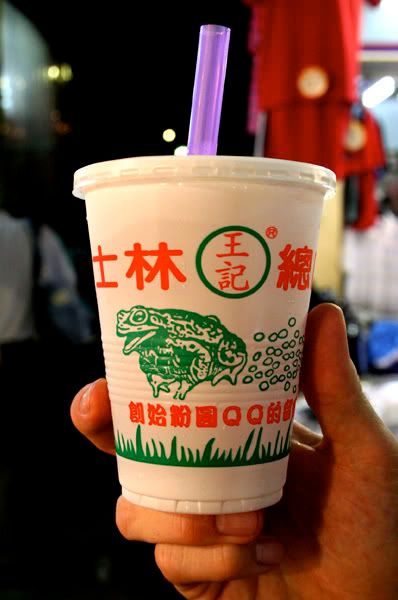 I'm really not one for novelty drinks or treats sold on any gross-out qualities. Maybe it was the silliness of the concept, or the fun graphics of the toad leaving a trail of bubble eggs. Or maybe it was that the drink itself- a lemony lime juice with chunks of lemon jelly (i.e.- the frog eggs)- was actually really tasty, and a nicely refreshing treat to help cool off from the crowds of the Guangzhou night market. But whatever it was, WOW Frog Eggs totally won me over.
Monday, July 07, 2008
36 Hours of Eating Taipei.
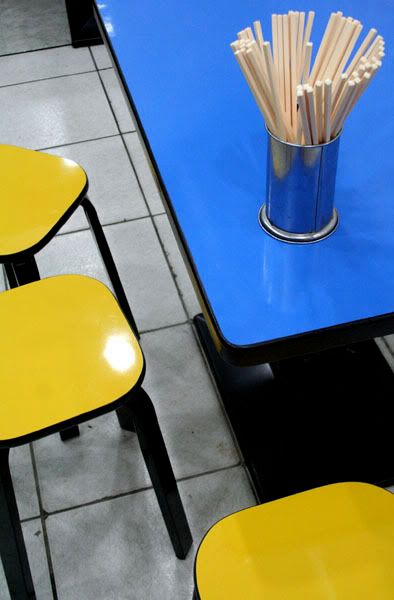 In advance of our visit, I attempted to research Taiwanese food. Whether it was because most Taiwanese dishes are still classified as Chinese, or whether it was because there simply hasn't been much interest on the subject in the English language press, I wasn't able to find out much. I did learn, however, that Taiwan is well known for its xiaochi, its 'little eats'. So upon our arrival we set out to sample these little eats. To do so, we passed up on big meals or restaurant menus. Instead, we spent our 36 hours in Taipei among night markets and noodle stands.
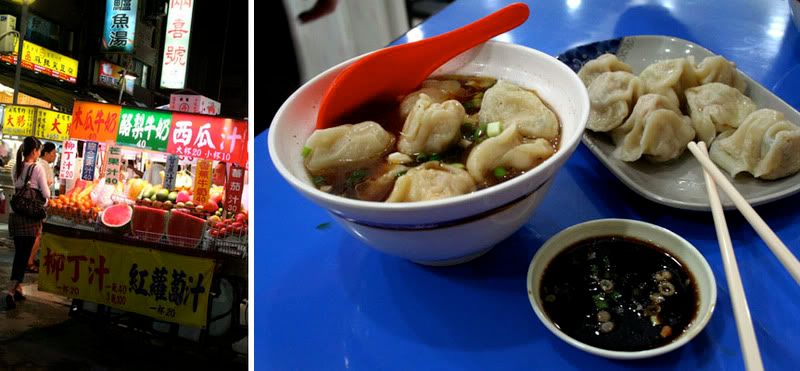 Not to be deterred by any weariness from our flight, we began our search for a local meal immediately, and after dropping off our bags we headed out to the Guangzhou night market. Among the rustling tiles of mah jong tables and the whirring gears of claw machines, we searched for our dinner. In the end, we had a bit of dumpling overload: we had expected to get beef soup with pork dumplings, but instead got dumpling soup with pork dumplings. No matter- the dumplings were tasty, and the deep rusty herb-flavored broth was sufficiently exotic to signal to my stomach that we were in new territory.
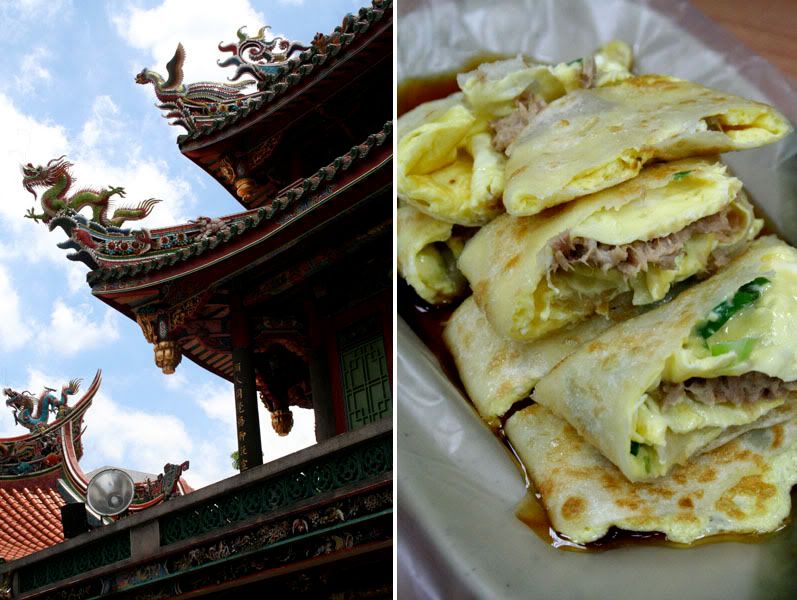 Before heading out for a morning pilgrimage to a nearby temple, we stopped at a simple breakfast shop. There, we ordered two plates of danbing. A choice of tuna, cheese, or bacon is grilled with a scrambled egg, and rolled up in a thin pancake. It was splashed with sticky sauce, and served on wax paper in a plastic basket. Taken with a glass of warm soymilk, this deceptively simple breakfast offered the perfect kickstart for the day.
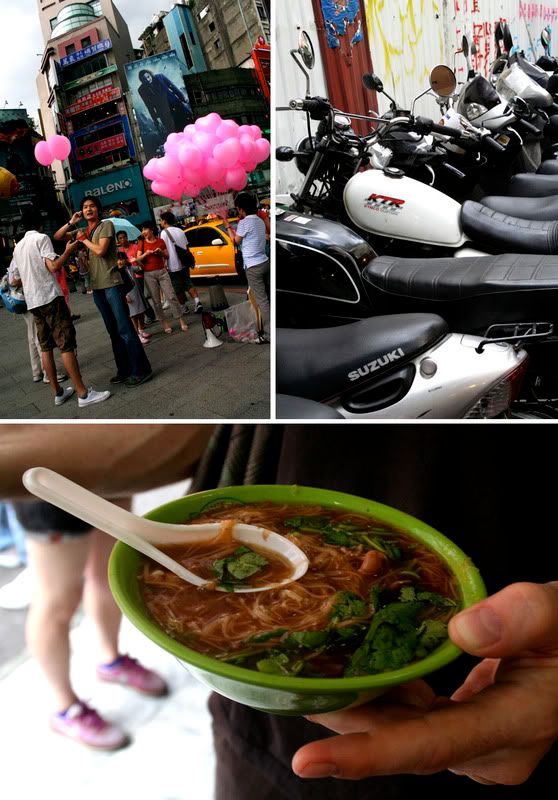 Midday saw our arrival in Ximending, a hip youth-oriented neighborhood of t-shirt shops and sunglass stands. Following the crowds, we stepped into line at Ay-Chung Flour Rice Noodle, where we were served a viscous noodle soup in green plastic bowls. Garnished with peanut sauce and a fresh cilantro leaves, it made a tasty lunch eaten standing up.
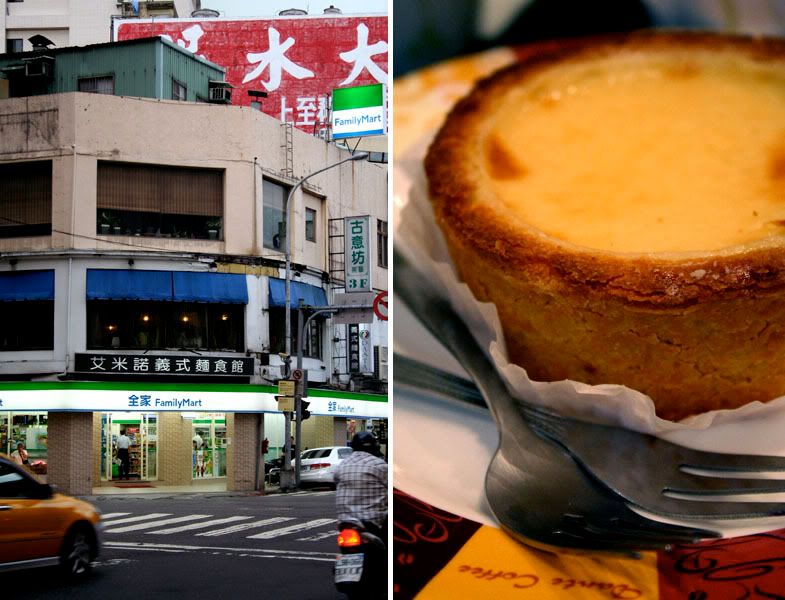 Seeking refuge from an afternoon downpour, we ducked into Dante Coffee, a willfully generic Taiwanese chain. Though the decor was bland and the coffee just above mediocre, our tea-time snack, a Portuguese egg-tart, was surprisingly good. It was taller and deeper than most I've had, which meant that there was more buttery crust and more room for rich custard.
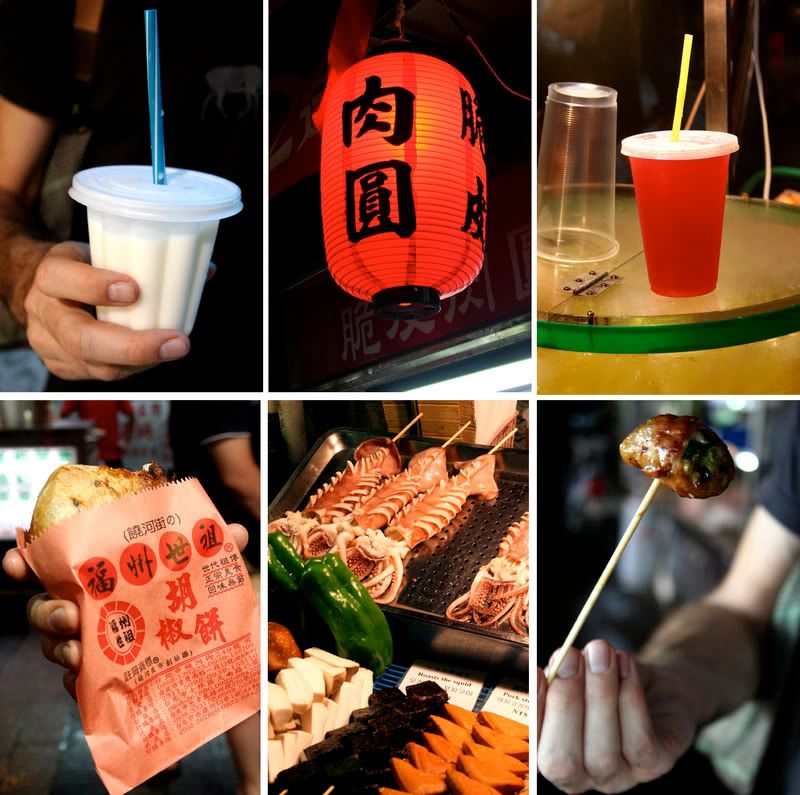 We travelled our farthest for dinner, which we took at the massive Shillin night market. I had expected something with the borders and definition of Bangkok's Chatuchak, but Shillin seemed to spread its web of toy stands and clothing boutiques over a confusing tangle of alleys and streets. In between the health elixirs and the racks of neon cargo shorts, there were stands offering more types of food than could be imagined- not just noodles and dumplings, but Japanese salad rolls, Indian chai, and Californian burritos. Out of reverence for Taiwan, we stuck largely to more local fare. Between a cup of almond milk and a last glass of cranberry juice, we tasted baked pork buns, grilled whole squid, and barbecued spring onion in a bacon wrapper. Filled up, and with tastebuds satisfied, we squeezed into the crowds of teenagers and were jostled to the exit.
Friday, June 13, 2008
Neighborhood market.
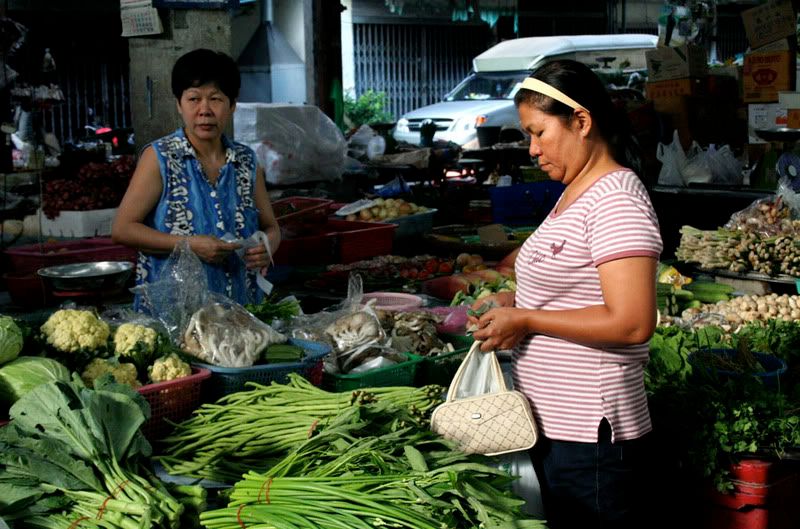 Now that we're not working full-time anymore, Bordeaux and I have been able to more fully explore our neighborhood. One of the best spots nearby is the local wet market, where we've started going to do most of our shopping. Shopping at the grocery store was often a vaguely frustrating experience, as even groceries in Bangkok seemed not to stock the things we needed to cook Southeast Asian food. But at the market, we never have problems finding turmeric root, sawtooth coriander or lotus stems, as there are mountains of fresh local vegetables and herbs.
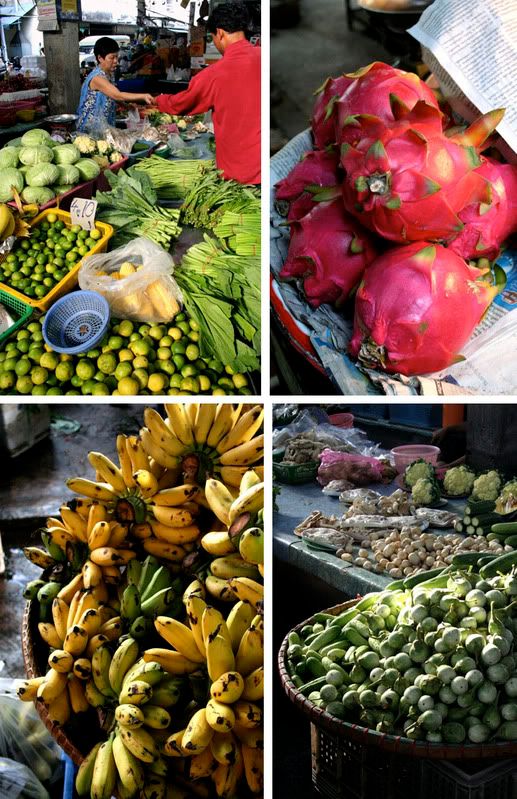 But perhaps the best thing about the market is the fruit. Tempted by the piles of colorful, cheap fruit, we often have the problem of wanting to bring home too much. We returned from the market yesterday with a papaya, two chunks of durian, a dragonfruit, a bushel of lychees, some egg bananas, and a huge bag of furry rambutans (below), which are currently in season- and only 15 baht (50 cents) a kilo.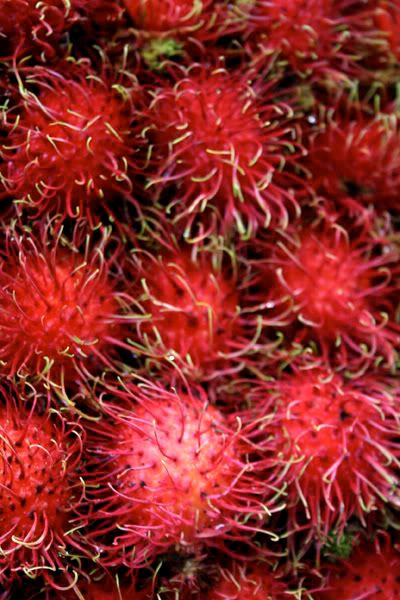
Monday, May 19, 2008
Friday, February 29, 2008
Bangkok Tourists: Exotic Silom.
 As a Valentine's Day gift, Bordeaux booked a night for us at a hotel in Silom, a stylish urban neighborhood near the city center. It's an area that we both like, and one that we thought we knew well. Yet spending the night there revealed a different side to the streets of Silom.
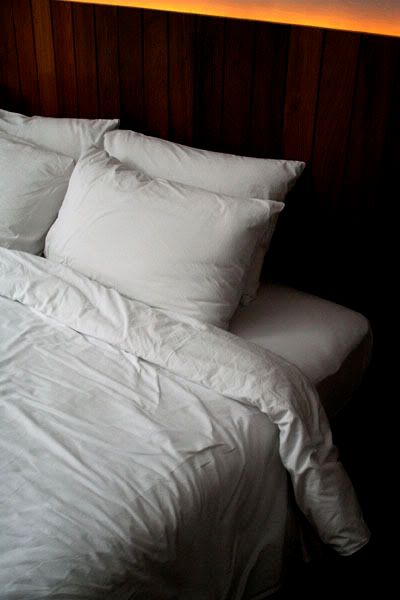 Bordeaux had booked a room for us at the Luxx, a boutique hotel on a leafy soi off of Silom. The stylish room was perfect for our night away. A huge bed with crisp cool white sheets, refreshingly spare decor, and a wooden bathtub with a rain shower.
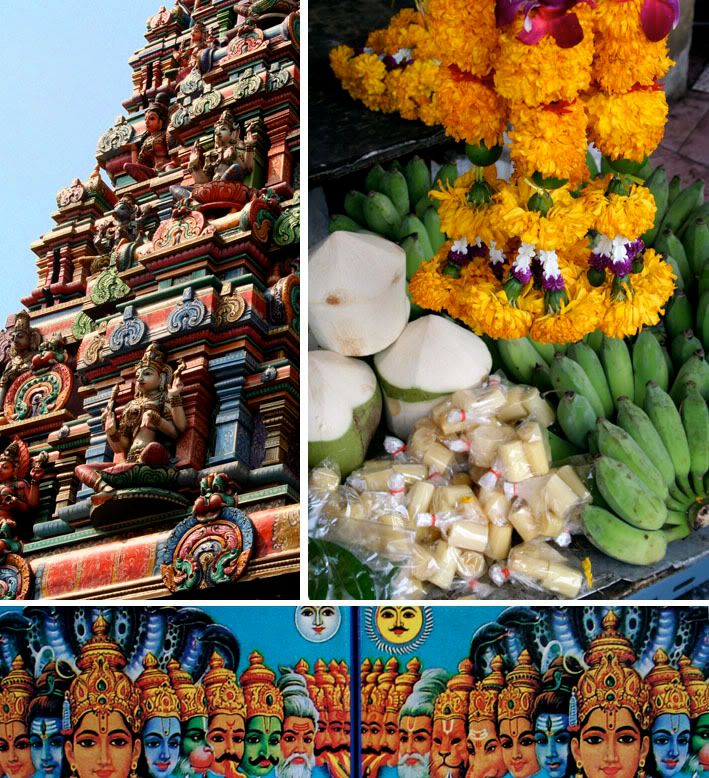 In search of lunch, we came across a Hindu temple that we had never seen before. The air around the temple smelled sweetly of incense, and the sidewalks were crowded with tables of offerings, garlands, and lottery tickets. Down the street we visited the Kathmandu Gallery, which was showing a mix of work by some very witty Thai artists.
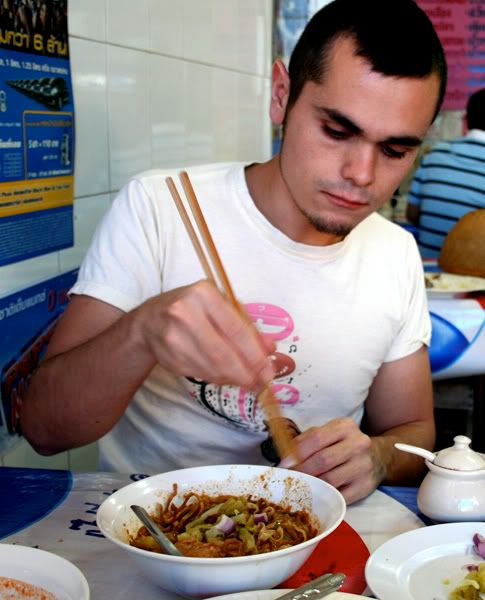
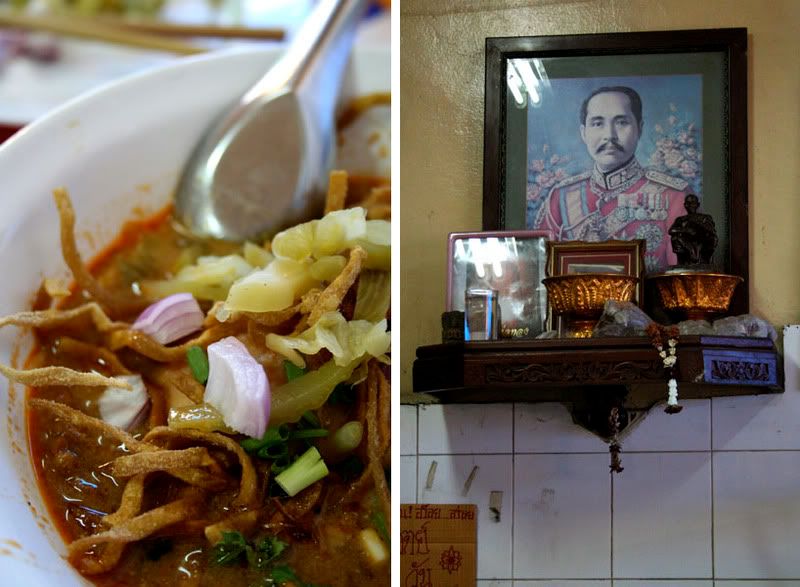 For lunch, we ate at a hole in the wallacross from the temple called Khrua Aroy Aroy. It's a popular little curry house, with a long lunch counter at the front of a small tiled room. Their greasy laminated menus show a mix of Thai regional dishes, from massaman curry to khanom jeen. I ordered the khao soi, a Northern Thai style curry dish that's somewhat difficult to find in Bangkok. The soft chicken and rich spicy broth were piled with delicious crispy noodles; seasoned with onions and pickled vegetables, it was an incredibly tasty dish.
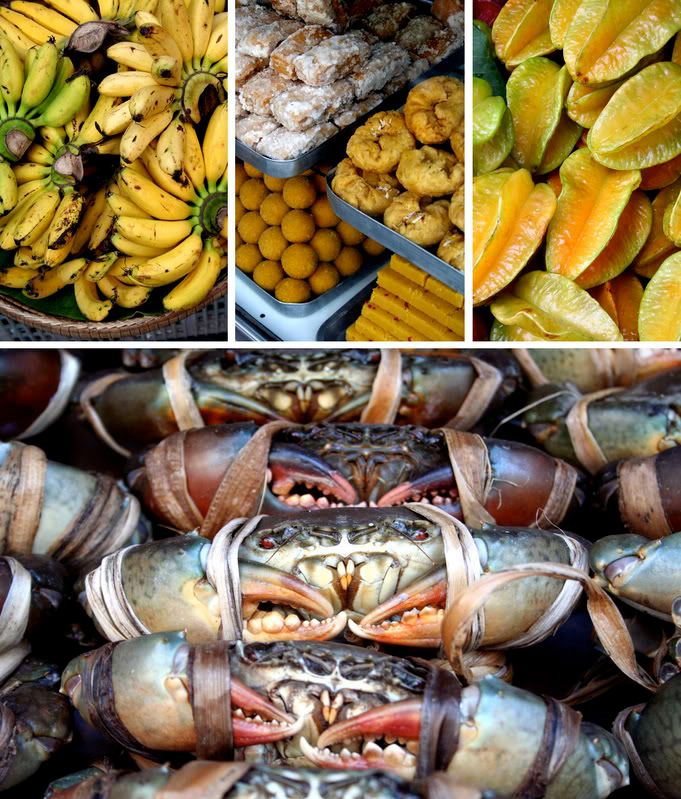 After lunch, picked up sweets at a nearby Indian bakery, and set out to explore the neighborhood. We wandered around the busy sois of the neighborhood. Up Silom Soi 20, we found a busy market, where citrus tinted fruits were stacked in piles. A woman flagged us down, trying to get us to buy Thai gay magazines, but we politely declined.
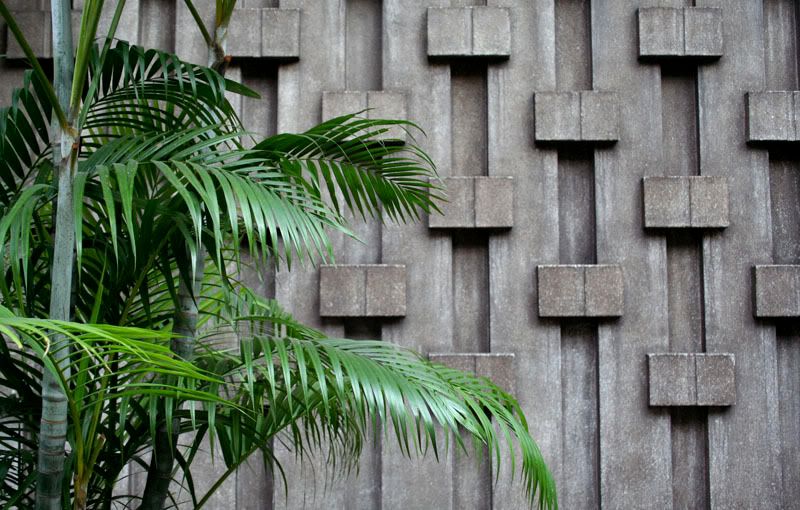
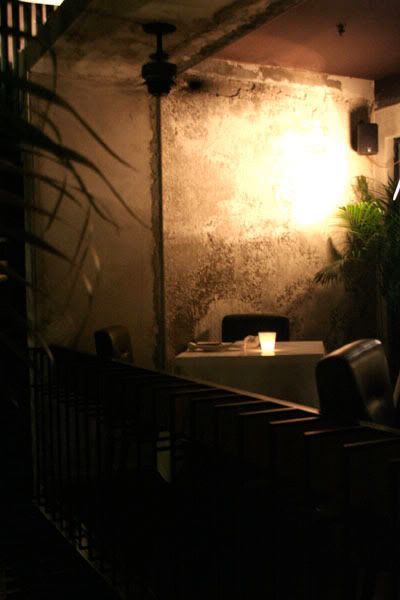 After a rest and a coffee, we went out for dinner at Eat Me, a chic restaurant and gallery. Set back from Thanon Convent in a palm shrouded compound, the atmosphere at Eat Me was seductively tropical. We sat on a long patio balcony, where jungle leaves cast shadows across bare concrete walls, and black fans swirled the air above every table. Over a long and leisurely evening, we had a lavish spread of dishes: duck spring rolls, herb braised fish, salmon and tarragon, which we paired with exotic cocktails. The highlight of the meal for me was perhaps the dessert, three scoops of creamy ice cream in spicy flavors: a refreshing milky lemongrass, a fiery ginger, and a potent chili vanilla.
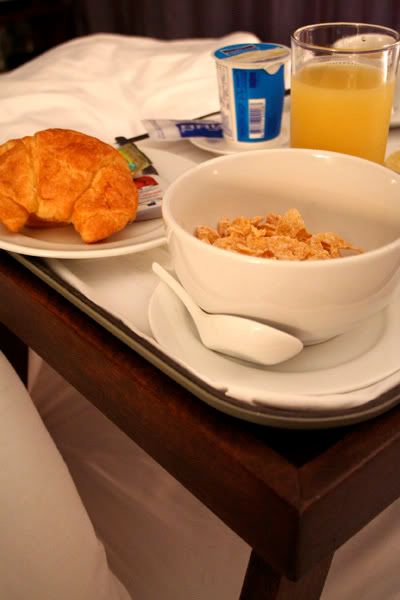 A solid night's sleep was followed by breakfast, which was brought to the bed on wooden trays.
Silom is a neighborhood that I enjoy, but not one that I often think of as being particularly exotic. Exploring the alleyways and hidden corners of the neighborhood revealed that side to me. In a way, Silom has got it exactly right: it's stylish and hip, but refreshingly tropical. It offers cosmopolitan charms, while still harboring delicious Thai flavors. It's the combination that makes Bangkok the amazing city that it is.
Thursday, January 24, 2008
Bangkok Snapshot: Curbside jack-fruit.
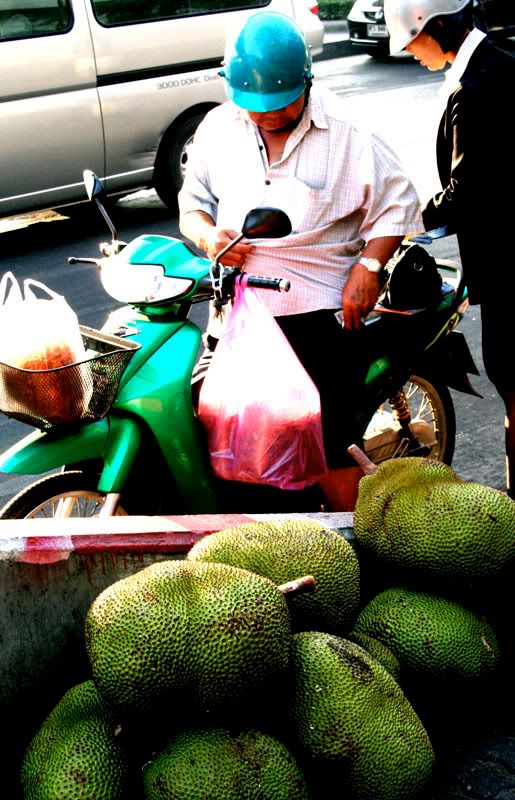 One of the more surreal aspects of passing a major produce market on the route to work is the unexpected appearance of a mountain of primeval fruit in an otherwise conventional setting.
Sunday, January 13, 2008
Sampling the savory flavors of Petchaburi.
 The train from Bangkok to Petchaburi was slow and dragging. It left the Hua Lamphong Station almost forty minutes late; and once on its way, the train made no efforts to hurry as it casually glided out of the capital. Even so, the journey was beautiful. Out of Bangkok, we passed through groves of coconut palms and wooden houses perched over reed-choked canals. We stopped briefly at small town stations, where the tracks were hugged by busy market stands. We were sheltered in tunnels of jungle growth, and cut through expanses of rice paddies hemmed in by distant jutting hills. By the time our train finally rattled into the station, dusk was beginning to settle on Petchaburi; the sunlight cast on the hillside temples starting to glow a pale orange.
The three of us (Bordeaux, our friend Tim, and I) climbed into the back of a pick-up tuk tuk, and made our way across town to the Rabieng Guest House. At first glance, it looked ideal: a thin leafy alley lead onto the teak veranda of an old river house. But the rooms were less appealing- dark cells with sunken mattresses, swarms of mosquitoes listlessly swimming in the sticky trapped air. We crossed the bridge to the nearest guesthouse, the Chom Khlao hotel. While their lobby was a chaotic mess of mismatched furniture and motorbike parts, the rooms were surprisingly pleasant. Though the bathrooms were basic and the furnishings rather worn, the high ceilings and tall windows gave the rooms a sun-soaked appearance, and the room's pale blue doors opened to look out over the Petchaburi river.
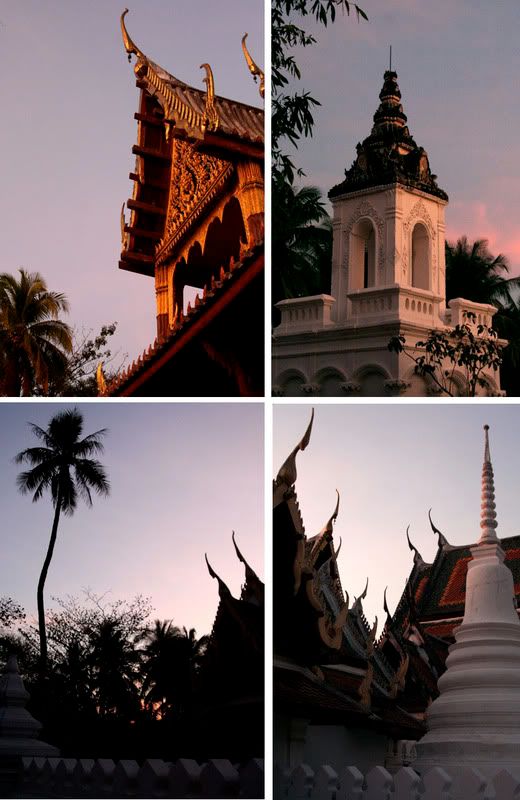 The town of Petchaburi is dominated by the spires of its temples; they look down the town from hilltops, and rise out over the city’s rooftops. As the light seeped from the dark sky, we set out to look around town. We had time to visit only one temple, Wat Yai Suwannaram; in the fading purple twilight, we were barely able to make out the ornate features of the temple.
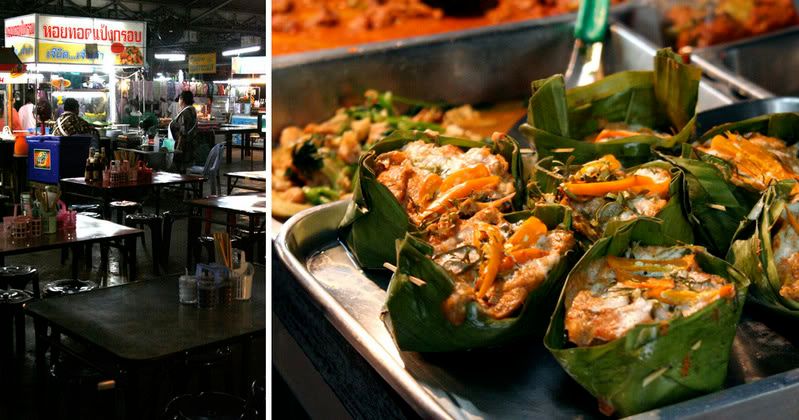 In search of dinner, we walked around the city's market, but found only a few forlorn roti stands and a cluster of unappealing noodle shops. We followed Bordeaux’s instinct until we came across a baby elephant being lead by it’s mahout; it in turn pointed us to the busy night market. There were numerous stands, offering simmering pots of curry, oily fried noodles, and of course, the famous Petchaburi sweets. We had no trouble putting together an impressive spread for dinner: a bowl of rich massaman curry, a deliciously fresh papaya salad, and a particularly flavorful haw mok (pictured above). Unlike most haw mok I’ve had, whose steamed fish custard was fragrantly seasoned with kaffir lime leaves and lemongrass, this one used strips of chili to give it a fiery, spicy burn.
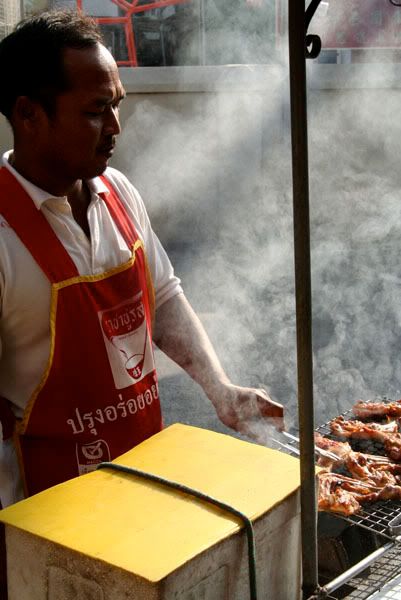 The next morning, we found the town’s market much more active. Old ladies filled their shopping bags with fresh greens and recently butchered meat, and the local men gathered at corner coffee shops. We put together an ad hoc breakfast as we browsed. We stopped for rich Thai coffee, where we were treated to a plate of oily Chinese donuts. Attracted by the scent of fragrant charcoal smoke, Tim ordered some delicious marinated grilled chicken. Bordeaux stood in line for a bowl of johk (rice porridge). As we waited, we chatted with a Thai woman who had lived in Reno, Nevada. She told us that the first time she visited Las Vegas, she was so excited to see it that she got a speeding ticket. Just before she left on her motorbike, bag of porridge in hand, she told us that this stand was famous for having the best johk in town. When we finally tried ours, and tasted the savory hot porridge, we had to agree.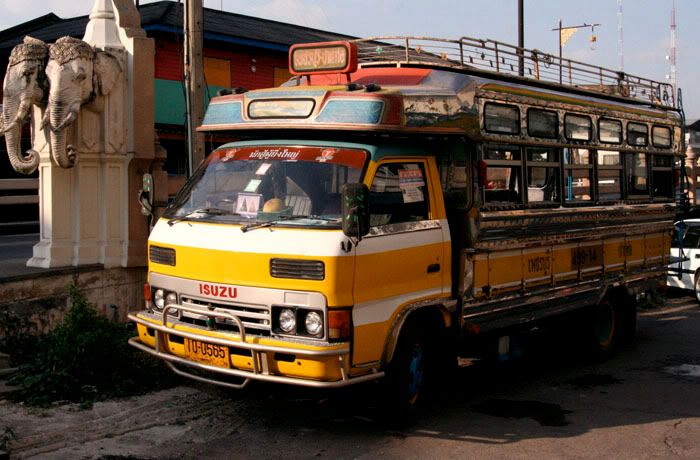
Tuesday, December 04, 2007
Bangkok Snapshot: Pineapple truck.
 As the sun faded over the umbrellas and stands of the Khlong Toei market, I noticed this guy picking pineapples one by one out of an open truck. The light hit him perfectly- bathing him in a golden shine that made him match his pineapples.
Monday, December 03, 2007
Black sticky rice.
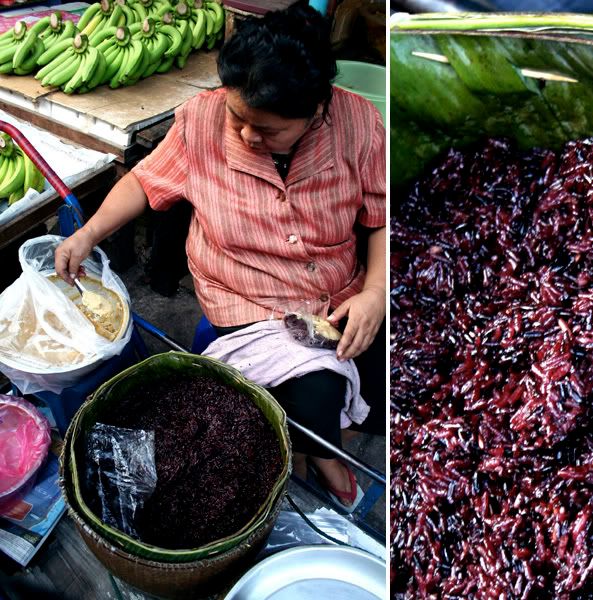 Yesterday, after loading up our shopping bags with fresh vegetables, Bordeaux and I came across an old couple selling black sticky rice at the Khlong Toei Market. I had first seen black sticky rice in Chiang Mai, during a market tour taken with my cooking class. Black sticky rice (kao niow dhom), or purple sticky rice as it is also called in English, is unhulled; the dark pigment of the hull bleeds in cooking, giving the rice its deep crimson color. I encountered it again among the markets of Laos; and though I ate countless balls of white sticky rice during my journey along the Mekong, I never got to try black sticky rice. So, more out of curiosity than hunger, Bordeaux and I bought a bag.
Our black sticky rice was scooped into a plastic bag, and topped with a quarter-inch slab of caramel colored custard. Together, they created an interesting combination of textures and flavors: smooth and coarse, sweet and wheaty. The rice actually tasted best on its own, as the hull that gives it its color also gives it a grainy flavor that white sticky rice is lacking. The difference in taste between white sticky rice and black sticky rice is less like the difference between white rice and brown rice, and more like the difference between white rice and it's non-relative wild rice. I will definitely keep an eye out for black sticky rice again in the future, and I would love to see if I can find it in any savory dishes, where I imagine its grainy flavor would serve it well.
Tuesday, November 06, 2007
A Market Lunch in Ayutthaya.
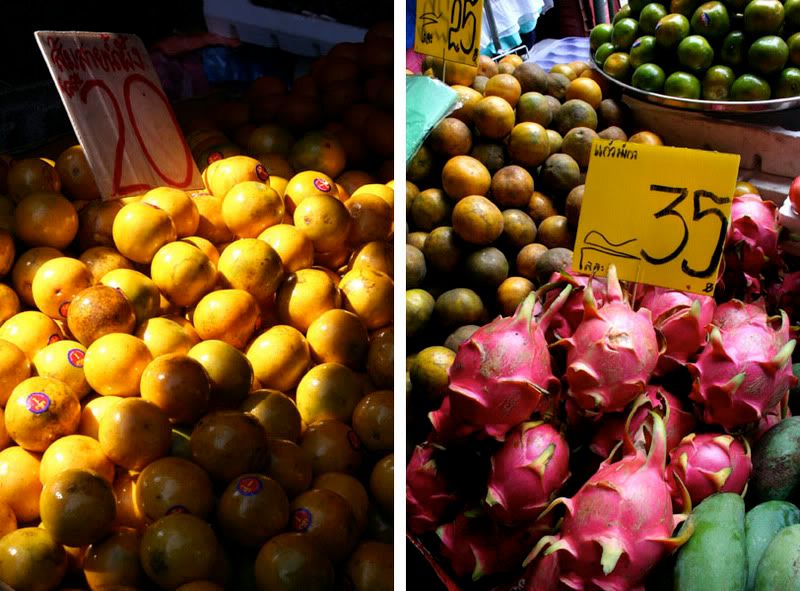 At the center of Ayutthaya is a busy covered market. Vendors' stands, piled with amulets, fresh fruit, cand discount appliances, curve around an ornate glittering shrine. Among the dark pathways and crowded sidewalks, one can buy kitchen wares, Buddhist antiques, or even small pets. Additionally, the market offers some of the tastiest food in Ayutthaya, served in an atmosphere that is far more engaging than at the town's tourist diners.
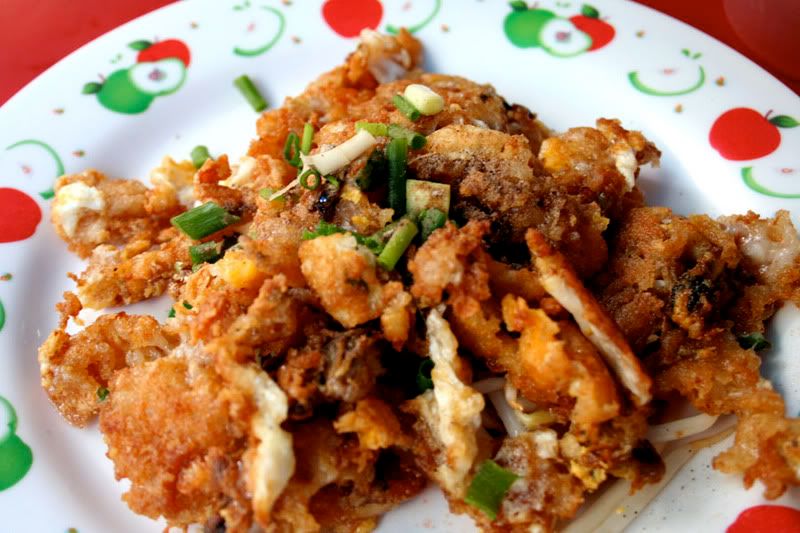 In a thin soi between fruit stands and flower stalls, Bordeaux and I found a number of open air kitchens. Feeling adventurous, we simply pointed to the first wok that looked intriguing; minutes later, we were brought a plate of hoy thod, a delicious fried mussel and egg dish.
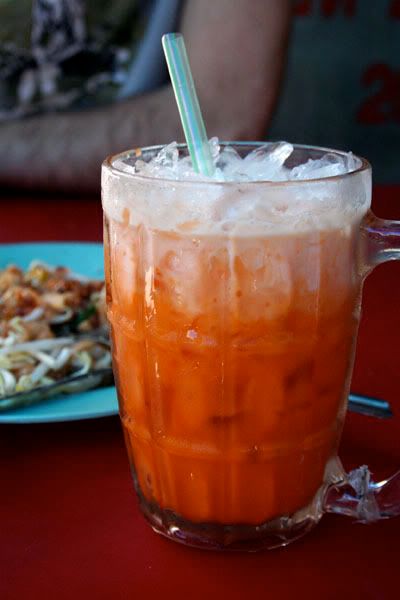
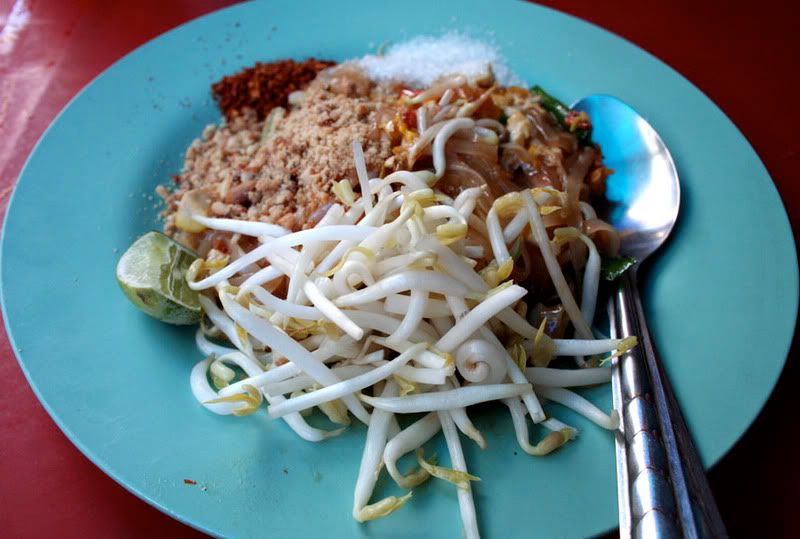 Our second course was phat thai, a dish that is less adventurous, but was still delicious. To combat the heat of the steamy alley, we ordered two creamy Thai iced teas, which were served frosty in their glass mags.
 Toward the end of our meal, a young girl calmly walked through the market crowds toward our table, a clutch of painted wooden birdcages hanging over her shoulder. Inside each cage was a bird, waiting to be purchased and released by a Buddhist person wanting to earn merit. The girl held out one of the cages to one of the market women; inside, a delicate songbird flapped and preened. The woman counted out some baht, and took the birdcage. She opened the cage door, and the bird quickly lept out, disappearing as a fluster of flapping wings into the sky.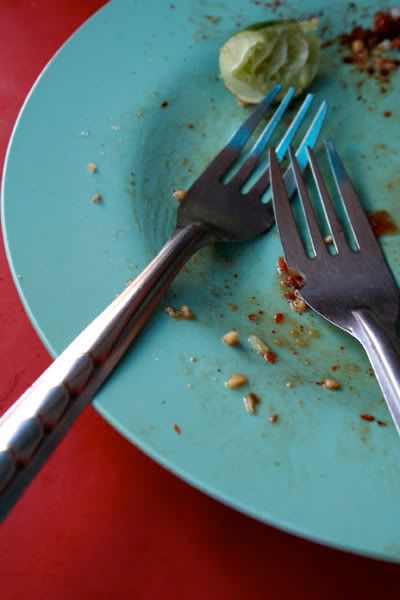
Tuesday, October 30, 2007
Bangkok Snapshot: Legs up in Pattpong.
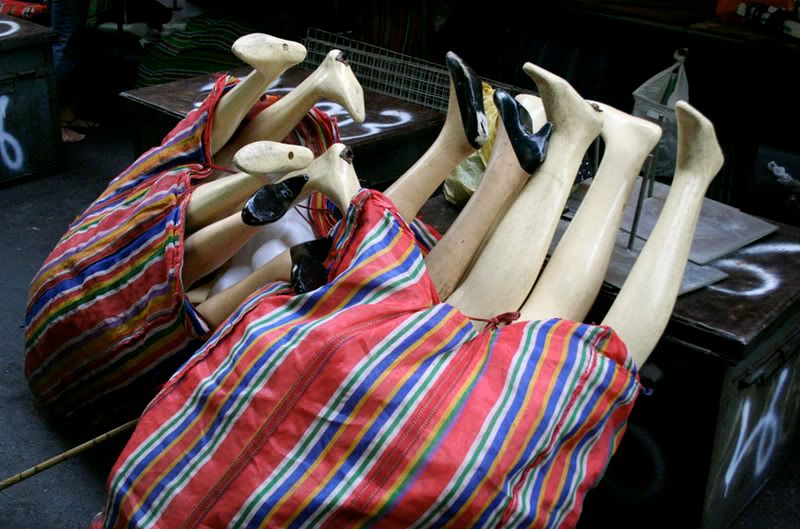 Pattpong is known mainly for it's burlesque shows, creepy Western men, and illicit tradings, but it was the sprawling sidewalk market that drew Bordeaux and I to the neighborhood. There, one can buy cheap t-shirts, tacky souvenirs, and a wide range of illegal DVDs. It can also be good place for some intriguing sights, like these bags of legs that Bordeaux spotted down a dank alley.
Saturday, October 20, 2007
Curious finds at a Bangkok antique market.
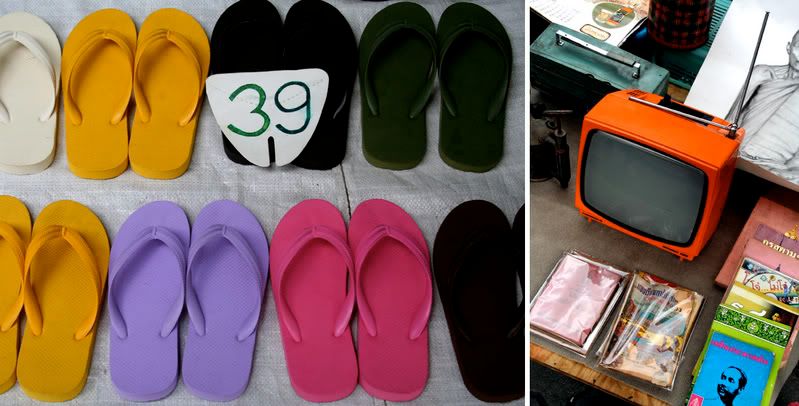 Bangkok certainly has no shortage of markets. There is the Khlong Toei market, selling fresh fish, meat and produce; the Suan Lum night bazaar, offering hip t-shirts and generic souvenirs; the Chatuchak weekend market, selling practically every dry good imaginable; and countless smaller markets, selling cut flowers, sewing supplies, illegal DVDs, and knockoff Levi jeans. Last weekend, Bordeaux and I visited one of the strangest markets yet. We were headed out to Chatuchack, but rather than getting off at the station closest to the entrance, we disembarked early at Saphan Kwai. Along the sidewalks of Paholyothin Road between Saphan Kwai and Chatuchak are a string of vendor's stands. Antiques and Buddhist amulets were the main goods on offer, but there was also cheap clothing, vintage Thai movie posters, and funky retro furnishings.
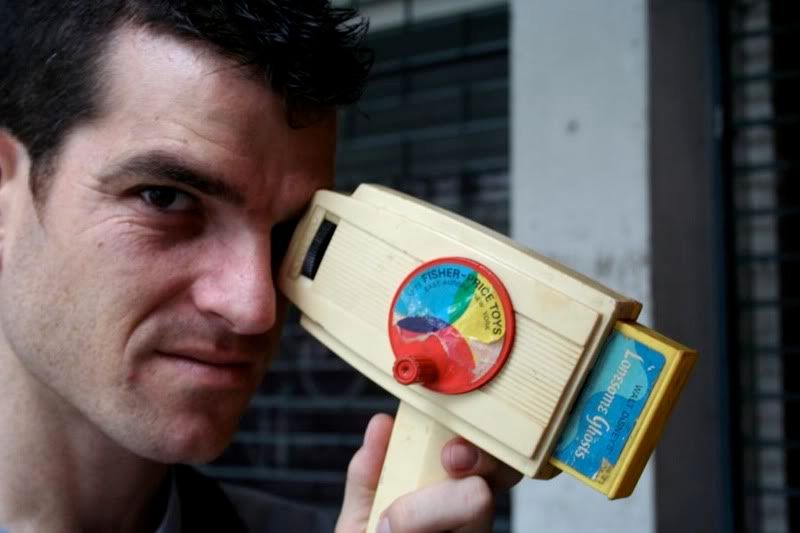 There were a few very intriguing finds among the cluttered card tables and blankets. We very nearly bought a set of 6 retro blue mugs, but couldn't justify having to buy the entire set. Bordeaux tried on bizarre sunglasses, which were both to funky and too expensive. And while I was browsing among a table of antiques, Bordeaux picked up and began playing with a strange toy camera. I was shocked when I saw it- I had the same Fisher-Price camera when I was a kid! In fact, I had the exact tape that was in the camera- Disney's 'Lonely Ghosts'. By closing one eye and winding the red dial on the side, you can watch cartoons in choppy animation.
 But the best find (and the only one I took home) was this rather unusual vintage postcard. I found it among a pile of antique photos and postcards. It is undated, but states that it was 'Made in Japan', and features the English caption: "Alligator Hunting." At best I can surmise that the image depicts an event that took place in Africa, and that they are actually hunting crocodiles. I loved the faded hues of the image, the romanticized African setting, and the strangely monstrous depiction of the crocodiles (I have a fondness for river monsters). I imagine it will look rather handsome framed, on a bookcase or in a study.
Wednesday, October 03, 2007
Khlong Toei Market.
 This past weekend, some friends took Bordeaux and I to the Khlong Toei market. Though this market is literally across the street from the school where we teach, the closest we had been was brushing past the noodleshop's pots of curry on the way to class.
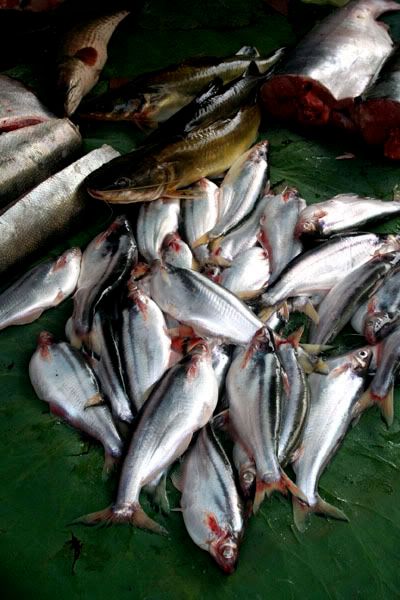
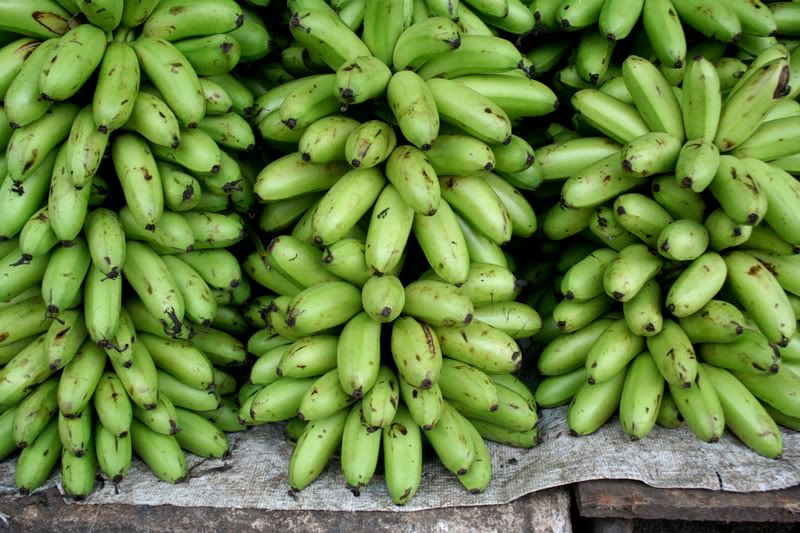
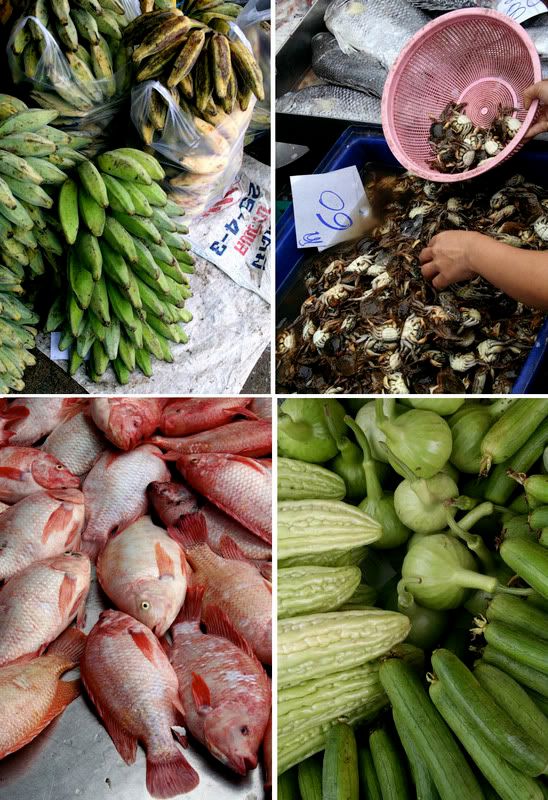 The Khlong Toei market is a popular wet market; many of Bangkok's restaurants shop here for the incredible range of fresh produce. The sheer abundance of food was staggering. There were tables and tables covered in pineapples, bags and bags of plantains, and mountains and mountains of green vegetables. There were also countless bins of iced seafood: crabs in varying sizes, and fish that still flopped and wriggled. One interesting feature of the market is that all prices are clearly marked, thereby eliminating the hassle (or fun) of bargaining. Our friends are experienced market shoppers (one of them is Thai, and the other has lived here for several years), so they were able to pick up all the supplies necessary for a lavish fish dinner. Bordeaux and I chose simply to pick up some fresh fruit and vegetables: mangos, carrots, broccoli and papaya.
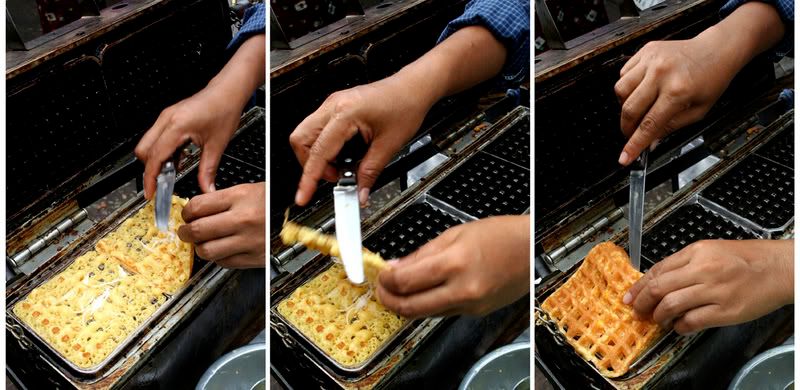 As usual at markets (or for that matter, any public space in Thailand), there were also a number of snack food vendors. They sold little griddle cakes, and popsicles made of frozen Fanta. I opted for a waffle, perhaps only because I liked the set up of the woman's stand. The waffle was served hot; so hot that it steamed up the plastic bag, and burnt my fingertips. After it cooled enough to eat, I decided that it was a bit odd. While the waffle itself was nice, it was filled with a mixture of coconut and corn, a favorite Thai combination that I haven't quite acquired the taste for.
Sunday, September 30, 2007
Exotic enclaves of Bangkok.
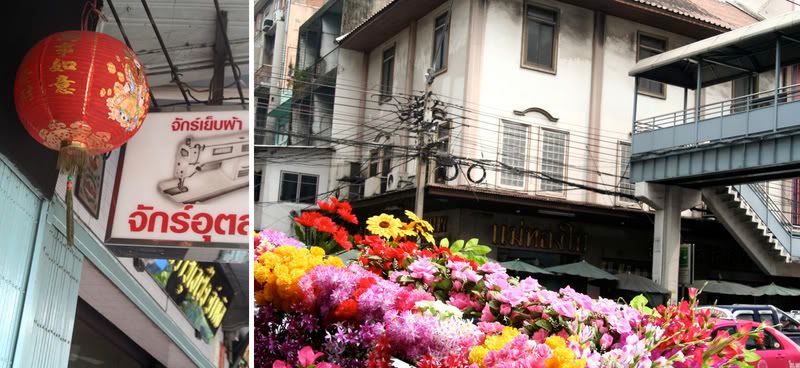 Why is my head in Africa lately? In part, I have a simple problem with being settled; no matter how much I love where I am, I'm always thinking about somewhere else. Thankfully, Bangkok is exotic enough to keep my wanderlust satisfied. Last weekend Bordeaux and I took advantage of the city's cosmopolitanism, as we crossed to the other side of town to visit Chinatown and Pahurat, Bangkok's Indian enclave.
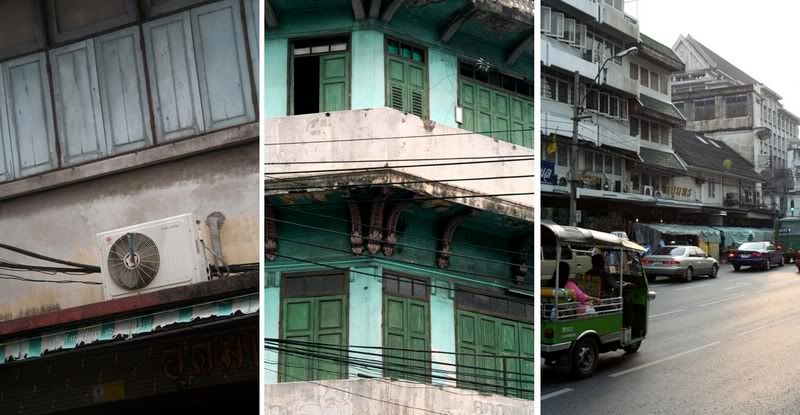 You can tell you've arrived in Chinatown by the warm smell of spices and herbs permeating the air. The streets are lined with herbal medicine shops, their dark antique wood cases stuffed with strange ingredients: golden colored roots, ground leaves, and dried out sea creatures. This area has a number of incrediblly beautiful buildings. Aside from the ornate Chinese temples, there are blocks of buildings from the early 20th century. Some are left clad in muted faded tones, and some have been freshly painted in eye-grabbing hues.
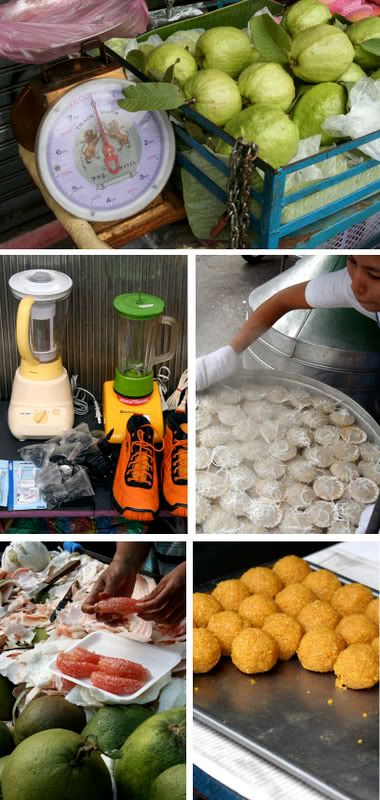 The sidewalks of both Chinatown and Pahurat are crowded with vendor's tables. There were stands selling t-shirts, used appliances, and Barbie dolls dressed like Thai school girls. Somewhat more photogenically, there were all sorts of foods for sale, like steamed desserts, sizzling satays, and juicy, freshly sliced pomelos. While we didn't get to try much of the street-food, Bordeaux and I picked up some pistachio-filled Indian desserts from an alley stand after lunch. As I bit into the first one, a woman on a passing motorcycle smiled at me, and said "Good, yes?"
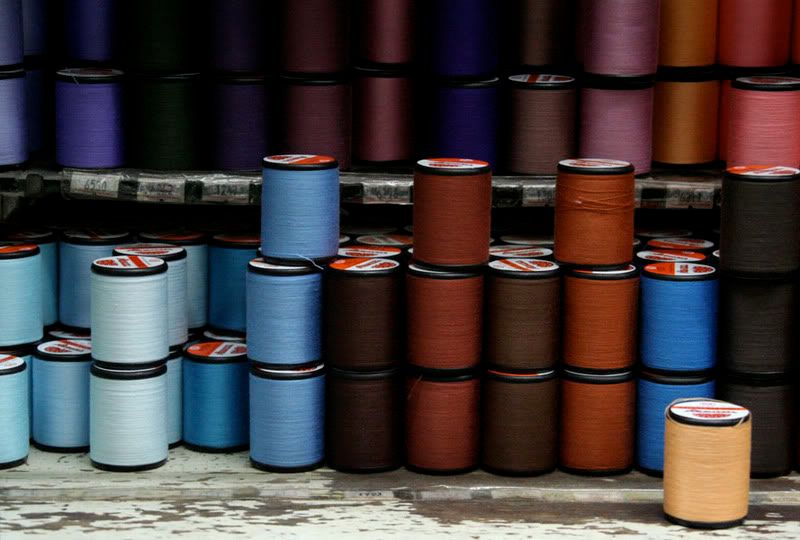 The main reason for our visit was to buy some fabric for Bordeaux's latest sewing projects. Paharut has a well-deserved reputation as the place to go to buy cloth and fabric; it boasts an impressive fabric market, packed with reams and reams of cloth in an amazing array of colors and patterns. After spending several hours among the maze of dark alleys in the fabric market, we emerged with several yards of cloth, coordinating zippers, and spools of brightly colored thread. For Bordeaux's side of the story, check out his blog.
Thursday, July 12, 2007
Beautiful Luang Phabang.
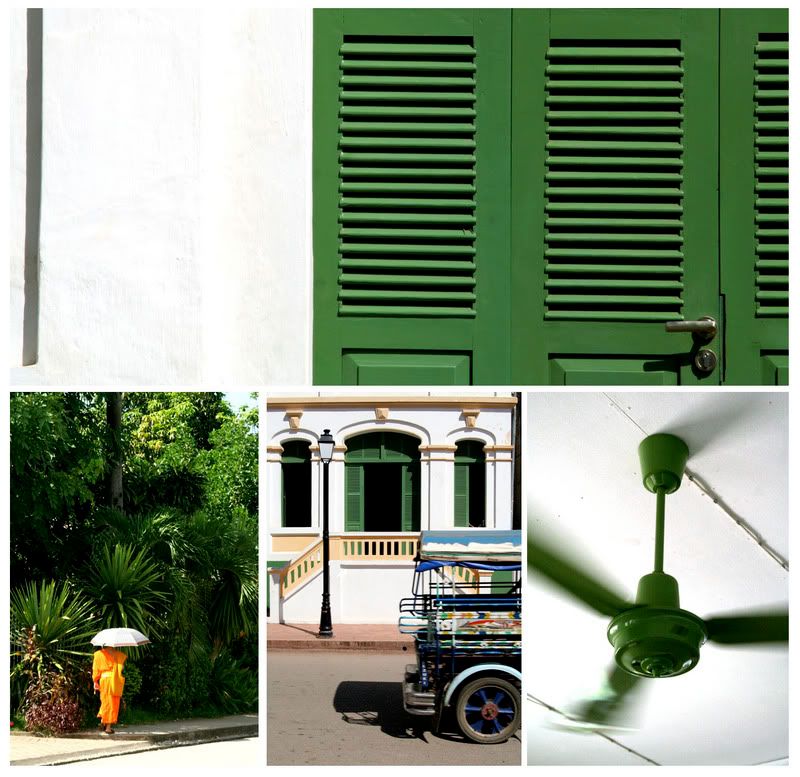 Few legendary destinations live up to their reputations of romance and exoticism. Louang Phabang certainly comes close. Admittedly, part of its glamour must have been a result of our means of arrival; after two days traveling by slowboat through the jungle of the Mekong, Louang Phabang served as a very welcome port of call.
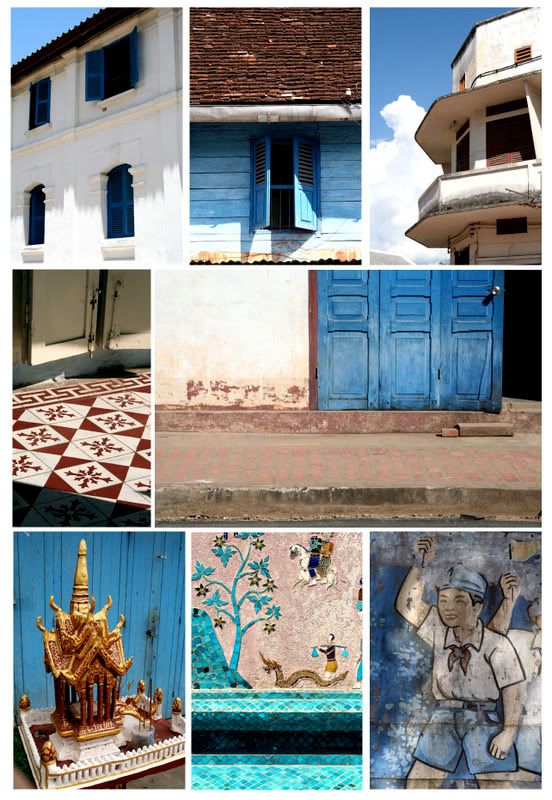 Apart from it's soothing views of the Mekong, the Nam Khan river, and the distant forested hills, Luang Phabang also boasts beautiful French architecture, numerous markets, and cafes brewing coffee grown in southern Laos. A city of cool white walls and blue-green shutters, Louang Phabang has a reputation for sophistication among the Lao. Unlike most of the country, which hasn't yet been able to fully emerge from years of economic isolation, there are few comforts or luxuries missing in Louang Phabang. Aside from a crumbling Socialist Mural perched above the Hmong market (Soclalist art always being recognizable by groups of united youth and the presence of a man holding a wrench), the only visible sign of communism is in the hammer and sickle t-shirts for sale. One could almost imagine that the city had gone smoothly from royal capital to French outpost to chic tourist destination.
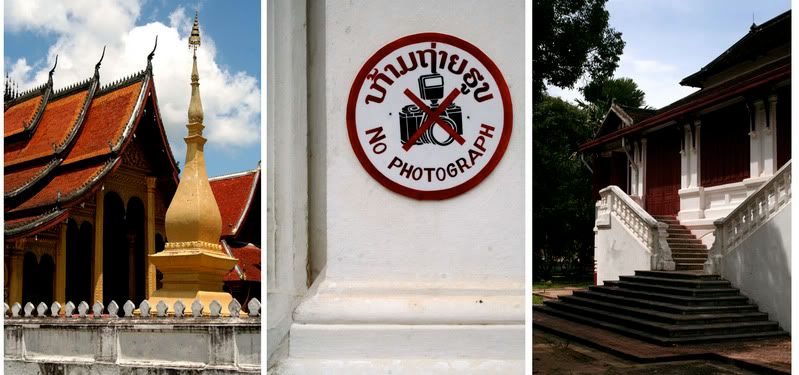 For being a relatively small city, Luang Phabang offers a few rather impressive sites. There are a number of wats, shimmering gold inbetween the gardens of neighboring villas. The most impressive is Wat Xiang Thong; the exterior walls of its pavillions and chapels are decorated in glass mosaic tile, depicting elephants, peacocks, and characters from Lao folktales. The premier site in town, however, is the Royal Palace, home of Laos' last king and queen. The entrance halls of the palace, which were redone in the late 1950s, feature colossal mosaics in metallic tile. Shards of colored glass create an entire universe of Lao folklore... In another chamber are a series of murals depicting the passage of one day in Louang Phabang. Painted in 1930 by Alex de Fautereau, the mural seems to have been an effort to mythologize Laos in the same way that Gauguin did for Tahiti. However, where Gauguin favored Polynesian women, it seems possible that Alex had a strong fondness for young Lao men; while the women in his mural are fully-clothed, often tucked away in shadows caring for childen, the men of Louang Phabang appear bare-chested in tight (and sometimes short) sarongs, standing in intimate conversation with one another. Beyond the entry halls are the royal residences, which are striking for their simplicity. Though they favored rather ostentatious ceremonial rooms, their own bedrooms have plain white walls and simple wooden furnishings. Behind the Royal Palace there are a number of galleries, which show surprisingly sophisticated work. In one old room there was even a show of work by Janine Antoni, featuring pieces she created in dialogue with several Hmong women.
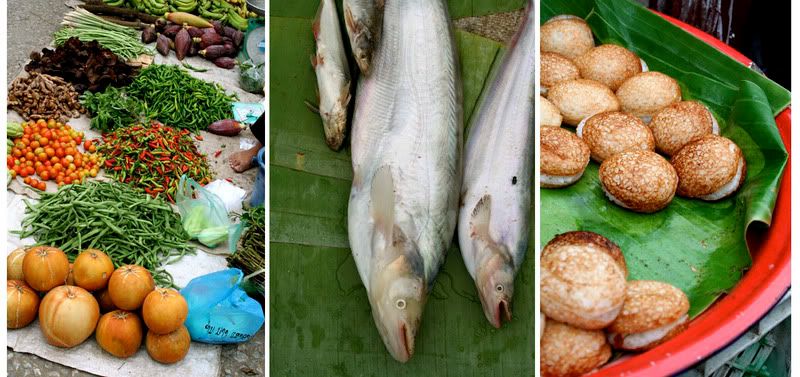 On our last morning in Luang Phabang, Bordeaux and I woke especially early. Starting at sunrise, the local monks walk through town, receiving alms from the local women. Since monks cannot cultivate their own food, they must be given it through this daily ritual. The woman sat patiently, often chatting and laughing with their friends, waiting for the procession of monks to arrive. At last they appeared, a long train of men, young and old, in orange robes. The woman would gather a handful of sticky rice from their basket, and give it to the monks. Once the last monks had passed by, the women would say a small prayer, and return to their homes. Leaving the morning ritual, Bordeaux and I headed to the morning market. Blankets were set out and small stands set up on a thin alley, where it seemed almost possible to find any kind of Laotian creature on offer. Plastic bags quivered with live crickets and crabs, water rodents tried to chew out of bamboo cages, and large birds lay dead on the ground, their splayed wings still covered in dark feathers. Bordeaux and I opted for a somewhat safer breakfast; rice porridge tarts, their edges browned to the flavor of a warm pancake, their insides still dripping hot.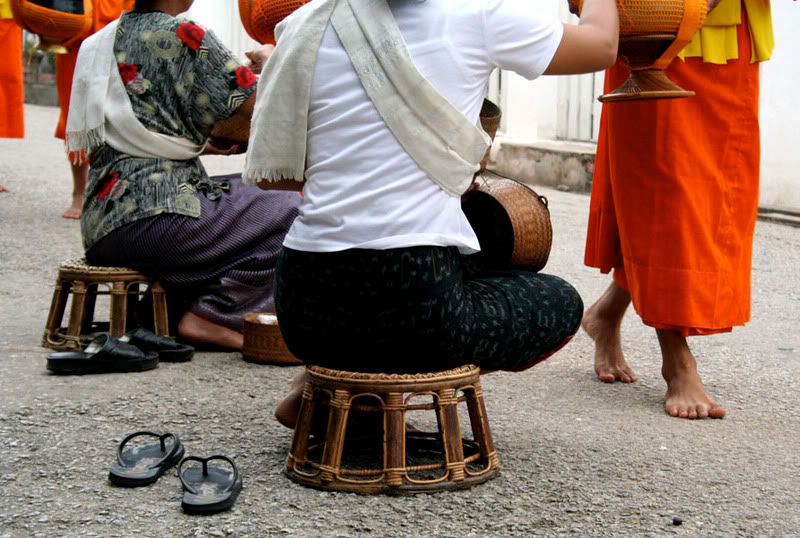
Subscribe to:
Posts (Atom)