 Last week I got to spend an incredible seven days around San Francisco and the wine country with my family. Our holiday was planned mainly around eating some incredible food, starting with a much appreciated stop at In-n-Out on our way from the airport to Napa. It might seem like a humble beginning to a holiday in one of the world's greatest food centers, but the meal really summed up what we were after: simple, satisfying bites of local California flavor. And anyway, if you've had a burger and shake from In-n-Out, then you probably understand.

Showing posts with label eaten. Show all posts
Showing posts with label eaten. Show all posts
Saturday, May 01, 2010
eating culture/eaten: In-n-Out Burger and Shake.
Last week I got to spend an incredible seven days around San Francisco and the wine country with my family. Our holiday was planned mainly around eating some incredible food, starting with a much appreciated stop at In-n-Out on our way from the airport to Napa. It might seem like a humble beginning to a holiday in one of the world's greatest food centers, but the meal really summed up what we were after: simple, satisfying bites of local California flavor. And anyway, if you've had a burger and shake from In-n-Out, then you probably understand.

Monday, April 19, 2010
eatingCULTURE/eaten: Melkkos.
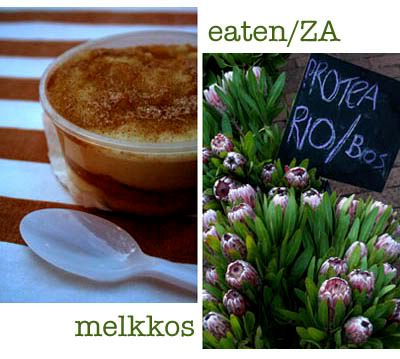 For a final breakfast in South Africa, we woke up early and headed out to Pretoria's Boeremark. We got there just as the sky was just starting to lighten, some of the late-coming vendors still setting up their stalls and laying out their produce. It had been raining the day before, and though the morning sky was clear there were still gaping mud puddles and a slight damp chill in the air. This made it the perfect morning to have a bowl of melkkos. A flour based porridge layered with strata of cinnamon and sugar, melkkos satisfies on all my requirements for a chilly morning meal: nourishing, filling, with just the right element of sweetness.
Tuesday, March 16, 2010
eatingCULTURE/eaten: Cendol.
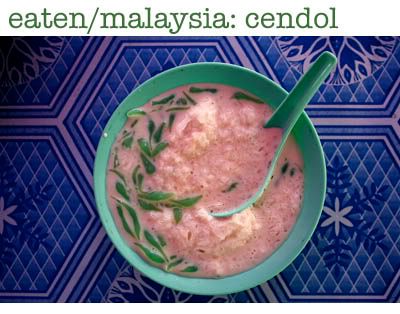 In moving traveling from Taipei to Borneo, we had to make a quick adjustment from the cold, wet winter weather of Taiwan to the sweltering tropical heat of Malaysia. Thankfully, we were able to find an aid to that transition. While walking through the market in Kota Kinabalu, we saw vendors with large plastic tubs filled with strange neon-green squiggles, explained only by signs advertising ‘cendol’. While we initially eyed this strange dessert with skepticism, it quickly became our daily treat, and our favorite way of cooling off.
A sweet dessert ‘soup’ made of bright green mung-bean-flour threads served with a mound of ice and coconut milk, cendol was served rather simply in Sabah. In Melaka, we sampled a much more mature version of cendol, in which red beans were mixed among the threads of cendol. While they might have made the dessert a little more savory, the effect was balanced out with a dark swirl of gula melaka, the rich local palm sugar. It added an additional complexity to the dessert.
But to be honest, while I can appreciate the Melaka version as a superior product, there’s something I rather liked about the simple cendol we got in Borneo. Without the red beans and the darkly-sweet palm sugar, it was uncomplicated and uncluttered, creamy without being too rich or too complex; satisfying in the same way that a simple scoop of vanilla ice cream might be more refreshing than a rich gelato on a hot summer day.
Wednesday, February 24, 2010
eatingCULTURE/eaten: Papaya Milk.
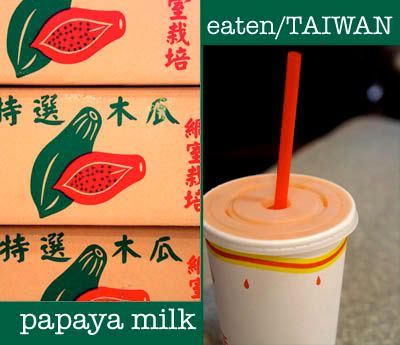 The first thing I consumed after arriving in Taipei back in 2008, Papaya Milk remains one of my favorite Taiwan treats. Ripe papaya is blended with milk for a creamy, earthy, sweet-but-not-too-sweet smoothie. It's available fresh, from night market stalls or from fast-food style vendors, or pre-made at 7-11s, where it's sold in fantastically retro packaging. It's perfect for a steamy summer's afternoon in the southern town of Kaohsiung (where the drink is recognized as a local treasure)-- but as I found out this month, is just as delicious on a drizzly Chinese New Year's holiday in chilly Hsinchu.
Tuesday, February 16, 2010
eatingCULTURE/eaten: Salt Encrusted Fish.
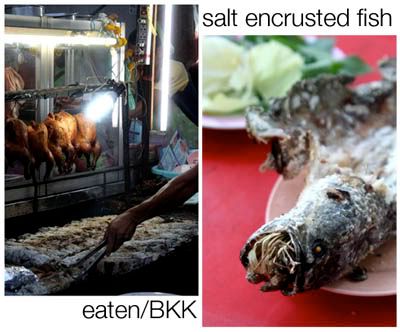 Our return to Bangkok was of course an excuse to indulge in some of our old favorite dishes, but it was also an opportunity to try a few things we'd always been curious about. With its body entirely coated in coarse salt, the grilled salt-encrusted fish had always intrigued me, but I'd never found the chance to try it. So when we passed by a stand that seemed to specialize in them, we took the hint, ordered one, and grabbed a table. The fish arrived with its salty-skin already peeled back for us, and accompanied by a small bowl of a spicy chili sauce. The fish's mouth had been stuffed with lemongrass, which gave a gentle flavor to its delicate white flesh. And the salt, somewhat strangely, gave the fish an added moisture-- by first leaching the moisture out of it, and then gently infusing it back in.
Monday, November 16, 2009
eatingCULTURE/eaten: Beskuit.
Eating the world, one bite at a time.
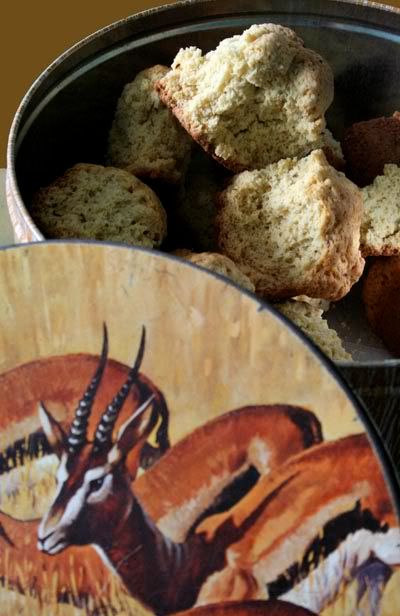
 No proper South African tea is complete unless attended by some beskuit. Known in English as a rusk, beskuit is the Afrikaans equivalent of biscotti: a biscuit that has been twice baked to dry it out and harden it, making it ideal for dipping into a warm mug of tee or koffie. Though classic beskuit have a relatively simple ingredient list (mainly flour, margarine, and buttermilk), they can be further enhanced with added seeds, dried fruit, or cereals. Pictured above are anise beskuit, made with self-raising flour for a more pillowy texture, and flavoured lightly with anise. If you're curious to try beskuit in South Africa, give the boxes in the grocery store a miss, and seek out some proper home-baked beskuit from a farm stall, a church bazaar, or a neighbourhood cafe; it will make all the difference for enjoying your tea.
For further reading, or to attempt some beskuit of your own, check out this recipe on Marita Says.
 No proper South African tea is complete unless attended by some beskuit. Known in English as a rusk, beskuit is the Afrikaans equivalent of biscotti: a biscuit that has been twice baked to dry it out and harden it, making it ideal for dipping into a warm mug of tee or koffie. Though classic beskuit have a relatively simple ingredient list (mainly flour, margarine, and buttermilk), they can be further enhanced with added seeds, dried fruit, or cereals. Pictured above are anise beskuit, made with self-raising flour for a more pillowy texture, and flavoured lightly with anise. If you're curious to try beskuit in South Africa, give the boxes in the grocery store a miss, and seek out some proper home-baked beskuit from a farm stall, a church bazaar, or a neighbourhood cafe; it will make all the difference for enjoying your tea.
For further reading, or to attempt some beskuit of your own, check out this recipe on Marita Says.
Wednesday, September 09, 2009
eatingCULTURE/eaten: Vetkoek.
Eating the world, one bite at a time.
 Cape Town’s Milnerton Market is not only a fantastic place to look for second hand kitchenware and used books; it’s also a great place to sample some simple South African foods. On our last visit, we went specifically with one food in mind: vetkoek. With a name that literally means fat cake, you shouldn’t be surprised by the bread’s somewhat greasy texture and flavour-- it’s a little like a savoury donut. We had ours filled with ‘mince’ (ground meat), for a rich and nicely greasy snack—a filling antidote to the cold rainy weather.
 Cape Town’s Milnerton Market is not only a fantastic place to look for second hand kitchenware and used books; it’s also a great place to sample some simple South African foods. On our last visit, we went specifically with one food in mind: vetkoek. With a name that literally means fat cake, you shouldn’t be surprised by the bread’s somewhat greasy texture and flavour-- it’s a little like a savoury donut. We had ours filled with ‘mince’ (ground meat), for a rich and nicely greasy snack—a filling antidote to the cold rainy weather.
Tuesday, February 17, 2009
eatingCULTURE/eaten: Padkos.
Eating the world, one bite at a time.
 Less than a week after arriving in South Africa, we headed into Kruger National Park. Though I've been in the park before, this was my first time doing it South African family style. Instead of staying at a lodge, we rented out restcamp cabins, and catered our own meals-- starting with a stop for some padkos on the way in.
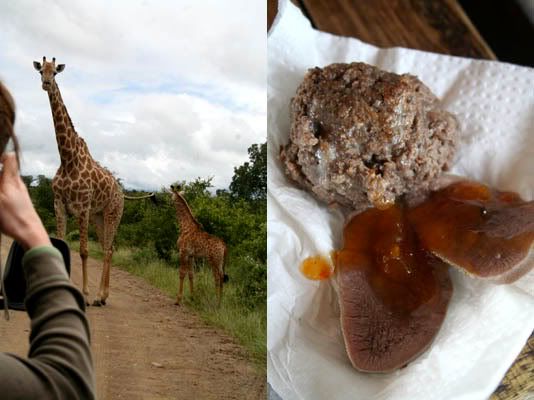
Though the Afrikaans term padkos could be translated as 'road food', it bears no resemblance to the street-side noodles and sidewalk satays I enjoyed in Asia. Instead, it's food for the road, packed ahead and meant to be eaten on a trip. For our first stop, we had two dishes: frikadelle and sliced beef tongue. Though a little heavy for a morning snack, the frikadelle was easily likable, as it was well spiced with cinnamon, nutmeg and coriander. And though I hesitated a little before biting into the tongue, it was surprisingly tasty as well. It paired particularly well with a tangy peppadew chutney, giving it the distinctly South African combination of savoury and sweet.
 Less than a week after arriving in South Africa, we headed into Kruger National Park. Though I've been in the park before, this was my first time doing it South African family style. Instead of staying at a lodge, we rented out restcamp cabins, and catered our own meals-- starting with a stop for some padkos on the way in.
Though the Afrikaans term padkos could be translated as 'road food', it bears no resemblance to the street-side noodles and sidewalk satays I enjoyed in Asia. Instead, it's food for the road, packed ahead and meant to be eaten on a trip. For our first stop, we had two dishes: frikadelle and sliced beef tongue. Though a little heavy for a morning snack, the frikadelle was easily likable, as it was well spiced with cinnamon, nutmeg and coriander. And though I hesitated a little before biting into the tongue, it was surprisingly tasty as well. It paired particularly well with a tangy peppadew chutney, giving it the distinctly South African combination of savoury and sweet.
Thursday, October 02, 2008
eating culture/eaten: Candied Ginger.
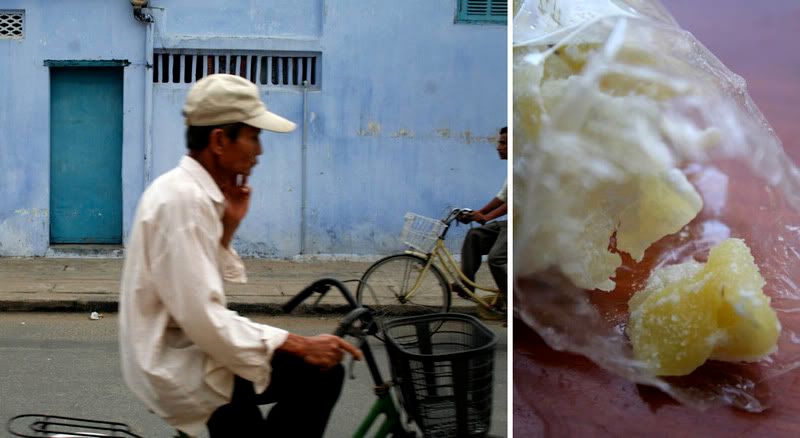 It's undoubtedly very touristy, but I love the sugared ginger sold by street-vendors in Hoi An. It's crunchy/stringy texture and sharp flavor make it the perfect snack after a mellow meal or during a stroll through the market.
Wednesday, May 14, 2008
eating culture/eaten: Mystery Cambodian Ice Cream.
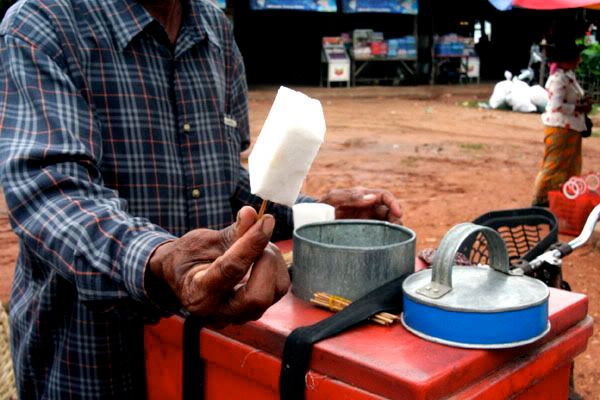
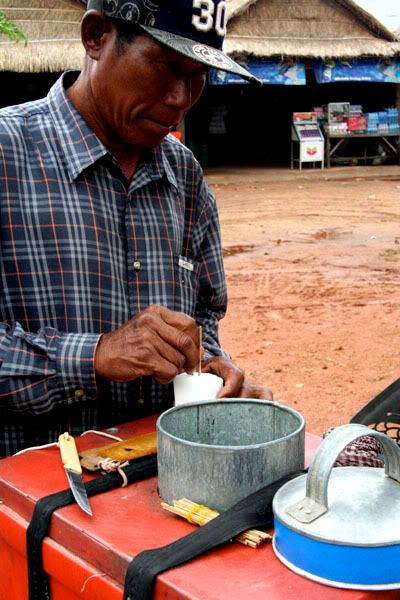 After a lunch in the seaside town of Kep, we were passed by a man on a bike. Our attention drawn by the clinging of his bell, we noticed that he had a blocky orange cooler strapped onto the back of his bike. We stopped him, and ordered one ice-cream each. Instead of the frozen popsicles we had been expecting, he took out a long white block, set it onto a small wooden cutting board, and sliced it neatly into sections. Sliding each one onto a bamboo skewer, he handed them to us.
As he chimed off on his way into town, we walked back to our guesthouse, taking licks of the ice cream as it melted in the afternoon heat. We had assumed it was just coconut ice cream, but we instantly detected a strange, subtle flavor. After a minute, we realized what it is: the infamous durian, which is currently in season. Though the fruit has a flavor most visitors find abhorrent, when mixed with the creamy ice cream, it offered just enough of an unusual, exotic flavor.
Monday, January 07, 2008
eatingCULTURE/eaten: Black Vanilla.
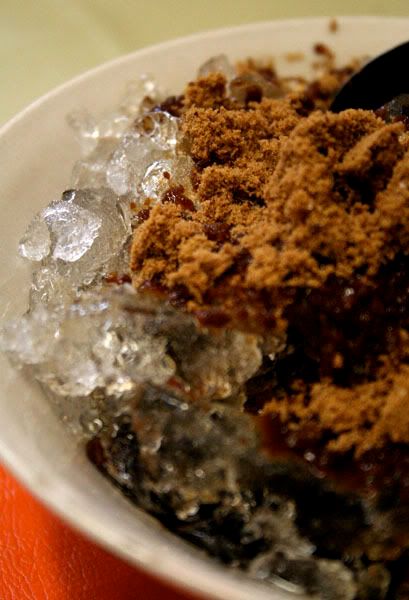 Though the delicious food in Thailand is undoubtedly one of the reasons that I moved to Bangkok, Thai sweets presented a strong challenge to my taste buds. Early on in my Thai travels, I often saw vendors at markets or on street corners selling trays of gelatinesque squares: unnatural looking blocks whose color ranged from ‘80s tints of hot pink and green, to brackish shades of mossy-black. I was hesitant to try them- not because I really had any reason to think that they would taste bad, but more than anything simply because they looked unappealing to me. I’m usually attracted to desserts like home made brownies and chocolate chip cookies: treats that look invitingly warm and doughy, and bear the loving irregularities of having been hand made. Many Thai sweets, on the other hand, looked to me cold and plastic, alarming in their neon colors and manufactured uniformity. Thankfully I got past my prejudices, and while I haven’t liked all of the ones that I’ve tried, I’ve had some really delicious surprises. Recently, I encountered a particularly tasty Thai sweet at the Chatuchak weekend market: a chao kuay treat called “Black Vanilla.”
 I’d seen the stand several times on one of my favorite alleys in Chatuchak, a busy lane in section 3 that's packed with hip t-shirt stands, tiny design stores, and expensive shops stocking candles and fragrant oils. This bright-orange dessert stand specializes in a dessert they call “Black Vanilla”. It is made with chao kuay, black jelly. Chao kuay is made from a Chinese plant, and thus has the unexpected taste of fresh herbs. It can be a little medicinal on its own- and it in fact is said to have health properties. The stand has a steady stream of customers, but thankfully the dessert is quick to prepare. One woman takes orders, while another stands at the front, scooping crushed ice and powdery brown sugar onto fat slices of black jelly. With its granulated sweetness and grassy jellyness, the dessert combines strongly contrasting flavors and textures. Once the ice begins to melt, however, the different elements begin to blend together. Once mixed, the herb flavors of the black jelly and the syrupy sweetness of the brown sugar take on a refreshing taste, like the flavor of a natural root beer. It’s n enjoyable unusual modern Thai treat, and the perfect refreshment for an afternoon pushing through crowds at Chatuchak.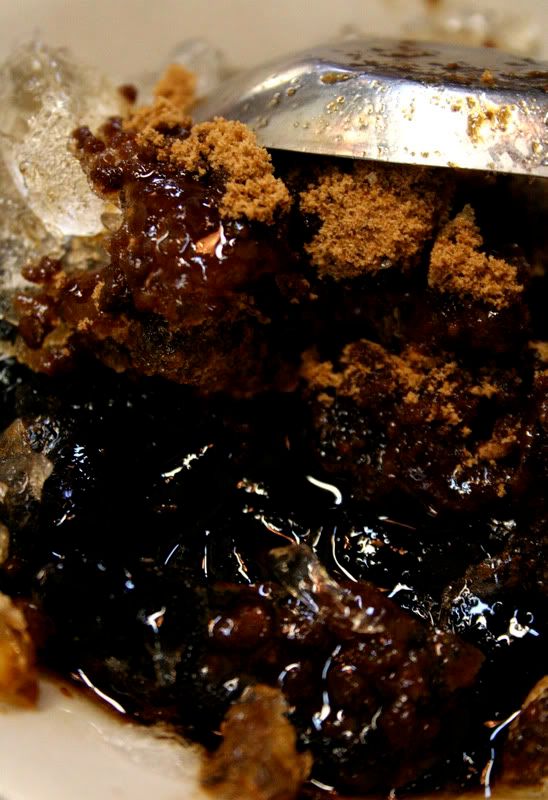
Sunday, August 05, 2007
eating culture/eaten: Grolan.
 While in Cambodia, there was one street-side snack food that I became rather fond of. And no, it wasn't the giant black spiders fried in oil and chili, shown above.
 My Khmer snack of choice was grolan, the sticky-rice equivalent of Gogurt. It's naturally pre-packaged, easy to transport, and fun to eat. I first encountered it along the riverside in Kratie. Bordeaux and I bought one for the bus ride, though we ended up forgetting about it until we got to Kampong Cham. Grolan is sticky-rice, mixed with coconut milk and blackbeans, and steamed in a bamboo tube. The bamboo is broken away, and it is served in just a thin bamboo sheath. To eat it, you peel that away, revealing the thick tube of sticky rice. The texture is a little like a hardened porridge, with occasional black beans adding a little sweetness. As one might expect of a steamed rice and coconut milk treat, grolan is extremely filling. On our last night in Angkor, Bordeaux and I bought one to take with us as we watched the sunset. It was the perfect treat for the trip- easy to take up the hilltop, and more than filling enough to tide us over until dinnertime.
Subscribe to:
Posts (Atom)