My reasons for wanting to visit the Chiang Mai Zoo were simple. I had long been fascinated with the Mekong Giant Catfish, the largest scaleless freshwater fish in the world. Left to grow in their muddy home, the creatures can grow to be over ten feet long and weigh up to 300 kilos. Though Bordeaux and I would soon be traveling by slowboat along the Mekong, we were unlikely to see any of these monsters, even if they were to thump along the bottom of our boat as we cruised by. As it happened, the Chiang Mai Zoo featured a freshwater aquarium that featured these catfish. This would thus likely be the best chance for me to see the creatures.

A short distance away from the walled center of Chiang Mai, the zoo seemed to be under heavy construction. The entrance was caked in fine grew cement dust, as workers put up a new parking structure and gate. Past the ticket booths were even more construction, as the zoo was having a monorail installed. Throughout our walk in the zoo we were accompanied by the silent green girder that slithered between trees, seeming more a forgotten ruin than the latest transportation technology. The zoo itself was planned rather oddly, so that to walk from one exhibit to the next often meant choosing from two unmarked paths, climbing a hill, crossing a parking lot, and then looking for the next brightly colored hand painted sign. Though the animals featured included a number of stunning mammals, like asian black bear, malayan sun bear, and Indian rhinoceros, the zoos biggest strength seemed to be its birds. A mesh tent had been raised over the hills natural forest, creating an aviary that housed parrots, peafowl, and the exotic Victoria Crown pigeon. In separate cages nested chattering storks, sullen owls, and several different species of exotic hornbills.

Though not the river monsters I was looking for, the zoo also had a beautiful collection of reptiles. There were dozens of Siamese crocodiles, which law open-jawed at the edge of mud wallows, flashing their jagged rows of teeth and occasionally blinking their yellow eyes. In low dark cages lived Burmese pythons, their sinewy coils lazily piled on top of each other. The zoo's general opinion was apparently that more is better when it comes to reptiles, so turtles and crocodiles were crowded together in huge numbers in concrete exhibits, where they climbed unevenly on top of each other in order to capture some sun. The exception to this was a sole beast kept some ten meters away from the other reptiles, in a round concrete pool all of its own: an enormous false gavial. It's red skin was thick and leathery, its body overgrown with age. While I stared down at it in admiration, it barely bothered to open its sharp eyes to look up beyond its thin, tapering jaws.

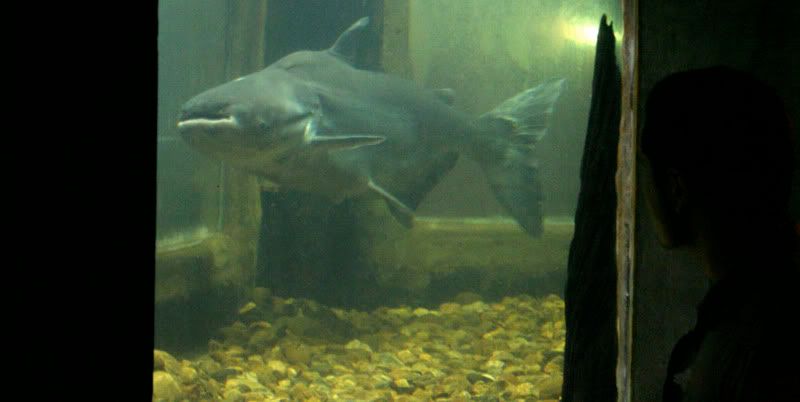
At last we found the waters of the Giant Catfish, at the far edge of the zoo. This corner seemed almost not to be in use anymore- fountains had run dry and cracked, and the pathways were overgrown with moss and creeping roots. We entered one dark rotunda, but found only small colorful fish, clustering in groups in the dim light of their tanks. Out the back door were only empty tanks, the concrete walls now stained with moss. Had the Giant Catfish once lived here? Was it gone? Down an unmarked path we found another door. Another tank with small fish- but also a path sloping down. It curved around two more aquariums, the fish growing stranger and more skittish in our presence. Down, around another bend in shivering florescent light. At last we reached a small lobby, unlit except for the green glow of the tank that curved around the u-shaped plot of tiles. Through the ripples of the clouded water, we saw an immense form moving slowly through the darkness. It seemed to glide effortlessly despite its heavy body, its eyes unblinking, the only sign of effort in the labored paddle of its tail. The Giant Mekong Catfish. It had been taken from its river, but it hadn't been stripped of its dignity or its grandeur. It had made this tank its new domain, obscured itself in darkness, and was slowly growing older and heavier in its own private kingdom.


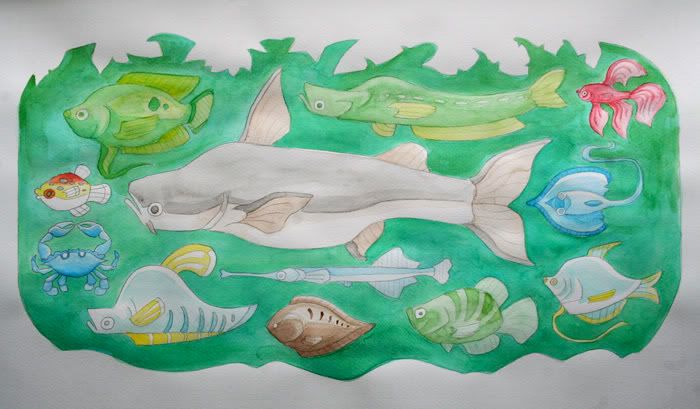 Fairly soon after I moved to Bangkok, I bought a set of watercolor paints with the idea to work on a few illustrations about the places and creatures that I encountered while exploring Southeast Asia. Finally, after living here for nearly ten months, I completed my first one. And whether it was having just finished reading 20,000 Leagues Under the Sea, or the influence of Jess Gonacha of Treasuring - this painting ended up being all about fish.
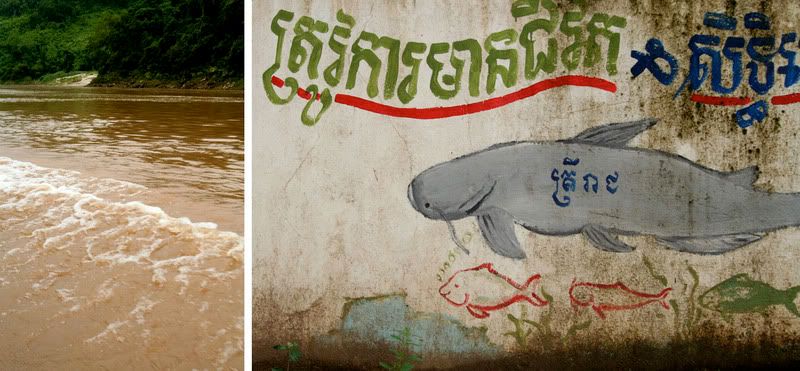 Tropical rivers have always held a fascination for me, and few regions are as defined by their waterways as Southeast Asia. There's the muddy, empire strewn Chao Phraya; the life giving Tonle Sap; and of course, the monstrous, epic Mekong. Part of what makes these waterways so mysterious is the strange creatures that it conceals.
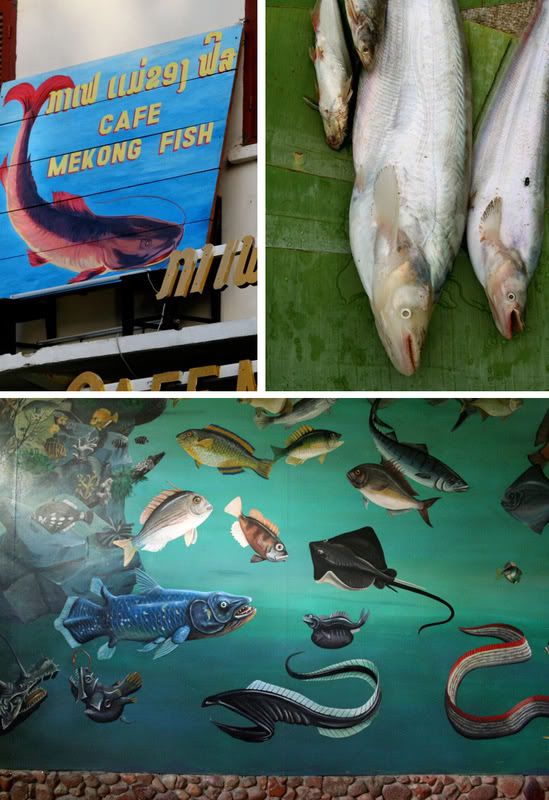 So, in simple stylized forms, I depicted some of my favorite aquatic creatures. In a style inspired by scientific murals (like the one at the Maputo Natural History Museum, pictured above) and the 'Freshwater Fish of Thailand' chart that I had in my classroom, I set them out to display their bizarre forms and shapes. The star of the piece is of course the star of the river itself, the Giant Mekong Catfish.