 I like jungles. A lot. Since I was young, I've had a thing for strange animals and dark and mysterious forests, and I used to dream of being able to travel among the forests of the equator. I've since learned a few things:
1) Animals are really pretty hard to see through all that greenery.
2) Most wild animals would really rather be left alone, not gawked at by tourists.
And, somewhat significantly-- 3) After a few trips to some of Asia's wild spaces, I've had to realize that I can really do without the usual trappings of a visit to the jungle-- getting heat stroke on long treks over leech infested trails, staying in run-down guesthouses with soggy mattresses, eating flavorless meals of instant noodles. Some people are into that stuff, which is cool, but it's really not for me. Which is why it's nice to find somewhere that offers a balance.
On our visit to Borneo, we were mainly looking to relax, but we couldn't go without a few days spent at the edge of the island's incredible rainforest. So we planned a stop in Sepilok, and a stay at Paganakan Dii. This small getaway is the work of a young local man from Sandakan, who recently returned from spending several years abroad. He's now brought a distinctly hip style to Sepilok with the opening of Paganakan Dii. We stayed in one of the bungalows, which are positioned at the edge of the hill, looking out over a lush forest. The cleverly designed bungalows have rolling doors for walls on two sides, so that the entire room can be opened up to the surrounding greenery.
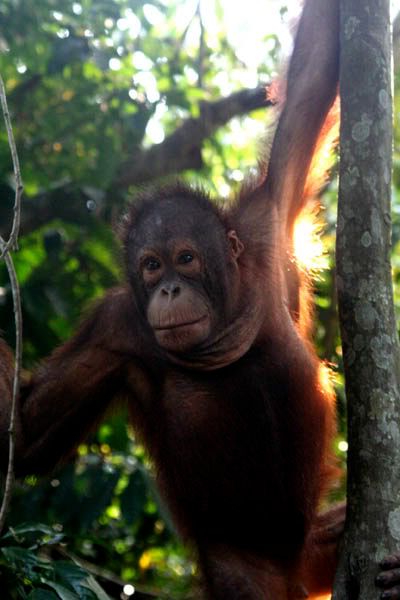
 It was an easy place to unwind, and we spent much of our time in Sepilok relaxing, though we did spend one key day out. The main draw for visitors to Sepilok is the Orangutan Rehabilitation Centre. It's run in part by Orangutan Appeal UK, which is really doing good work. The forest in Borneo is being cleared at an alarming rate, in part so that more palm oil plantations can be built. Borneo's wild animals, which include incredibly rare species like the orangutan and the Sumatran Rhino, are forced into ever smaller spaces. At the Rehabilitation Centre. This in effect does a few good things: it helps maintain the population of orangutans, it increases awareness, and it lets tourists see orangutans, while letting the ones that are in the wild remain undisturbed.
 A ticket to Sepilok allows for the visitor to see two feedings a day. As a tip, the feeding in the morning can get swarmed with tour groups-- in comparison, the afternoon feeding can be relatively quiet. Fruit is set out on platforms, and slowly the orangutans emerge for the forest, swinging in on ropes, to grab a meal. Many of them are young, so they're incredibly cute and playful-- sometimes too playful, as on our visit we were practically surrounded by a group of curious young apes.
 Between feedings, we wandered over to the Rainforest Discovery Centre, which offers several trails into the Sepilok Reserve. We took a short one, and wandered among towering trees, . Lucky hikers can see orangutans or hornbills-- we saw neither. The closest we got to wildlife was seeing a giant black squirrel asleep in a tree. Like the rest of our time at Sepilok, it might have only been a small glimpse into one of the wildest places on earth, but it was enjoyable getting that glimpse at any rate.
Especially enjoyable, I'll admit, in the knowledge that we had crisp white sheets and a functioning shower waiting for us afterwards.