Showing posts with label Islands of the South China Sea. Show all posts

Monday, September 13, 2010

A glimpse of paradise (good luck for Monday).


I should point out that due to a general slowness in posting, I am not currently in Bali as may be suggested-- I am back in Taiwan, currently working a 9 am to 9 pm schedule (only for four more days!). But I'll keep us on the island a little longer-- I thought maybe you and I could both use a shot of Bali green on this Monday to keep us going.

Enjoy.

Friday, September 10, 2010

Order the pig.


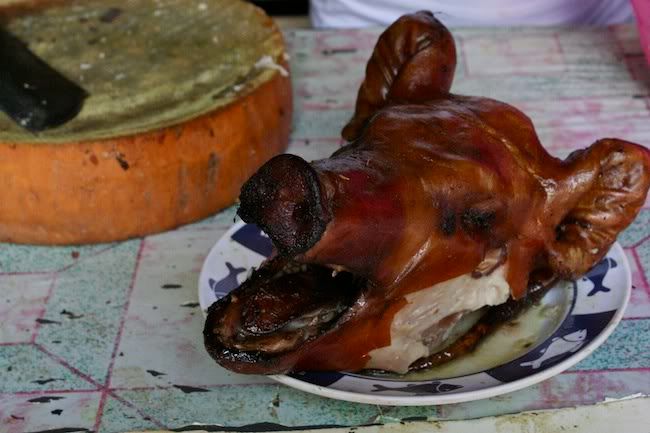
I couldn't decide whether seeing the pig's head pointed at me was actually appetizing or not, but at the very least I was intrigued. My eyes had originally been drawn to the neatly arranged rows of jars and bottles at this Bali market's stand, but the pig certainly was an attention grabber. So I stopped, and tried to find out more about it. The woman behind the counter greeted me, and showed me to a glass display case containing bowls of fresh salads. "Lawar babi", she explained to me; the words meant nothing to me then, I would have to look them up later. She pointed to the pig again, and then her own cheek, indicating that if I tried the lawar, I would be treated to some of the animal's face. I wasn't hungry, but I had to try it. She grabbed a paper cone, scooped in some rice, then spooned on some of the lawar. To complete the dish, she ripped shreds off the pig's head, and folded them up into the parcel.

I didn't open the package until later, when we were sitting, legs tucked under the tables at Ibu Oka. Specializing in Balinese suckling pig, babi guling (a heap of which is pictured top right), Ibu Oka is famous worldwide. We had just had our plates set before us: waxy brown paper holding small mountains of rice, topped with tender shreds of pork and crispy squares of skin and fat. The first bite explained and validated the restaurant's fame: the crunch of the skin released a melting burst of rich, luxuriant pork flavor. 

Mid-meal, I remembered the package from the market still in my bag. It might seem like over-kill to pull out the lawar babi at this point, but I decided that if I was already indulging this much, I might as well just give in. I pulled it out, unwrapped it, and put it on the table to share. Amazingly, and this may just have been the rush of fat to my brain, it outshone the meat we had been consuming. While the pork in the lawar was not as good as Ibu Oka's-- the skin didn't crackle as much, the fat wasn't as tender-- the rest of the dish compensated: young jackfruit, green beans, shrimp paste, and shredded makrut lime leaves gave it an intensely exotic flavor. 

But either way, market stand lawar babi or Ibu Oka babi guling, order the pig in Bali and you won't be disappointed.

Thursday, September 09, 2010

beautiful/grotesque.

While visiting the puras of Bali I was really struck by a feeling of balance. Yet while religious spaces may generally have an air of serenity, what makes these temples most striking is how that feeling comes from the drastic use of both the beautiful and the grotesque in the same site: a grimacing guardian may look over a pool of delicate lotuses. For while to my Catholic-school reared mind concepts like 'good and evil' exist in dichotomy, they cohabit in the Hindu traditions of Bali; creation and destruction are not discreet forces, and that which is the most terrifying can also be the most protective. And certainly, the beauty of these spaces would not have been as sharply illuminated without their equal use of the grotesque. 

Yet another product of my schooling I'm happy to leave by the roadside.

Sunday, September 05, 2010

culturedPRIMITIVE/stockist: Muji Hex Double-Ended Pens.


I love to travel and I love to sketch, but I've never been able to be the kind of traveller who sketches. I think that when I'm exploring a new place, I have an easier time pulling out my camera than pulling out a sketchbook and some pens. But I'm trying to change that. On this trip to Bali I packed a new sketchbook (in the hope that I would feel compelled to fill the clean white pages) and a variety of Muji's Hex Double-Ended Pens. With one end a felt-tip brush and the other a thin pen, I could vary my line without having to dig a different pen out of my bag. And with a variety of nuanced greens and bright tropical hues on offer, I was really able to capture some of my island surrounds.

Island of the gods.


Many people visit Bali just to do a little pura gazing, and understandably so; they're rewarded with some of the most spectacular Hindu temples in the world. Moreover, the beauty of many of these sacred sites are multiplied by the incredible natural environments that surround them, whether they are perched on the edge of a rice terrace, or hidden in a valley dripping with tropical plants. Perhaps the most spectacular was Ulun Danu (pictured above), which rests in a mist-enshrouded caldera lake in the island's breezy highlands.

Saturday, September 04, 2010

Bali Bamboo.


I loved the abundance of bamboo in Bali, where it was seen not just growing alongside rice paddies, but also as a material for architecture and design. It's such an incredible material; easily renewable and incredibly strong, but also beautiful in a very subtle way. The above shot is of a building under construction, and while the bamboo is just a temporary frame for building, I think it would be stunning if they could complete the house with the tangle of bamboo visible and intact. Who wouldn't want to live in their own personal bamboo grove?

Thursday, August 26, 2010

Bali Colors: heat and relief.

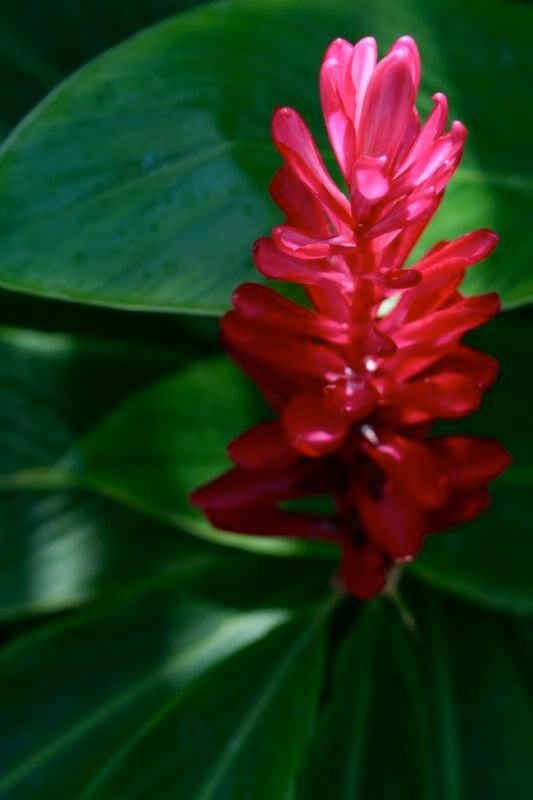
For my color series I usually isolate one color that defined a place for me, but the color scheme of Bali was a little too complex for that tactic. So much of the beauty of Bali was in its carefully balanced opposites; the good and evil in its religious epics, the beautiful and the grotesque in its temple architecture, the fire of a sambal and the cool bite of lime in its food. So in its colors too, it makes sense, there was a balance; between the heat of bursts of pink, orange and red, and the relief of deep green. 

Wednesday, August 25, 2010

Bali.


I have just returned from Bali, and I think I am still recovering from what an incredible destination it was. I had expected to like it, but not to love it-- and certainly, not to love it as much as I did. The idea of 'Bali' seemed like such a cliche that I was sure it would be one big tangle of resorts, or perhaps just feel like a letdown. But this island was full of surprises. Like the seemingly endless miles of brilliant green rice terraces, hemmed in by bamboo groves and coconut palms. And the grandeur of the temples, trimmed with ornate details and surrounded by lush gardens. Or how incredible mealtime was-- the fresh bite of lawar, the richness of suckling pig, the flavors of coffee, vanilla and palm sugar. Or how neatly the quiet threads of ritual seemed to run through Balinese daily life. The island not only surprised me with every day, but it also shook me out of my jaded state, and reminded me of what I love about Asia-- and made me thankful that I'm able to live here.

Monday, March 08, 2010

A market by the sea.

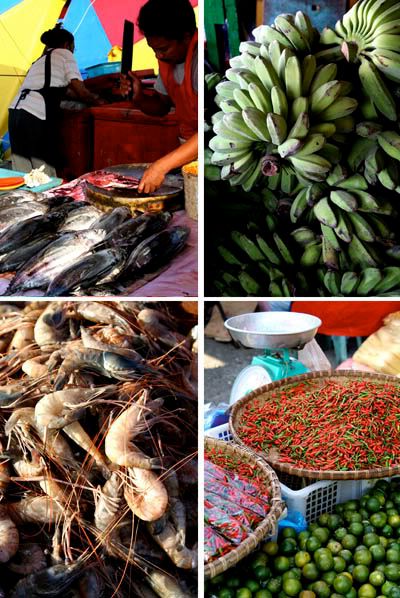
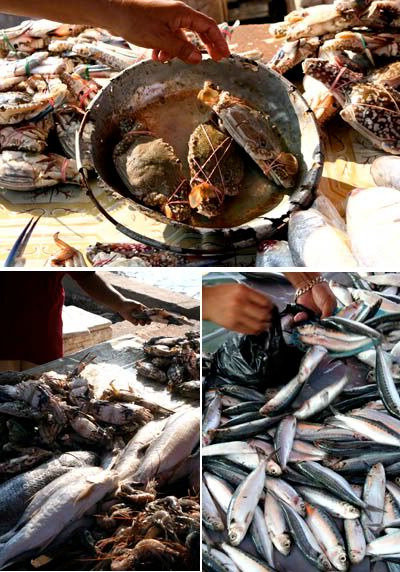
While much of KK can seem a little washed out, there is one spot to visit if you're seeking color. Right on Kota Kinabalu's waterfront sits the town market. Where in a few hours crowds of locals and tourists will be dining on fried noodles and grilled squid at Kota Kinabalu's night market, a gentle trade takes place as people wander among the stalls, picking up a few ingredients here and there.

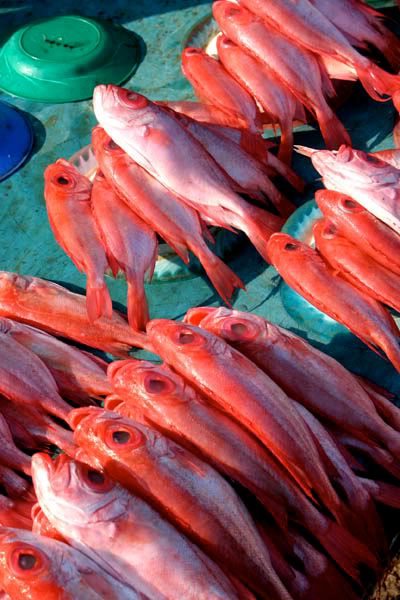
While some vendors sell fresh fruit, and others trade in lemongrass and chili, the big draw here is incredibly fresh seafood, pulled right off of boats as they pull up to land. There are fish, in orange, silver, and turqouise blue; piles of fat prawns; and beautiful crabs and lobsters, their claws held firm in rubberbands.

And if any of it looks tempting, remember to return in the evening for a dinner at the Filipino barbecue. Those same prawns could show up on your plate.

Saturday, March 06, 2010

A day on the plate in Kota Kinabalu.

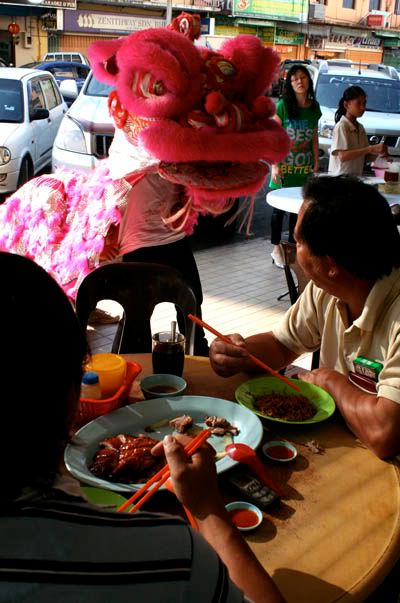
Despite the mystery and allure evoked by its name, something about Kota Kinabalu keeps it from being a particularly engaging city. It's a city of placid avenues and grid-like concrete buildings, too modern to be characterful, but just a little too worn to be graceful. But if there is one moment when the city may be redeemed, it's when its residents sit down to eat.
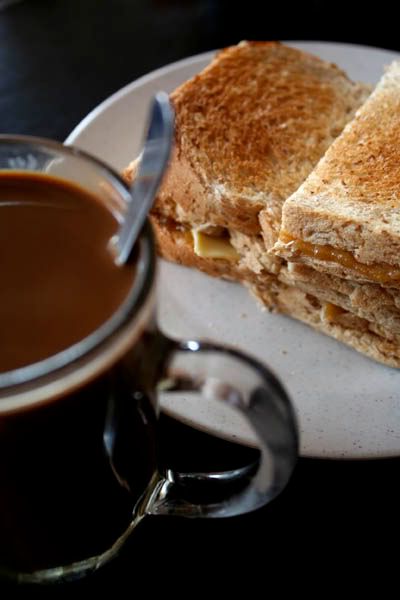
Many people take their meals under the swirling ceiling fans of kopitiam, Chinese style coffee shops. For breakfast, this is where to go for a warm, sticky glass of coffee, sweetened with condensed milk. If you're lucky, you'll also be able to find a plate of bread with kaya, a rich coconut jam.
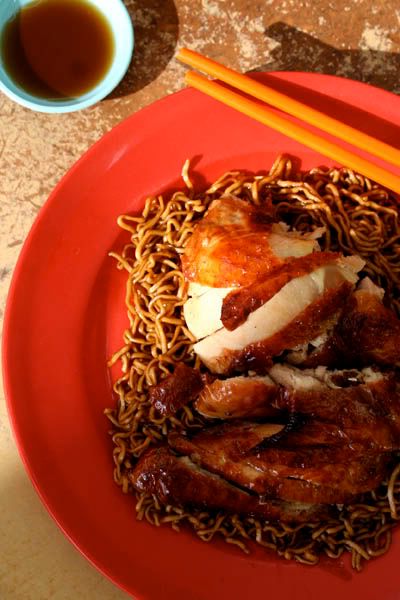
The kopitiam stay in business all day; you'll be able to swing by again for lunch. Items on the menu range from Chinese favorites, like char siew (barbecued pork), to Malay, like laksa (noodles in a coconut milk curry), to Straits specialities, like chicken-rice (poached chicken served with a delicate soup and a mildly garlicy bed of rice). Sometimes the most satisfying meal is the most straightforward, like the above mee ayam: a pile noodles (mee) that have been wok-fried in kejap manis (a dark, sweet soy sauce) are topped with cleaver-cut slabs of delicious crispy skinned chicken (ayam).
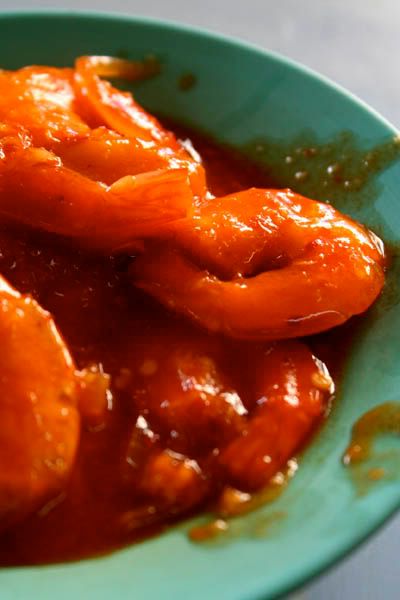
Elsewhere, Indian style restaurants sell a diverse range of curries, made with chicken, lamb, and vegetables, or even squid and shrimp. A few select shops serve their curry on a banana leaf; more often, a more humble presentation involves a plastic plate and a mound of rice. Look for the large griddles to identify a shop specializing in roti canai, unleavened bread served with small dishes of curry, or murtabak, a folded roti canai filled with meat or vegetables.
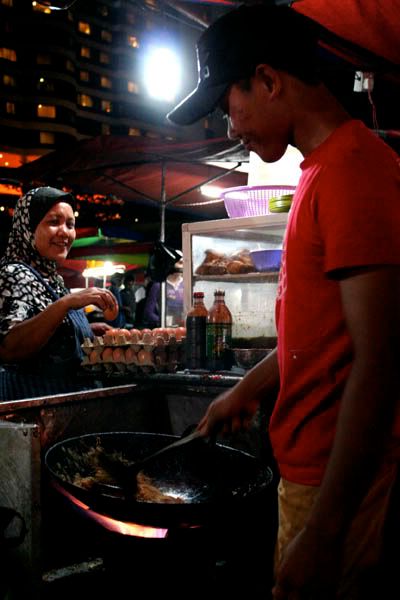
You'll still find the city's restaurants and kopitiam awake at night, but for a more lively dinner, head toward the night market on the waterfront. The stalls at the centre of the market seem oddly lacking in variety-- most sell fried rice, fried noodles, or soto, a spicy soup-- but you'll likely find a cheap, tasty meal at least. Around the periphery are dessert shops-- perfect for the sultry Borneo evenings are shops selling cendol, a pandan flavoured dessert served over ice with a dash of coconut milk.
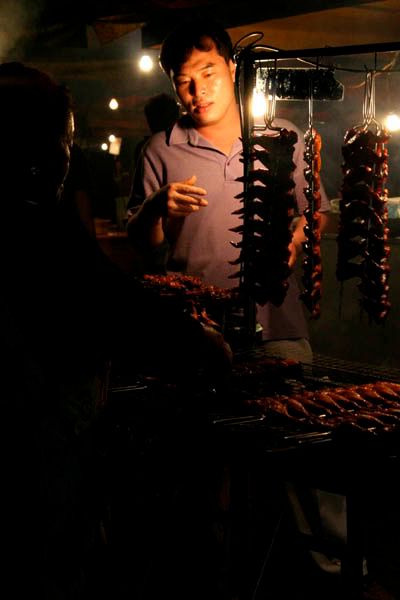
For a more unique dinner you'll need to penetrate the clouds of smoke toward the back of the market. There, you'll find yourself among the grills of the Filipino Barbecue, where vendors display dazzling piles of seafood-- massive prawns, formidible lobsters, and technicolor fish-- all available to be grilled and served with a dressing of chili. It's perhaps the cheapest spot to indulge in the incredible catch available off Borneo's coast.

To walk through the city at mealtime is to hear the sound of spoons scraping at woks and of roti being slapped onto the griddle, to see piles of gorgeous seafood, ducks hanging in shop windows, and trays of colorful curries. It's encountering the unique mix of cultures-- Chinese, Indian, Filipino and Malay-- and the contrasting geographies-- from the tropic seas to the fertile forests-- that make up KK. You might not always be able to see what's exciting about Kota Kinabalu, but at least you can taste it.