Showing posts with label Stockist. Show all posts
Sunday, September 05, 2010
culturedPRIMITIVE/stockist: Muji Hex Double-Ended Pens.
I love to travel and I love to sketch, but I've never been able to be the kind of traveller who sketches. I think that when I'm exploring a new place, I have an easier time pulling out my camera than pulling out a sketchbook and some pens. But I'm trying to change that. On this trip to Bali I packed a new sketchbook (in the hope that I would feel compelled to fill the clean white pages) and a variety of Muji's Hex Double-Ended Pens. With one end a felt-tip brush and the other a thin pen, I could vary my line without having to dig a different pen out of my bag. And with a variety of nuanced greens and bright tropical hues on offer, I was really able to capture some of my island surrounds.
Friday, November 20, 2009
culturedPRIMITIVE/stockist: Pinotage.
The global guide to stocking your pantry.
One of the pleasures of the Cape lifestyle is that wine is plentiful and affordable. However, while we very much enjoy a regular glass of wine at sundown, we're really not proper wine drinkers. We mostly buy bottles on whim rather than on research, we drink out of whatever glasses are at hand, and on the off chance we buy a bottle that isn't a screw-top, we pull the cork with a well-travelled swiss army knife. But maybe that's why we're so fond of pinotage.
Pinotage is a distinctly South African wine. Not only in its origins (it was first cultivated in Stellenbosch in the 1920s), but in its character as well-- this isn't a delicate wine. It has an earthy smoky flavour flecked with hints of tropical fruit. It's a full-bodied combination that makes it ideal for pairing with heavy meats, game, and spicy flavours. In other words, you can serve it at your braai, and it will actually complement your boerwors.
One of the pleasures of the Cape lifestyle is that wine is plentiful and affordable. However, while we very much enjoy a regular glass of wine at sundown, we're really not proper wine drinkers. We mostly buy bottles on whim rather than on research, we drink out of whatever glasses are at hand, and on the off chance we buy a bottle that isn't a screw-top, we pull the cork with a well-travelled swiss army knife. But maybe that's why we're so fond of pinotage.Pinotage is a distinctly South African wine. Not only in its origins (it was first cultivated in Stellenbosch in the 1920s), but in its character as well-- this isn't a delicate wine. It has an earthy smoky flavour flecked with hints of tropical fruit. It's a full-bodied combination that makes it ideal for pairing with heavy meats, game, and spicy flavours. In other words, you can serve it at your braai, and it will actually complement your boerwors.
Monday, November 02, 2009
culturedPRIMITIVE/stockist: Rooibos.
The global guide to stocking your pantry.
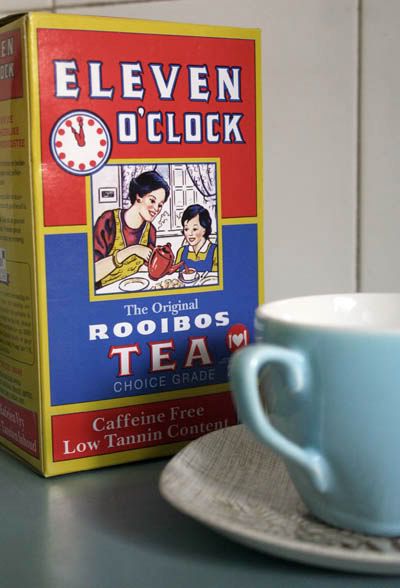
I am generally a coffee drinker, but I do occasionally take tea. In South Africa, that often takes the form of rooibos, a brewed beverage indigenous to the Western Cape. Rooibos is of course known outside of its country of origin; it is perhaps one of the few products with an Afrikaans name to successfully branch into the international market. That name, by the way, translates as 'red bush', an evocative descriptor of the rusty-earth colour the needles take once they have been oxidized. It is available in many brands, in organic loose-leaf or chai flavoured tea bags, and even in an espresso like form, but I rather favour Eleven O'Clock Rooibos for its no frills tea, and its attractively vintage graphics. Outside of South Africa rooibos is mainly sipped by the health crowd (it is high in anti-oxidants and caffeine free) and is generally taken black, but here in the Western Cape we take it in the proper South African way: with a little milk and honey, and preferably, a crunchy buttermilk beskuit on the side.
Subscribe to:
Posts (Atom)