Showing posts with label desert. Show all posts

Thursday, November 22, 2007

Thanksgiving among Bedouins.

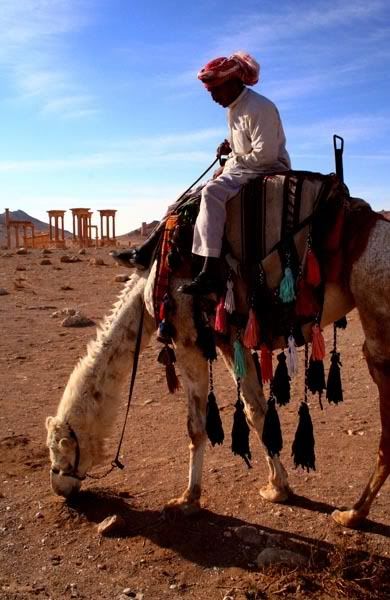
This year marks the third Thanksgiving that I have spent out of the Unites States. Last year I was in South Africa, and I barely noted the date as it passed by. The year previous, I was in Syria, halfway through a trip around the Middle East, and had a very memorable Thanksgiving in a desert oasis. I spent the evening having coffee with a small group of Bedouins, an all-white camel named Zenobia, and a mysterious German woman whose real name I never learned.
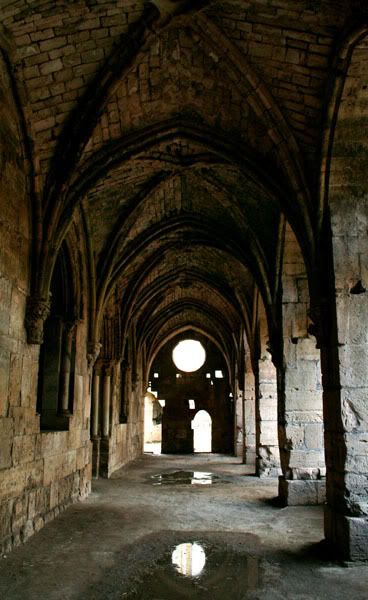
The day before, I had taken a minibus tour provided by my Hamas hotel out to see the Roman ruins of Afamia, and the crusader castle the Crac des Chevaliers. In the minibus with me there were several other guests from my hotel: two Danish men who were traveling together, an older Belgian man who was traveling alone, and a young German woman who introduced herself as Carmen.

"What do you do in Germany?" the Belgian man asked Carmen.

"I design blindfolds," she answered simply.

The ruins of Afamia were simple, but beautiful- as the early morning light filtered through the crowd cover, the columns stood strong in silhouette. We visited several small castles on the way to Crac des Chevaliers. Some looked tiny, their staunch bodies tightly fortified. Others had been used in the building of new towns, the old castle walls now providing sturdy foundations for modern housing.

Crac des Chevaliers itself was astounding, a massive complex of outer walls, inner sanctums, and a mix of Gothic and Romanesque details. Amazingly, we were the only people there; a small group of tourists in a vast and abandoned tourist site.

On the minibus ride back to Hamas, we discussed our onward travel plans. Carmen, the Danes and I were all planning on heading to Palmyra. The Belgian had already been.

"Palmyra is overrated," he stated dismissively.

"Oh, you would probably say that the pyramids are overrated," Carmen sighed.

"Yes- the pyramids are overrated," he responded.

Carmen leaned forward to my seat, and asked me how I was getting to Palmyra. "Perhaps we should travel together," she suggested.

Back at the hotel, we disbanded, Carmen and I setting up loose plans to meet in the morning. After dinner I returned to my hotel room; I switched on the tv, and found a channel showing English language programming. I settled in for an incongruous evening, watching Kindergarten Cop and revisiting the sights of the day in my head.
I woke up on Thanksgiving morning to find that Carmen had already departed, leaving me a note at reception. "I woke up early," it read, "but saw that the lights in your room were off, so I have gone ahead. Carmen."

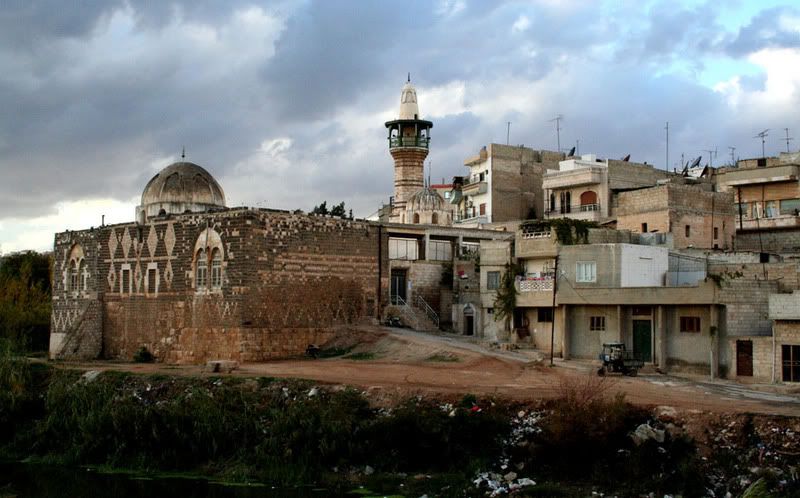
I caught a taxi to the bus station, and caught a minibus to the transport hub of Homs. There, I caught a cab to from one bus station to another, and located the bus heading toward Palmyra. The inside of the bus was heavily decorated, with elaborate drapes, plastic fruit, and small painted cherubs. Two young boys sat at the drivers side; while we waited for bus to fill up, they asked me where I was from, and imitated the sound of bomber jets upon hearing my response.

Leaving Homs, the landscape abruptly transitioned from scrubby forest into harsh desert, the pines and craggy rocks thinning out as the horizon became a razor-edge of burning red sand.
Upon arriving in Palmyra, I located a cheap hotel at the edge of the ruins. After a short rest on one of the twin beds, I headed out to look around. As I walked through the lobby, the clerk stopped me, and handed me a slip of paper. Confused, I unfolded it.

"Ah, so we are staying at the same hotel! If you wish to have coffee in a Bedouin tent, meet me at 9 o' clock in front of the Hotel Zenobia. Carmen."

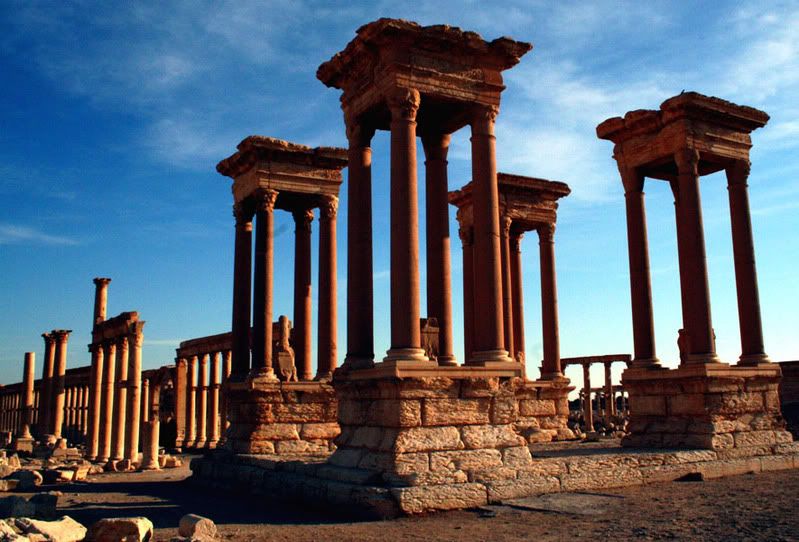
Palmyra, as it is called in English, is so named because it was founded at an oasis of Date Palms- also giving it its Arabic name, Tadmor, meaning place of dates. It was once the center of a vast trading network that stretched from China to Rome, and a cosmopolitan meeting place for disparate cultures.

Traveling in Syria gives one the sense of physically seeing the past, one layer piled upon another layer. Atop a distant hill sat a medieval castle, which looked down over the desert ruins below. The fragments of ancient Palmyra itself looked an odd cross of Egyptian and Roman- Western forms redone in a pale sandstone.

In the distance I saw two men talking; one was on foot, and the other sat astride a pure white camel. He approached me, and waved an arm to signal me hello. He introduced himself: he was Mahmoud, a Bedouin. He gave me his card, with his photo, cellphone, and fax. He offered his tours, and a homestay at his camp. I took the card, and told him that I would consider it for tomorrow, that I wasn't sure if I would stay in Palmyra for a second day.
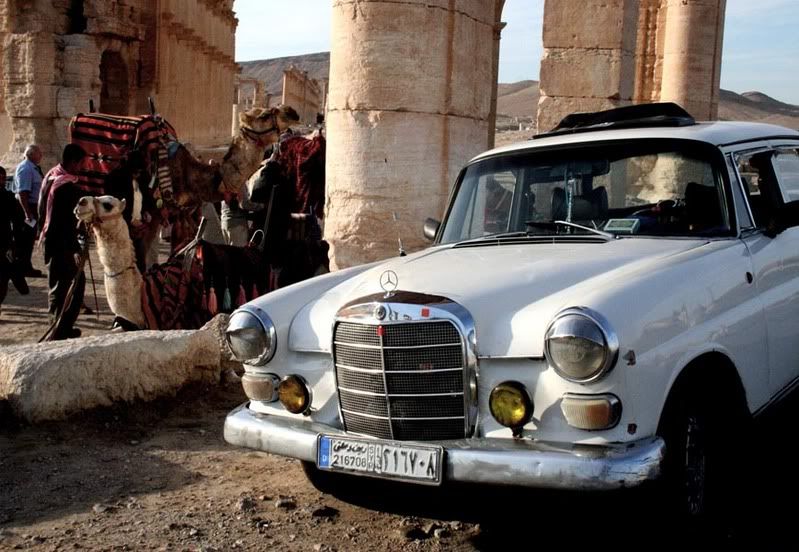
I felt obliged to stay among the ruins until sunset, so I found an isolated spot and fixed my gaze on a distant pair of tombs. Nestled at the base of a hill, the two towers both had an unusual sloping form that made them look even more unreal than their setting already did.

Heading back into town, I looked around the main tourist drag for dinner, but found only empty dives decorated in Bedouin kitsch. Scanning them, I wondered which Bedouin tent Carmen wanted us to have coffee in. Each tourist diner had one, hoping to lure in visitors with their exotic florescent charm. Finding little that appealed to me, I bought a bag of dates, and headed back to my hotel room.
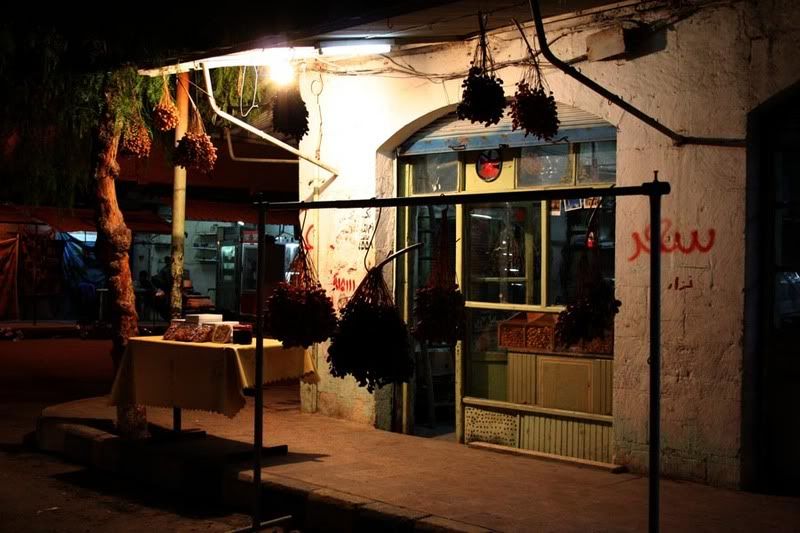
A few minutes before 9, I left my room and walked out to the Hotel Zenobia. It was so dark that all I could see was the faint silhouette of the ruins against the distant mountains.

I was wondering whether I should look inside the hotel when I saw her approaching, her bulbous down jacket looking so uneven on her thin legs.

Upon arriving, she explained to me that she had met a Bedouin man who had invited her for coffee, and she hadn't wanted to go alone.

"How did you know that I was staying in the same hotel as you?" I asked her as we waited.

She smiled coyly. "Haven't you ever heard of a woman's intuition?" She paused, and scanned the starry sky. "I saw your passport behind the front desk."

A motorbike puttered up the road, and into the drive. A handsome man with dark eyes stepped off the back, and the driver u-turned and headed back the way he came.

As he came nearer, I realized that it was Mahmoud- the man who had given me his card that afternoon. "Ah, Susan," the man said. She shot a look at me. "I'm glad you came."

We followed him through the darkened ruins back to his camp. Fragments of temples and shards of broken columns appeared out of the blackness, taking form as we grew near, and disappearing again as we walked further.

At his camp, we found three other men waiting for around a fire. Before taking us to join them, Mahmoud introduced us to his camels. He proudly introduced us to Zenobia, the white camel that I had seen him on earlier.

"She is a very special camel," Mahmoud told us. "My favorite. Very special to me."

"Because she's so beautiful?" I asked.

"Because she is so smart," he said, patting her on the neck.

The other men had prepared coffee for our arrival, and poured us each a cup as they warmly invited us to sit. The night air was already crisp, and the hot cup warmed my hands quickly. The coffee was thick, coarse and delicious, richly spiced with cardamom. From a distance, Zenobia and the other camels watched over our conversation.

"What do you do in Germany, Susan?" Mahmoud asked Carmen.

"I test drive speed boats," she answered simply.

Mahmoud impressed us with his language skills, offering phrases in German, Italian, Spanish, and French. He explained that while he had settled at Palmyra in order to make money off of the tourist trade, his parents were true Bedouins, who lived as nomads in the desert.

The evening grew late as we talked, and Carmen eventually indicated that we should head back to the hotel. We talked little as crossed the ruins again. She asked me my age, and raised her eyebrows exaggeratedly when I told her. "I could never have done what you're doing when I was your age," she said. She said that she was planning on staying in Palmyra another day. She wanted to see some of the further ruins, and perhaps to spend a night out in Mahmoud's camp. "Perhaps I'll see you around tomorrow," she said as we parted in the hotel hallway.

The next morning, I woke early and caught a bus heading toward Lebanon, leaving no notes behind.

Wednesday, October 17, 2007

The Incident at Organ Pipe.

On our roadtrip through the American West, Bordeaux and I spent one night in Organ Pipe National Park. It's in a desolate corner of southern Arizona, almost to the border with Mexico. After looking around, we set up camp, and prepared dinner as the sun rapidly disappeared. Once the light had receded over the surrounding hills, darkness enveloped us, and the air quickly grew cold. During the day, every inch of Organ Pipe had felt alive. But in the total darkness of night, with just the sound of kangaroo rats scratching over the sand, we could truly feel our isolation.

I've always found deserts to be beautiful. Part of what makes them so intriguing, however, is that they have an aura of the forbidding. Their barren appearance suggests loneliness, the landscape of the abandoned and forsaken. At night, they only get more eerie. Surrounded by the towering shadows of saguaro, it seemed the proper theatre for some old-fashioned spiritualist photography. We created our own ghosts, the camera becoming the instrument for a desert séance.

Friday, May 25, 2007

Monuments of the Four-Corners.

Roadtrip, Part 3
From the quiet, unusual beauty of the desert, Bordeaux and I traveled to the monumental wonders of the Four Corners.
The sky became dark as we approached Sedona, and it was raining by the time we found a place to have lunch. Outside, the red cliffs and pinnacles were alternately drowned in shade and caught in pools of light as the storm moved overhead. When the rain cleared we walked around town, which, as it turns out, is extremely tacky. Bordeaux and I wandered around town, and wondered what the correlation is between New Age culture and a lack of taste.
Bordeaux and I arrived at the Grand Canyon that evening, escaping a second storm. We set up camp, made dinner, and went to sleep without seeing the canyon. The next morning, we took the shuttle to the ridge. The Grand Canyon is always an odd sight to visit, since it's image is so common in books and magazines. It's still an incredible sight, but it's hard for it to be really outstanding, since it always has an element of familiarity. Still, I like the Grand Canyon- especially since the place has kind of a '50s family vacation feel.
I'd seen the Grand Canyon from the rim several times, but on this visit Bordeaux and I decided to hike down into it. We had hoped to sleep in the canyon for one night, setting up camp at Indian Garden, but found that they had given out all the backcountry camping passes already. We settled instead on simply taking a morning hike down Bright Angel Trail- about 3 miles down and back. On the way to Bright Angel Trail we passed the mule pen. I hadn't realized how many people came to the Grand Canyon to ride mules- the appeal of which is lost on me. I was fairly fascinated by the crowds of middle-aged men and women, dressed in cowboy hats and bandanas, that waited for their turn for a mule ride. We passed the mules throughout our hike. Aside from the mess they made of the trail, the mule trains were fun to watch- giant obese men in cowboy hats, and dozing off old ladies propped up on the sadly plodding animals.
Bordeaux and I camped, but we still found time to check out the Grand Canyon Lodges. I think my favorite is the Bright Angel Lodge- it's not as dramatic and grandiose as the El Tovar (which was modeled on European hunting lodges), but it has a funny 1930s Western theming that makes it much more charming. It has a soda fountain, a log-cabin giftshop, and a dark bar with smoke-stained murals of a Native American Pueblo. On our last night Bordeaux and I had drinks on the patio at El Tovar, and watched the sun set over the canyon.
Just outside of the park, we stopped at Chief Yellow Horse, an over the top souvenir stand. The exterior, with massive signs, and a giant boat-car (painted in the same yellow house paint as the signs), was far more interesting than the interior, which was filled with dusty turquoise and postcards. Leaving Chief Yellow Horse without purchase (which would have been hard if we ahd wanted anything, since the place seemed deserted), we continued on our way to Utah. As Bordeaux and I had noticed throughout our trip, if you drive for 30 minutes in the Southwest, the landscape will change dramatically. From the dry woody Grand Canyon, we passed into scrubby grassland, punctuated by strange mesas and multi-colored rock formations.
Just past the Utah border, Bordeaux and I entered Monument Valley. Compared to the Grand Canyon, Monument Valley has a strange sense of remoteness. It's not an unfamiliar place, as its dramatic buttes are featured in all sorts of adverts and movies. However, despite its use in the media as an icon for the West, not many people think to visit Monument Valley. There are no hotels nearby, and not many restaurants, making it seem like a distant outpost, even with the Dutch and French tourists milling around.
When I last visited Monument Valley, the scene was of a rugged desert landscape. Red buttes rising out of dusty red earth. But due to the recent rains, Monument Valley was in bloom this time. Green shrubs, purple flowers, and white yucca blossoms sprouted from the soil, giving the area the softer, less barren look of a grassland. Bordeaux and I made the driving circuit of the park- through a herd of skittish goats, under massive red clay walls, and to a windswept stand selling dream catchers. Completing the circuit, Bordeaux and I decided not to camp at Monument Valley- we'd seen the park, and the constant film of red dust was getting annoying. Instead, we continued to Southern Colorardo.
I have been to Southern Colorado many times, but I never realized how beautiful it is. There was still a fair amount of snow on the mountains, which contrasted with the lush green fields that skirted the highway around us. With the rolling forested hills, dramatic snowy purple peaks, and rushing frosty rivers, the scene looked perfectly American, like an ad for a pickup truck or a domestic beer.In the morning we backtracked a little to Mesa Verde, which sits almost right on the four corners. The park offices were designed in a pueblo-modern style, and contained such novelties as a taxidermy cougar and a practice-tunnel to prepare visitors for exploring the ruins. Bordeaux and I bought tickets to tour Cliff Palace, which is the biggest ruin site, and does not contain any tunnels. We drove out through burned forest to the site, and waited for the tour to start. Our tour guide was a scholar on Native American history, who seemed somewhat resigned to the jokey tour he recited.
We spent two nights at a cabin in Pagosa, Co, though we spent more time out in Durango, where New-Age devotees mixed with drunken college students. We passed through Pagosa proper as we left town, and decided to stop at the Malt Shoppe. The place was crowded, the orange formica booths full, so we got our malts to go and continued on the road.
Once again the landscape changed, flattening out into grassland. We had our second large wildlife setting an hour outside of Pagosa- a herd of bison. They were farmed bison, but beautiful none the less. As we approached Great Sand Dunes, we realized that we were heading into a storm. Caught in a sliver of light from between the dark clouds, the sand dunes themselves looked particularly strange: peaked golden hills, glowing in front of the dark, distant mountains.
I had expected the Great Sand Dunes to look something more like Namibia, but the setting was far stranger. The sand dunes were high but fairly sloping, rising from beyond a shallow stream. Just beyond them were a crest of snowy mountains, preventing any sense of being in a Saharan desert. We walked along the stream, our shoes making shallow grooves in the wet earth that filled up with water as soon as we raised our feet.

Monday, May 21, 2007

In Barren Lands.

Roadtrip, Part 1
Roy's Motel & Cafe, Amboy, CA

After picking up breakfast and coffee at Larchmont Farmer's Market, Bordeaux and I headed out of Los Angeles. Packed with all of our belongings into my Civic, we drove out of town on the 10, through exotic areas of LA that Bordeaux had never gotten to see. Eventually the urban thicket thinned out, giving way to the dusty suburbs and characterless shopping malls of the Inland Empire. We passed through towns where mid-level chain restaurants clustered against the highway; watching as Benihana and The Elephant Bar were replaced by obscure steakhouses with names like Beef and Beer and Cask and Cleaver. Eventually the city fell away completely, flickering out in sudden outlet shopping malls and fastfood drive-thrus as groves of joshua trees replaced houses. After stopping briefly in the town of Baker to pick water (and to stare up at the World's Tallest Thermometer), we continued on our way. We crossed over a sandy ridge, and exited from the desert wasteland of interior California...

...into the neon wasteland of Las Vegas, Nevada. I had tried to prepare Bordeaux for Las Vegas, but how could I? The lights were far brighter, the casinos much nosier, the cocktail waitresses far more haggard, and the people far more obese than I possibly could have put into words. We traveled to downtown Las Vegas, where we met up with friends who were enjoying cheap drinks and mingling with tattooed showgirls. Despite the alleged "revival" of Downtown Las Vegas, Fremont Street still had a sad pall of desperation. The casinos looked rundown, the showgirls even more so; a large screen flashed images of naked women, concealed with cartoon explosions featuring incongruous interjections, like "yikes!" and "gabzooks!" After losing three dollars playing blackjack at the Golden Nugget, we checked into our room at the Flamingo. The first hotel opened on the strip, and formerly the most expensive hotel in the world, the Flamingo is one of the last symbols of old-Vegas glitz still in operation. With its Miami-deco styling, palm-leafed tropical theming, and elderly clientele, the hotel has the feel of a retirement home loaded with slot machines. We passed our 24-hours in Vegas by trekking between casinos, playing nickel slots (through which I lost another three dollars, and Bordeaux won five), and searching out free drinks.

After stealing souvenirs from the Luxor's Pharoah's Pheast buffet, we refilled the gas tank and got out of town. Driving away from the noise of Las Vegas, we turned south from the 15, and entered the painfully quiet Mojave reserve. The Mojave was a stark landscape of sand, rock and joshua trees, interrupted by the occasional splintering ruin. As cotton-tails darted away from us, we walked around an abandoned corral, wondering why the ground was strewn with dirtied ladies' summer-wear.

Just out of the Mojave, we pulled into a service station in Amboy. Less a town than a series of abandoned businesses, Amboy offered a diner (non-functional), a motel (abandonded), a school (in ruins), a church (in disrepair) and a post-office (closed). We walked into the service station, and picked two bottles of water (Amboy Water, with self-printed labels) out of the fridge. Unsure of whether to just leave the money on the counter, we waited until the owner, a scrawny man with an untamed beard, arrived in his golf cart. He came with two small dogs; one of them immediately hopped up on the lunch counter, and reclined, panting, on the cool formica.