Showing posts with label Found Images. Show all posts

Tuesday, June 29, 2010

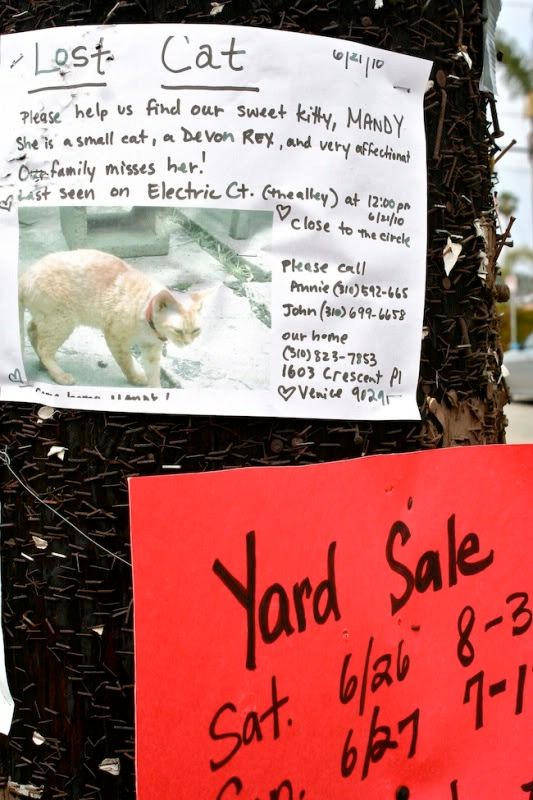
Missing.

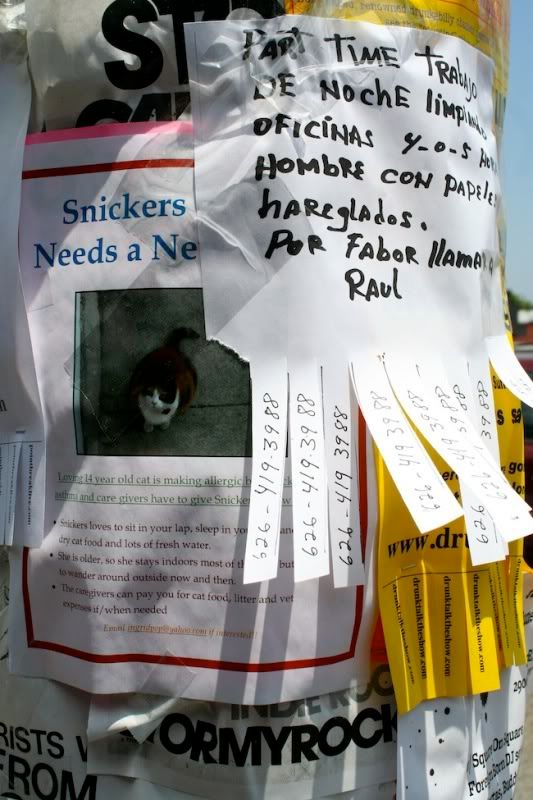
Taking a moment to read posted signs, ads, and leaflets can be one of the quickest ways to connect with the soul of a city.

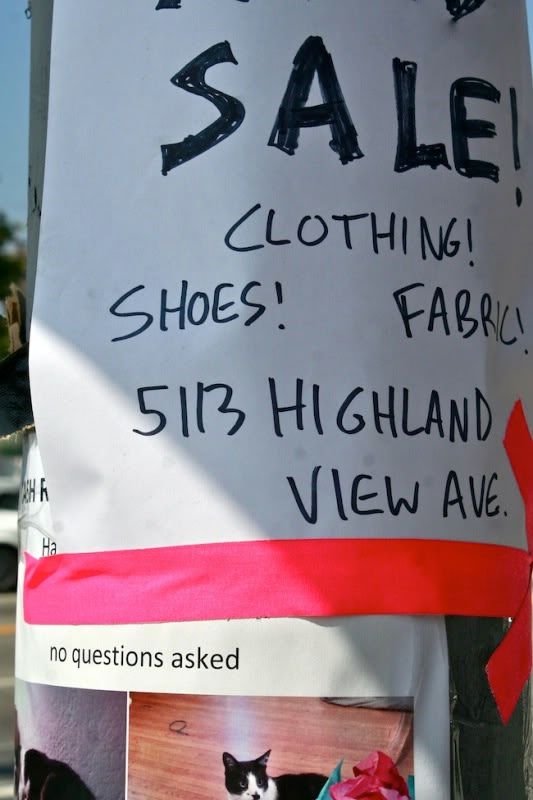
It gives you an instant tap into the triumphs and heartbreaks of its residents. We're having an art show. Our cat is missing. We're economizing-- come buy the stuff we can't afford to keep.

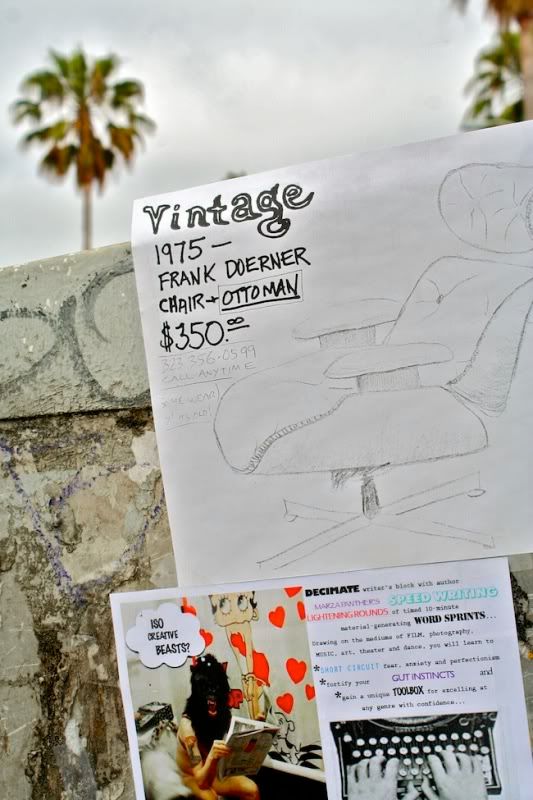
Abbot Kinney in Venice may be one of the few places I can imagine seeing a $350 chair being advertised on a hand-drawn flyer.


Come home, Whiskers. No questions asked.

Friday, May 14, 2010

SF signs.

I'm always a fan of vintage typographies and design, so in San Francisco my eyes were often trained upwards-- to take in all of the funky signs. Even the dry cleaners seemed to have great signs! These were a few of the favorites I spotted.

Friday, May 07, 2010

Murals of the Mission.

Over our week in San Francisco, we seemed to find a daily excuse to head back toward the Mission. Sometimes it was to pick up pastries or donuts, other times in search of a delicious local lunch, but mainly it was just to enjoy the atmosphere of the neighborhood. The murals for which the mission are so well known seem to seem up the Mission's diverse nature, their edgy illustrative styles reflecting both hip pop imagery and the neighborhood's heavily Latino culture. Many of the best murals are hidden in discreet alleys, on garage doors and the backs of shops, making for a perfect stroll after grabbing a lemon thyme donut.


Friday, November 06, 2009

Early views of Table Mountain.

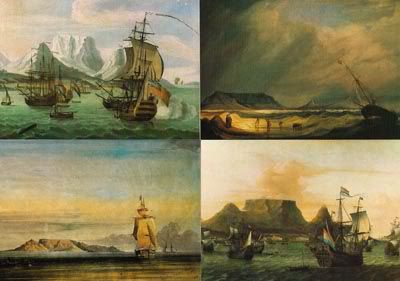
I am obviously not the first person to develop a fascination with capturing views of Cape Town's neighborly mountains. On Monday we took a visit to the Castle of Good Hope, a fort built by the Dutch East India Company in the early days of settling the Cape, where we found a fantastic collection of early paintings of Table Mountain. I love images created in the early days of exploration-- they're always such an interesting mix of science and fantasy. Comparing them gave a real sense not only of the history of the Cape, but of changes in how artists depicted the natural world. Here are a few of my favourites. (I've included a recent photograph of the mountain at the bottom, labeled for convenience. You may have to click to make it larger, unless you have super sharp eyes).
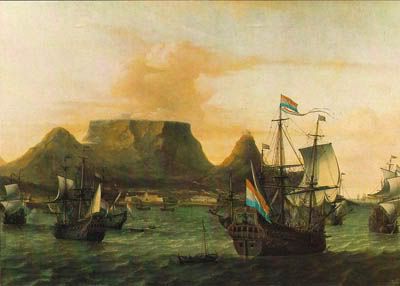
This rather early one was done by Aernout Smit, in 1683. It is a little odd for me to picture Table Bay swarming with galleons (they would later be replaced by whaling ships, later on by massive tankers of international trade). Though Lion's Head is looking a little bulbous, on the whole the city is depicted rather well. If you look closely, you can see how little of the city was developed-- just a few forts and buildings near the shoreline.

This one was painted about 50 years later, in 1730, by Samuel Scott, who I suspect may never have visited Cape Town. Not only is Lion Head here transformed into a steep pinnacle, and Devil's Peak is given a sloping hillside that fills up the whole of the city bowl, but the whole mountain is for some reason carved of a blue-white stone. It almost looks like some sort of antarctic glacier. A Table Mountain ice sculpture? Looking at this painting, one can really get a sense of what a strange and fantastical place the Cape must have seemed to people in Europe-- a settlement on a distant corner of Africa, in the far Southern reaches of the known world.
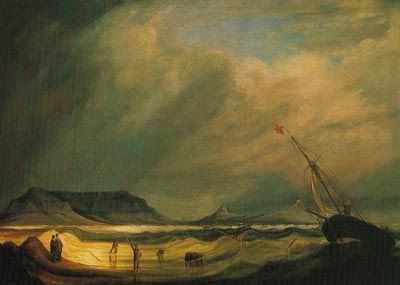
This painting by William Syme, done in 1850, uses light and shadow quite evocatively. The scale of the humans are miniscule, just a fleck of paint compared to the churning sea, the distant afloof mountains, and the broken, cloudy sky.
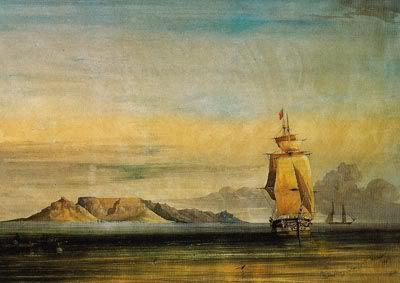
While I like the moodiness of Syme's painting, this view, painted by Thomas William Bowler in 1857, might be my favourite. I love how well he used simple, flat shapes to depict the different peaks of Table Mountain. Lion's head is particularly effective as just a dark shadow.

And here's my own view, photographed in 2006. A little less glamorous without all the wooden ships? If you click on the photo to make it bigger, and look very very closely to the right of Devil's Peak, you'll even see the three towers of Disa Park-- which look no less alluring to me from this angle.

Thursday, January 15, 2009

Sugar cane.

Even though we've left Asia, we thankfully haven't left the food behind. Just after we got back to the US, we attended a Thai cooking demonstration at an Asian grocery store in Albuquerque. We've had good luck with local Vietnamese restaurants (though not Thai), and we've been experimenting in the kitchen, on meals like kaeng massman, green mango salad with crispy catfish, and canh chua. We even started the year by making a New Year's Eve feast of Cambodian catfish sandwiches, banana flower salad, and grilled beef salad rolls (the vodka fizzes Bordeaux mixed to drink and the glazed bananas and cinnamon ice cream my sister served for dessert weren't strictly Asian, but paired nicely). The past year and a half were spent mainly trying new dishes and experimenting with unfamiliar flavors; this next year will hopefully be about making some of those flavors our own.

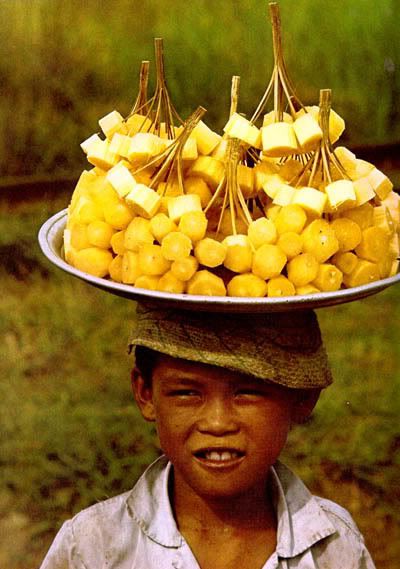
On the side, we've been pursuing some other food interests. I've been doing a lot more food-reading, and have been studying a diverse selection of cookbooks (including the Time Life volume on Southeast Asia, from which the above photograph was lifted). I've been enjoying breakfast, from simple bowls of muesli and fresh berries to decadent almond french toast. We've also been experimenting in baking: last weekend was a two-layer cinnamon and chile cake, this weekend will be homemade donuts.

What are you enjoying eating lately?

Wednesday, July 09, 2008

Tuesday, May 13, 2008

River monsters of the Bayon.

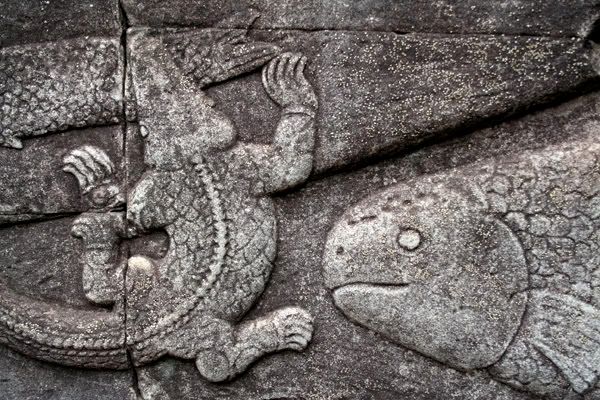
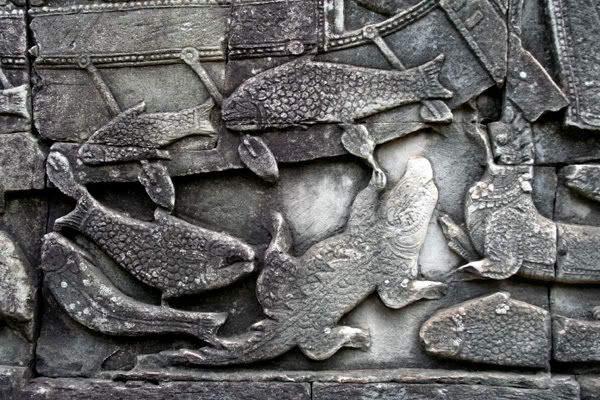
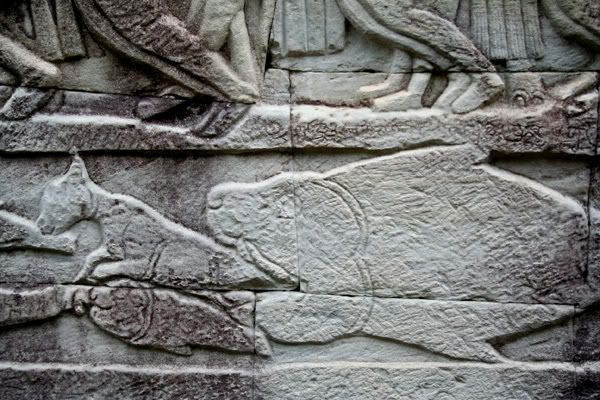
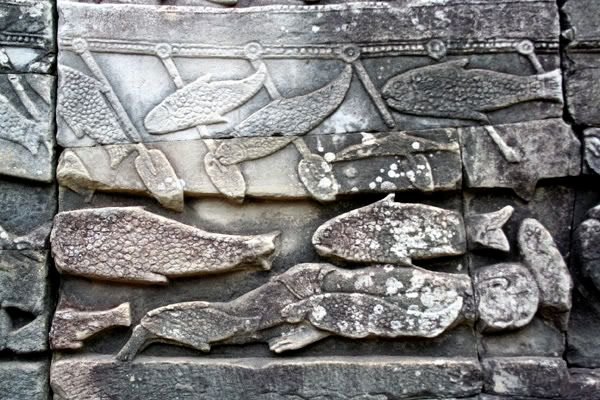
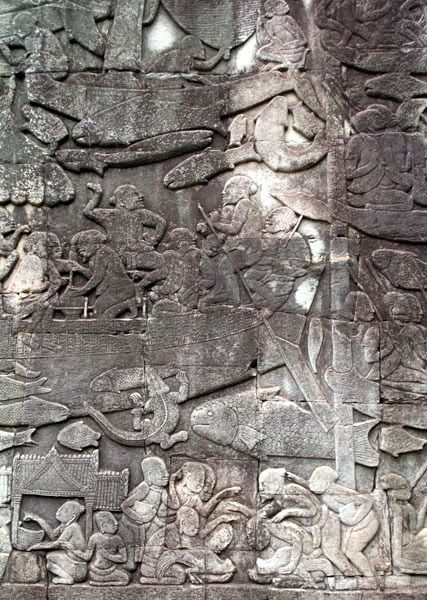
The bas-reliefs that line the outer walls of Angkor's Bayon depict scenes from life under the Khmer empire. Many of the stories are of historical battles, of Khmer soldiers in combat against Cham armies. Other scenes are of everyday life: citizens gather at the market, men watch a cockfight, women groom their friends' hair. There are also some more unusual scenes tucked between the chatting old ladies and the armored elephants: an old man climbs a tree to hide from a hungry tiger; a parade of unusual circus animals march through town. This empire of stone is watched over by a host of river dwellers: lazy crocodiles and giant fish that seem to observe the procession of human history with only a passing interest.

Some of these creatures seem truly monstrous, like the crocodiles that wait for the victims of war...

... or the fish that swallowed a deer.

But in most cases, they seem merely indifferent to the lives of the humans around them.

Tuesday, December 18, 2007

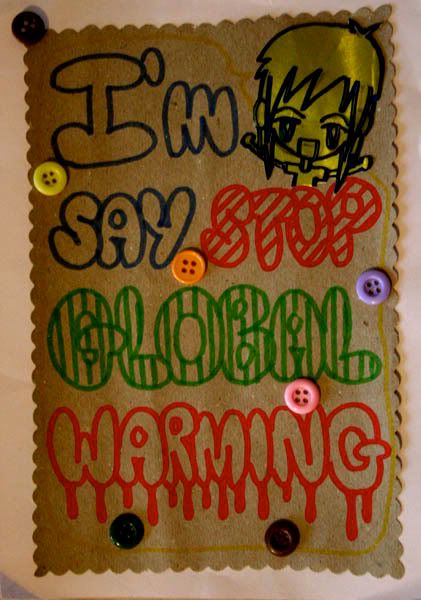
I'm say stop global warming.

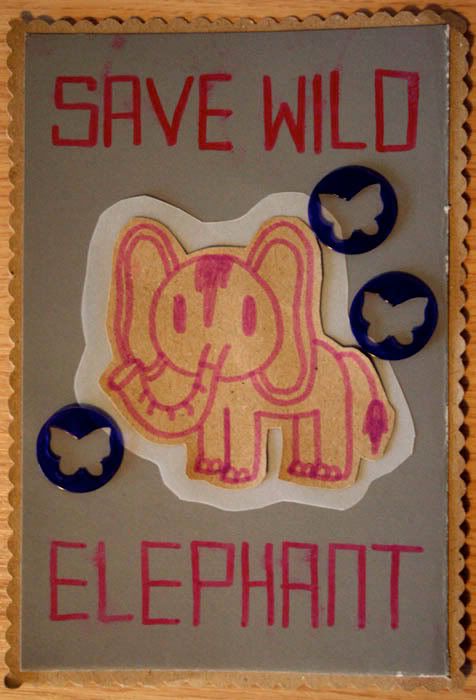
Last week, I picked up three handmade postcards being sold by the students of my school. Apparently designed to promote several environmental messages, they had a charmingly simple, graphic style. The first was a cute drawing of an elephant, accented with plastic butterflies.

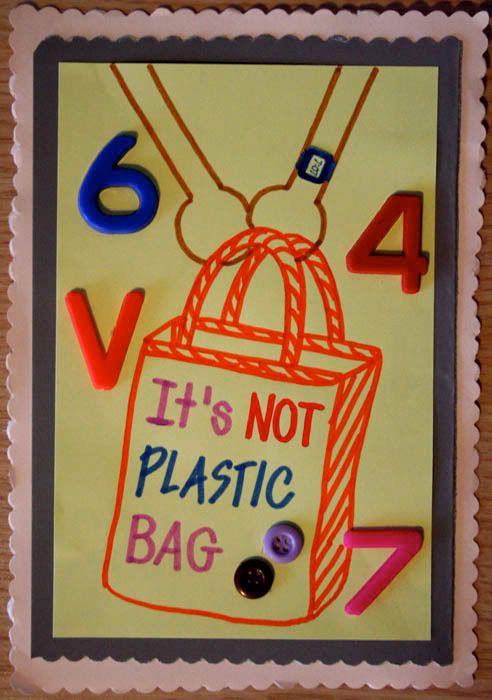
The second was a sweet misquoting of the "I am not a plastic bag" purse, which is currently one of the hottest knock-off bag designs in Bangkok.

And this one, of course, had obvious appeal.

Sunday, December 16, 2007

Painted Stork.

Back in July, Bordeaux and I visited the Chiang Mai zoo, mainly so that I could see the beautiful Mekong Giant Catfish. While there were a few odd elements- a confusing layout and an abundance of concrete trees- it was a rather impressive zoo, with a wide range of animals scattered throughout the beautifully landscaped forest. One of the most intriguing aspects of the zoo was the use of hand-painted signs to identify animals. With their bold colors and dramatic lettering, they made even the penguins look like stars in an action movie.

Wednesday, August 01, 2007

Cambodian Signs.

Aside from the crumbling relics of French colonial architecture, one of the most attractive elements of Cambodian streets are the abundance of hand painted signs. They advertise sewing services, appliances, and hair salons. The images seem to be taken from specific photographs; I'd often see the same woman's face on multiple signs, with only the color of the dress or the details of the hair changed.
Not all hand painted signs are used for advertising. Some of the most intriguing are those with a social message. Hand painted billboards warn against the dangers of drugs, speeding, and landmines. I'm not sure of the exact meaning of this somewhat mysterious one below, which seems to caution against the dangers of women.