Showing posts with label Vietnamese Food and Coffee. Show all posts

Tuesday, May 04, 2010

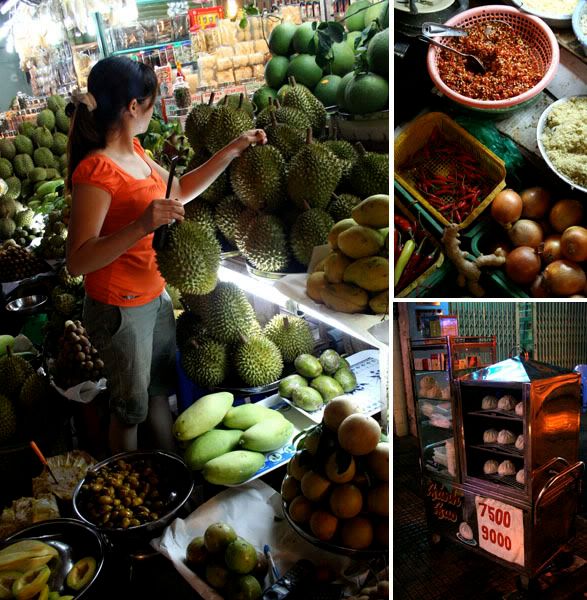
3 Binh My in SF.

One of the most surprising details about San Francisco for me was the way in which binh my, Vietnamese baguette sandwiches, have practically been adopted as a bay area specialty. We saw them sold everywhere and eaten by everyone, from non-descript downtown kiosks catering to local office workers, to the menus of trendy cafes and restaurants, to hole-in-the-wall Tenderloin shops where the queues were startlingly diverse. I love binh my, and likely could have eaten one every day, had I not forced a little restraint upon myself. But as it was, I was able to sample three different binh my, from radically different sources and in quite different forms.

I hate to say it, but the binh my I ate from Saigon to Hanoi might have made me rather particular. While each of the ones I tried in SF were great, I never found a perfect one-- though they came close. Any suggestions on where to try next time?

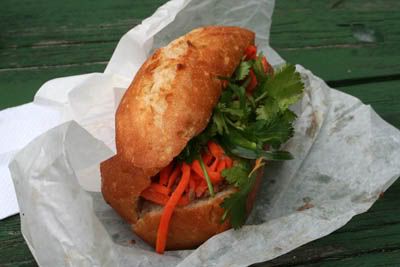
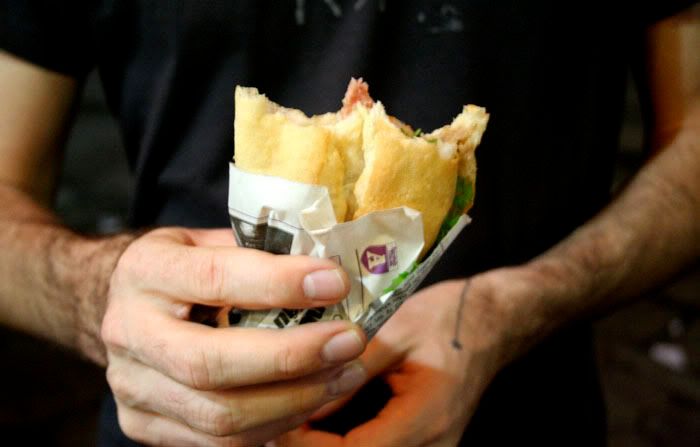
1. Binh My Pate, from Saigon Sandwich (pictured at top)
We swung by Saigon Sandwich to pick up binh my awhile before lunch-time, but even so there was already a line out the door when we arrived. And after unwrapping my sandwich and taking a bite, I could see why. The sandwiches had a great mix of salty, savory and spicy, with big slices of chili and a generous handful of cilantro. The only problem was the pate flavor, which had too much of a liverwurst flavor, which overpowered a little toward the end. Perhaps I should have ordered the combination pate and cold meats, for a more balanced taste.

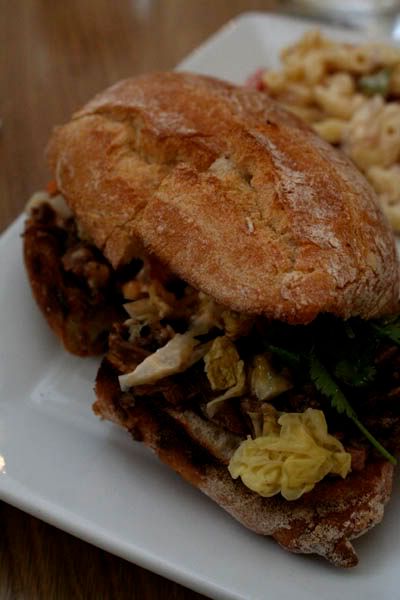
2. BBQ Brisket Binh My, at Wexler's

When I saw the BBQ Brisket Binh My listed among the items on the US South-inspired menu at Wexler's, I knew I had to try it. Unfortunately, the result was a little disappointing. I should point out that had I ordered the sandwich simply as a BBQ brisket, I would have had no complaints: the meat was incredibly delicious. But the sandwich was really lacking the binh my flavor it promised. The cilantro and chili were barely present, the pickled cabbage not a perfect substitute for fish-sauce marinated carrots. A great idea, but not terribly well executed.

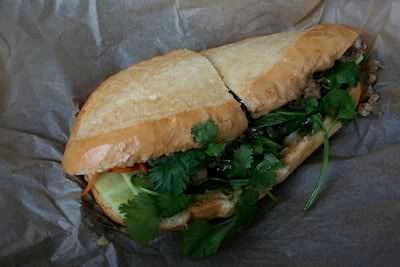
3. Hoi An Meatball Binh My, from Out the Door

Our first meal in the city itself was a fantastic Vietnamese lunch at the Slanted Door. After leaving, I glanced at their take-away cafe Out the Door, and noticed that they had binh my on the menu. So on our last day, I asked that we swing by the Ferry Building so I could grab one as a final lunch in the city. Though both the Roast Pork and 5 Spice Chicken sounded good, I opted for the Hoi An Meatball sandwich just to be a little different. And once again, the team behind the Slanted Door delivered with a fantastic sandwich that burst with the taste of Vietnam. My only complaint with the sandwich was that, unlike the sandwiches in the city it references, it had no spice. The binh my I had in Hoi An were always doused with a fiery chili sauce, which would have been a nice addition. Perhaps its available upon request?

Friday, March 20, 2009

Eating to the Mekong's end.

While Bordeaux zipped off on the back of a scooter, I retreated with my backpack into a tiny pocket of shade. The line of motorbikes and trucks in front of me growled impatiently, waiting for their turn to board the ferry. Feeling a tugging on the hem of my t-shirt, I looked down to find a child, who waved a stack of lottery tickets in my face. Her mother approached, and I assumed she would point out the obvious problem the girl—that I was a clueless foreigner, and didn’t know how to play the lottery—but she simply motioned to the child, and looked at me with her lips pursed in an insistent frown.
To feign being busy, I turned to browse at the snack stand behind me. Packets of candied fruit, bags of coconut taffy, boxes of dry biscuits; all coated in a thin veneer of red dust from the road. I was grateful I’d had a decent breakfast before leaving Saigon. I had come to Mekong Delta for a number of reasons, but the main reason, I reminded myself ironically, was to eat.

My desire to taste the Mekong Delta had been growing for some time, developing out of a vague collection of cravings into a refined and pressing hunger. It had started, perhaps, when my boyfriend Bordeaux and I first decided to move to Southeast Asia. After some deliberation, we had settled on Saigon as our ultimate destination. In retrospect, it’s hard to say why exactly. Bangkok seemed the more accessible option, but horror stories about the pollution, traffic, and urban chaos put me off. But why Saigon? Really, I knew nothing about the city, or about Vietnam in general. If I’m honest, I’ll admit that it was perhaps the idea of being so near to the Mekong Delta that drew me. Though I had no real knowledge of the river, I had assembled a mental pastiche of images, gleaned from travel brochures and old movies. Images of slim boats drifting over sluggish water through an arcade of palm fronds, and giant catfish sheltered just below the surface. Tropical and mysterious, the qualities that were drawing me to Asia to began with.
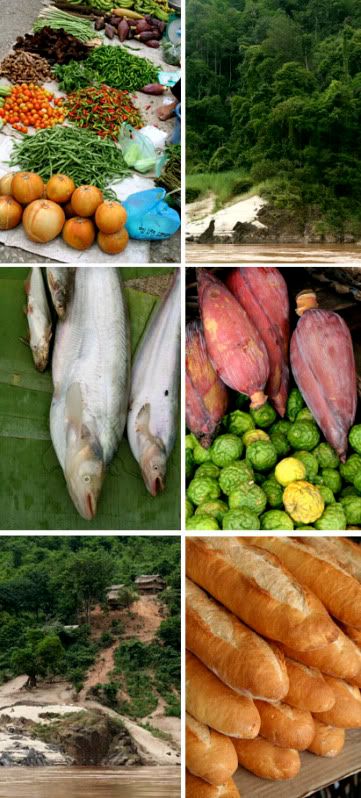
From our arrival in Bangkok to the culmination of our journey, we spent a solid three months traveling. And throughout that time, the Mekong River was a constant guide. We followed it from town to town, drifting downriver at only a slightly slower pace than its muddy brown water. And along the way, we came to know and love how the river tasted. We could feel its richness and fertility in the dripping golden papaya we savored on the banks of Chiang Khong, on the first morning that we saw the river itself; we grasped its salty aquatic flavor in the crisp squares of fried river-weed coated in sesame seeds and dabbed with chili sauce, which we sampled on the promenade in Luang Prabang; and we has tasted its history and culture in the sliver of green mango that garnished a French baguette sandwich in Phnom Penh. But, as close as we came, we didn’t get to taste the river to the end, to the delta.
We made it to Saigon, but only briefly. After only a week in Vietnam, Bordeaux and I boarded a plane and returned to Bangkok. Despite the misguided preconceptions I’d had, we had both turned out to adore the city, and were eager to try living there. So though Vietnam seemed fascinating, we left—never having made it anywhere near the delta. The river’s end remained unseen and untasted, as our plans of living near the Mekong Delta came to an end.

The hunger pangs, however, didn’t end quite so easily. Getting to the delta became a constant goal, a desire I nursed as we lived and traveled throughout the region. And so it happened that over a year later we finally made it there—and I found myself alone, waiting at the ferry port of Ben Tre.
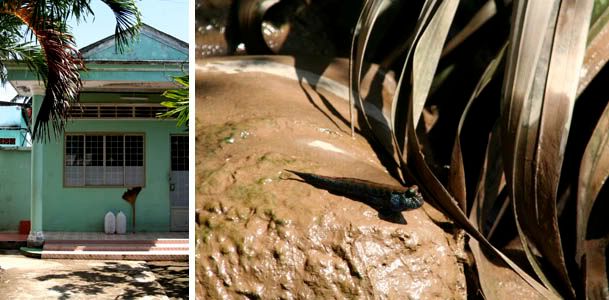
Thankfully, our hotelier returned quickly, and instructed me to climb onto the back of his scooter. We zoomed off, leaving the sun-soaked chaos of the port behind, and slipped into shadow among the leafy gardens of a quiet neighborhood. We passed a string of sugary candy-coloured houses, clacked over a canal on a thin wooden bridge, and twisted into the gate of his guesthouse.

It wasn’t, as I had imagined when I made the booking, a charming boathouse tipped over the river itself, with a hammock slung on the verandah from which I could gaze into the flow of the water. Instead, it was an inland compound of modern mint-green buildings, surrounded by trees. But even though we weren’t on the river itself, there were signs of it everywhere. The air felt sticky with humidity, as if we’d just come on shore after a quick plunge. The garden was flourishing with fruit trees, with pomelos and papaya hanging heavily on straining tree limbs. And a network of shallow streams and canals criss-crossed the yard, giving the feeling that the earth may sink or be swallowed in a flood at any moment. As I climbed off the bike, I found Bordeaux peeking into one of these streams.

“Come, look here.”

All along the bank, there were tiny fish with cartoon eyes, hopping out of the water and onto land. Mudskippers. I’d seen them before in nature documentaries and wildlife books, but they were infinitely stranger in real life. Yet somehow, their amphibious lifestyle seemed to make sense here, where the dividing line between water and earth seemed so thin.
Looking into another patch of murky water, we spied the vague outline of a large fish. It came up to greet us, it’s lips barely breaking the surface of the water. We gazed around the lush garden, continuing our search for wildlife, and spotted a low metal cage partly obscured under some bushes. Looking in, we caught the glimmer of scales on a muscular snake.
“Cobra,” the guesthouse owner informed us. “Maybe you’ll have some for dinner?” We laughed politely, assuming he was joking—though we would later be corrected of this assumption as we looked over the menu for dinner.
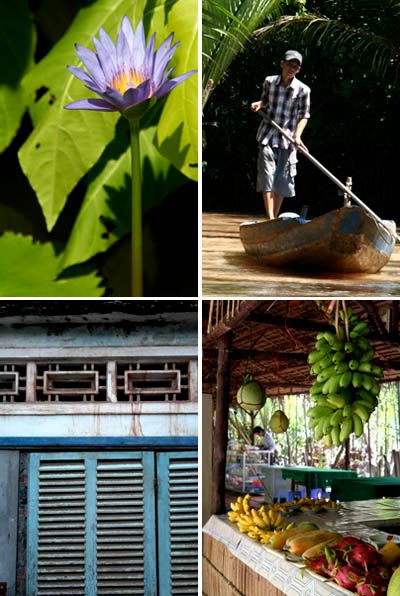
We spent the afternoon strolling around town, peeking into coconut candy workshops, being hailed by men wanting us to witness a cockfight, and sipping iced drip coffee in a neighborhood joint. We returned to the guesthouse as the air was cooling down, just in time for dinner. We sat at a table outside, under a pitched canopy of dried palm leaves. After being presented with two icy green bottles of Saigon beer, we were handed a menu, though we had little reason to actually look at it. We’d booked this hotel with a purpose, to eat their specialty dish: elephant ear fish. The fish that had greeted us as we arrived, in fact.
We had only to order and we were immediately summoned to the same stream where we’d had that sighting. Gripping a long net, our waiter scooped into the water, and lifted out a massive silver fish. He dropped it onto the soil, and as it began to make desperate somersaults, commanded me to take a picture. I obligingly took one shot, though I wasn’t eager to document the last undignified moments of my dinner’s life. Satisfied that I’d captured the moment, he grabbed the fish, and disappeared into the kitchen.
When we next saw the fish, it was in a much-altered state. Supported in a wooden frame, it was held upright, and was set on our table with fins splayed, looking almost as if it had swum there itself to join us. Its skin was now more golden than silver, its scales crisp and flaky. It’s tender meat seemed ready to melt away at the first jab of a chopstick. Accompanying it were a bowl of rice noodles, a stack of thin rice paper, and a plate crowded with piles of pineapple, bean sprouts, tomato, and fresh green vegetables and herbs.
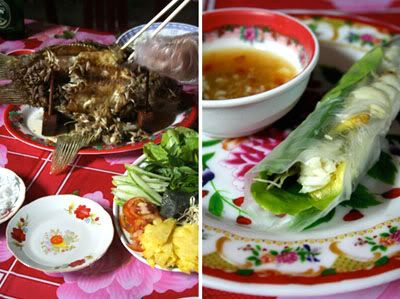
I snipped off a morsel of the fish with my chopsticks, layered it on the rice paper, rolled it up, and bit in. The green vegetables tasted sharp, the pineapple exuded an acidic tang, and the well-fried fish was luxuriant fatty. The rice paper contained it all, holding it in for a moment before the flavors revealed themselves on my tongue. I dipped a second piece into the sauce of chili, garlic and fish sauce; it tasted even better.
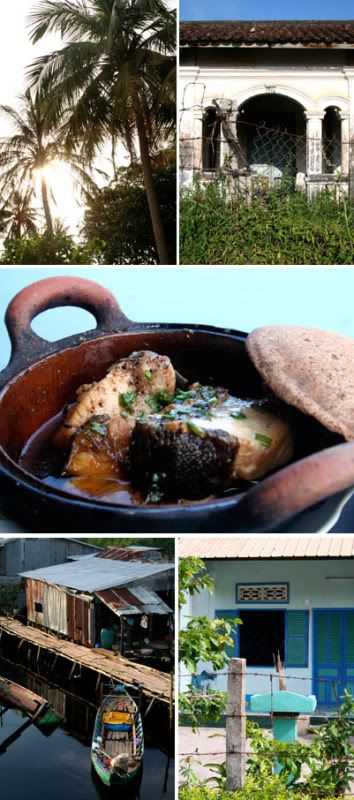
Over the next week, we crossed the entire delta, and continued our slow tour of Mekong flavors. We rode to the far Western border, past wide grassy expanses dotted with Khmer-style temples and pinnacles of limestone, to slurp on sour spoonfuls of canh chua ca. We rode over the waves to the pristine palm-fringed beaches of Phu Quoc, where we dined on salty caramel-sweet claypot fish. And in every meal, in every dish, and at the bottom of every bowl, we encountered the same flavors. Spicy, tangy, salty, sour, and fresh. The flavors that I had come to know as the taste of the Mekong River itself.
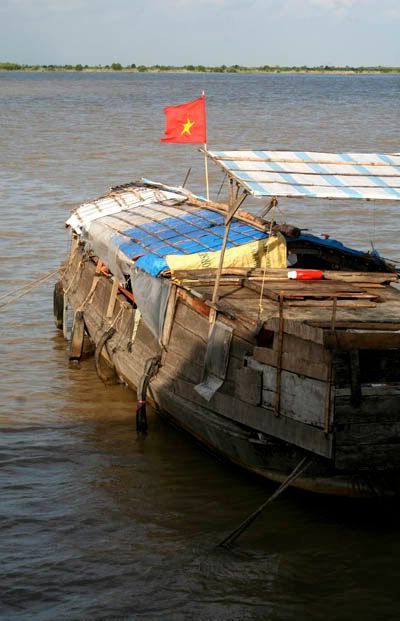
Thursday, January 15, 2009

Sugar cane.

Even though we've left Asia, we thankfully haven't left the food behind. Just after we got back to the US, we attended a Thai cooking demonstration at an Asian grocery store in Albuquerque. We've had good luck with local Vietnamese restaurants (though not Thai), and we've been experimenting in the kitchen, on meals like kaeng massman, green mango salad with crispy catfish, and canh chua. We even started the year by making a New Year's Eve feast of Cambodian catfish sandwiches, banana flower salad, and grilled beef salad rolls (the vodka fizzes Bordeaux mixed to drink and the glazed bananas and cinnamon ice cream my sister served for dessert weren't strictly Asian, but paired nicely). The past year and a half were spent mainly trying new dishes and experimenting with unfamiliar flavors; this next year will hopefully be about making some of those flavors our own.

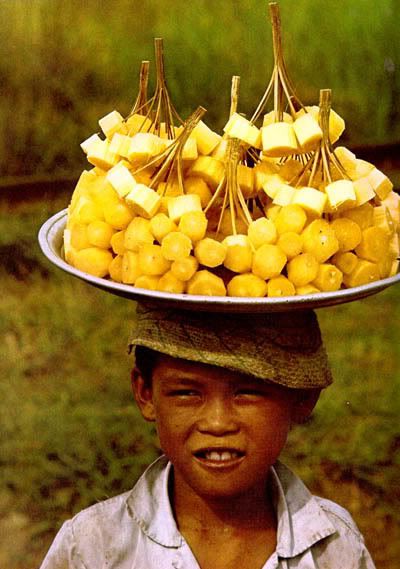
On the side, we've been pursuing some other food interests. I've been doing a lot more food-reading, and have been studying a diverse selection of cookbooks (including the Time Life volume on Southeast Asia, from which the above photograph was lifted). I've been enjoying breakfast, from simple bowls of muesli and fresh berries to decadent almond french toast. We've also been experimenting in baking: last weekend was a two-layer cinnamon and chile cake, this weekend will be homemade donuts.

What are you enjoying eating lately?

Wednesday, October 22, 2008

One day of eating in Saigon.

Even though I've managed life in Bangkok for over a year, the city of Saigon still intimidates me. I am, however, fascinated by it-- it's a colorful town with a tropical atmosphere, and its streets and sidewalks teem with activity. I almost chose to live there, rather than in Thailand, and I'm still curious about what life would have been like. Despite, I feel as though I can barely began to comprehend the city, can barely see over the traffic of whirring motorbikes-- making eating, in a sense, a challenge. Searching out a distant market seems daunting, seeking specific street-snacks seems impossible. Thankfully, there are enough good flavors and tastes in the city that I was well-fed on my last visit, despite my lack of adventurousness.

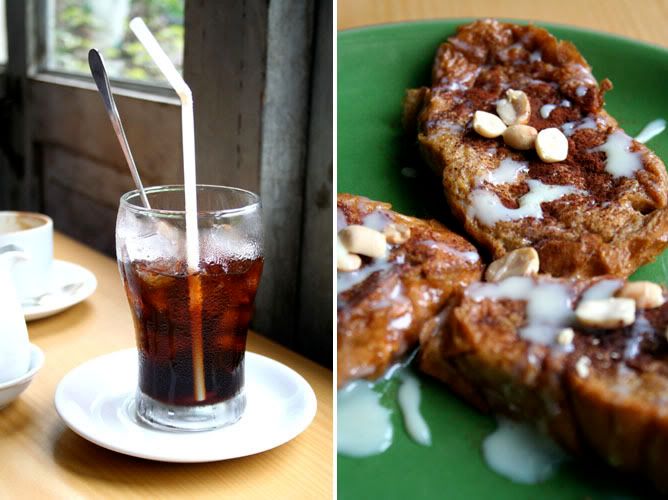
On our last full day in Saigon, Bordeaux and I took a leisurely breakfast at La Fenetre Soleil, an inviting upstairs cafe. Though it's located up a dingy staircase and down a dark hallway, it manages to attract it's fair share of fans (including a fellow blogger). My breakfast was a double dose of rich Vietnamse coffee: an iced black drip coffee, and Vietnamese coffee french toast. The latter was particularly spectacular: smooth and well-flavoured, and drizzled with sweetened milk (though I don't know what peanuts have to do with Vietnamese coffee, they added a nice crunchy texture).

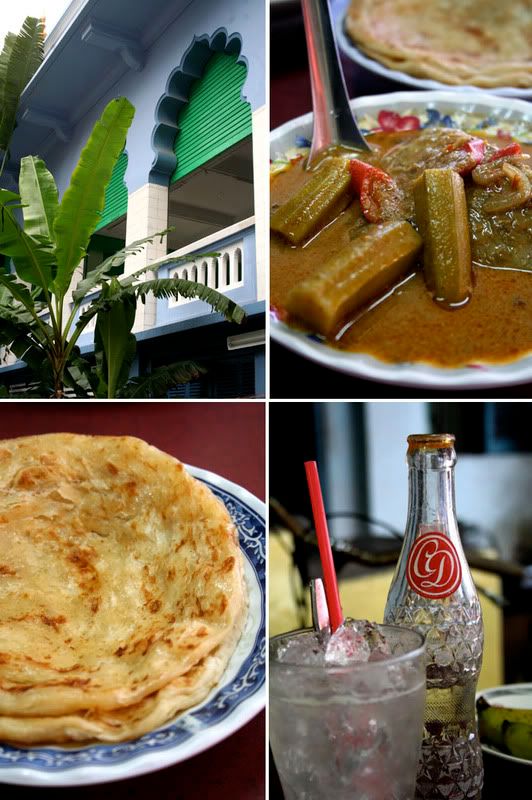
For lunch, we ducked behind a downtown mosque, to a shady courtyard curry shop. The richly spiced dishes were excellent- particularly a beef curry with tender strips of okra. It was eaten with roti, which were crisped golden brown. The beverage, though simple, should be noted- bubbling soda water with two wedges of lime, and a little white sugar. After drip coffee and avocado shakes, it's my favorite Vietnamese drink-- perfect for the steamy tropical heat.

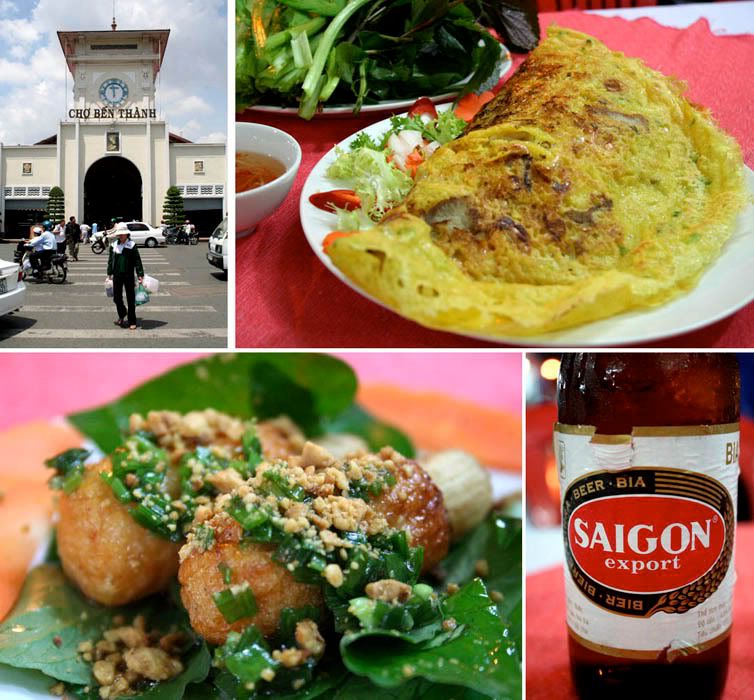
For dinner, we chose an outdoor restaurant near the central Ben Thanh market. Among our dishes were grilled shrimp on sugarcane, and a crunchy banh xeo pancake. We have another restaurant there that we favor, and we should have gone there again-- they didn't live up to the quality of their neighbor. At least the Saigon beer was cold.
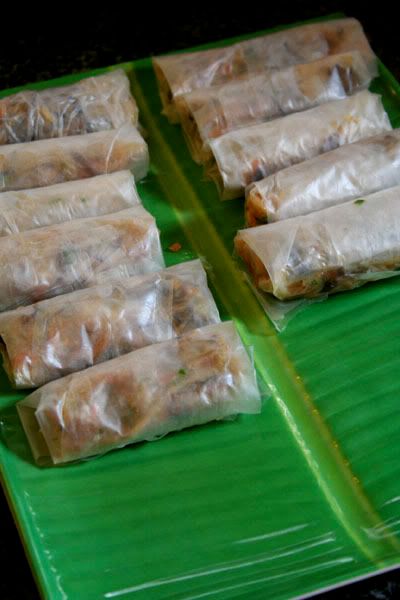
Hopefully next time I'm in town I'll be better prepared, and feeling a little more adventurous. In the mean time, for an expert's guide to eating in the city, cruise Robyn's Saigon articles on Eating Asia.
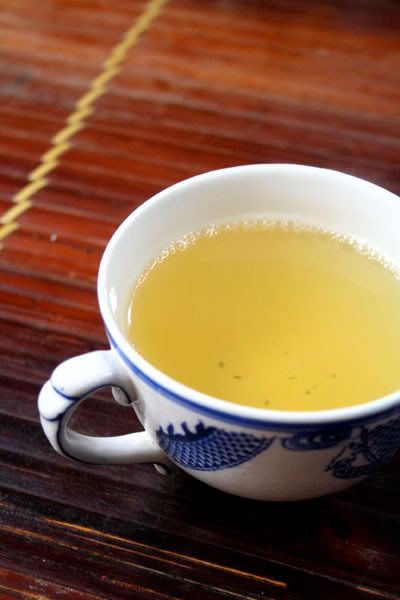
Friday, October 17, 2008
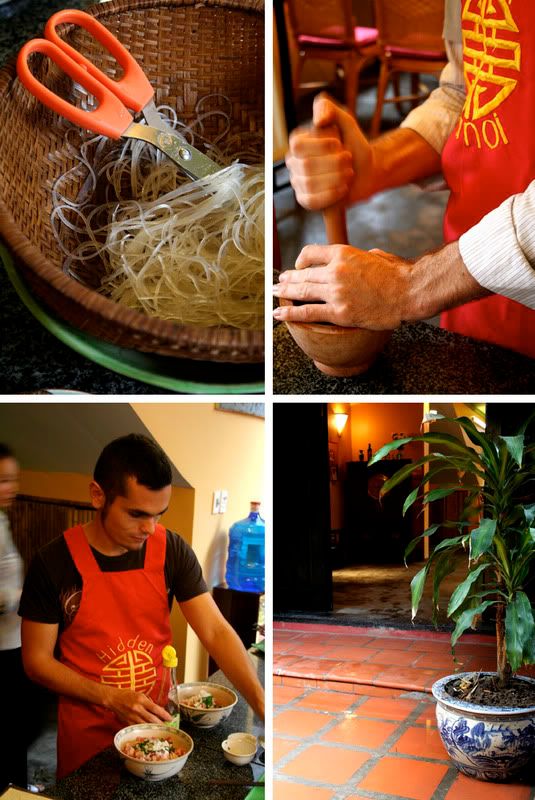
Red Bridge Cooking Class in Hoi An.

Back in March, when Bordeaux and I went to Hanoi, we briefly considered taking the long train trip down to Hoi An. Thankfully, we stuck around Hanoi-- at the time, we of course didn't know that we would get to return to Vietnam, and have the chance to spend almost a week in Hoi An. While doing a little online research in Hoi An back then, I encountered the Red Bridge Cooking Class. It sounded great- a chance to cook some local Hoi An dishes in an attractive riverside setting. I bookmarked the page, setting aside just in case.

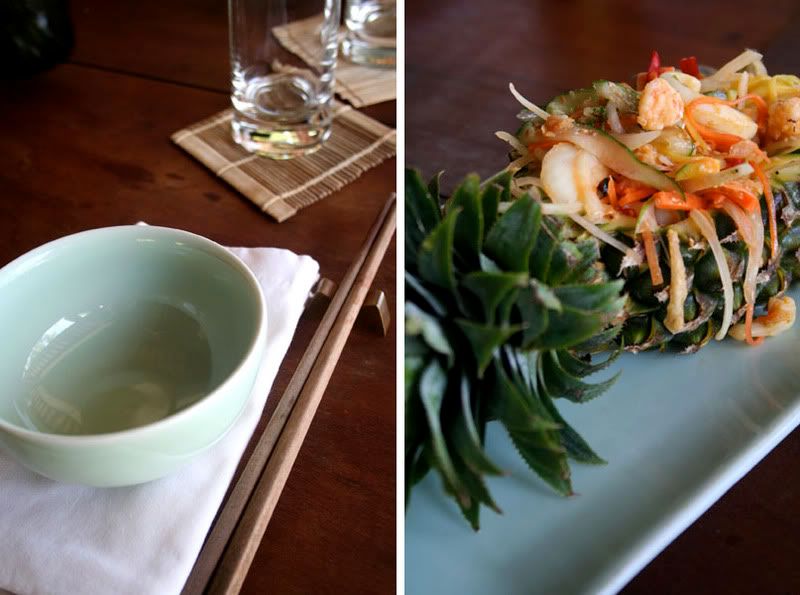
As we prepared to visit Hoi An, the cooking class at Red Bridge was on the top of our must do list. Upon arriving in town, we stopped by Hai Cafe, where the classes are organized. Two classes were offered at Red Bridge- a half day class and a full day class, each with only one menu available. The full day class offered the chance to make pho bo (beef noodle soup), cha ca (grilled fish) with dill, lemongrass shrimp in banana leaves, and chicken and banana flower salad. Though we love all of these dishes, the menu didn't sound right to us- both pho and cha ca with dill are more associated with Hanoi, and we know how to make banana flower salad. Instead, we chose the half-day class, which seemed to focus more on Central Vietnamese cooking, and had some dishes we wanted to know how to make- eggplant cooked in a claypot, seafood and pineapple salad with fresh herbs, rice paper rolls with freshly made rice paper, and banh xeo, 'Happy pancakes.'

We met the other students at the Hai Cafe, in Hoi An's old town. There, we got the first sign of a major difference between other cooking classes we'd taken-- the number of students was much larger. As we waited for the class to depart, more and more people came, and the class quickly grew to around 20 people- massive, compared to the five person average we'd had at other cooking classes. Thankfully, multiple guides appeared, and we broke up into small six-person groups.

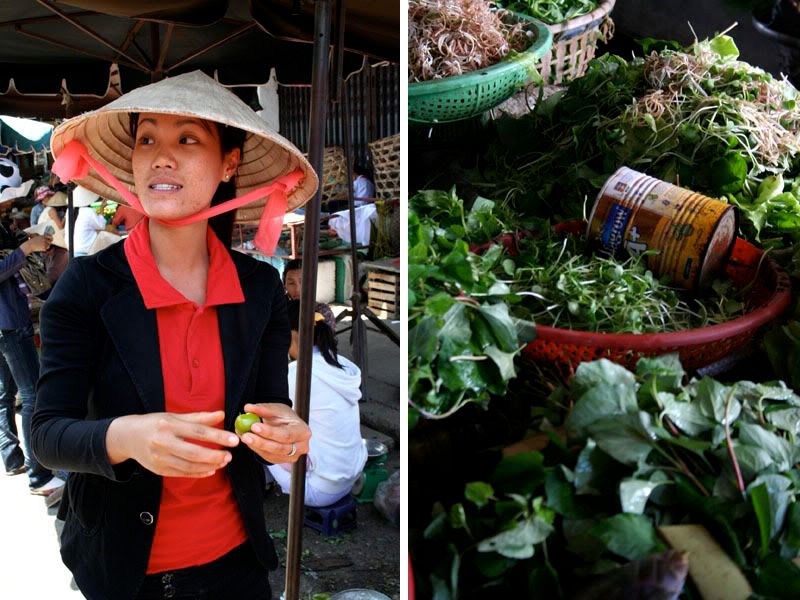
Like most cooking classes, this one began with a market tour. Hoi An has a great central market, and the tour took great advantage of it-- introducing us to local flavors and herbs, strange vegetables and fruits, and interesting utensils that revealed local cooking techniques. Our guide was great- informative, engaging, and funny.

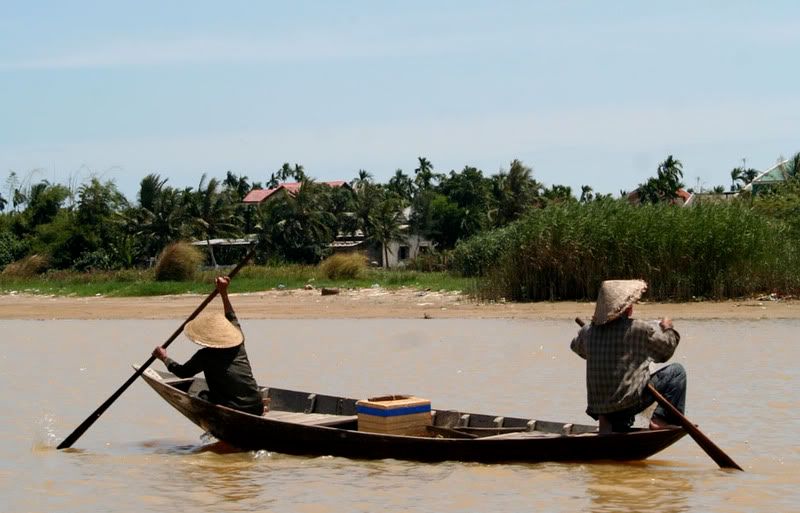
She dropped us at the pier, where we boarded the boat to the cooking school. The trip was a definite highlight- a twenty minute float down the muddy river, past fishing traps and under arching palm leavess. Along the way, an old woman in a canoe, smiling between chomps of betel-nut, motioned our boat over. When we got close, she lassoed us, and hitched a lift off us.

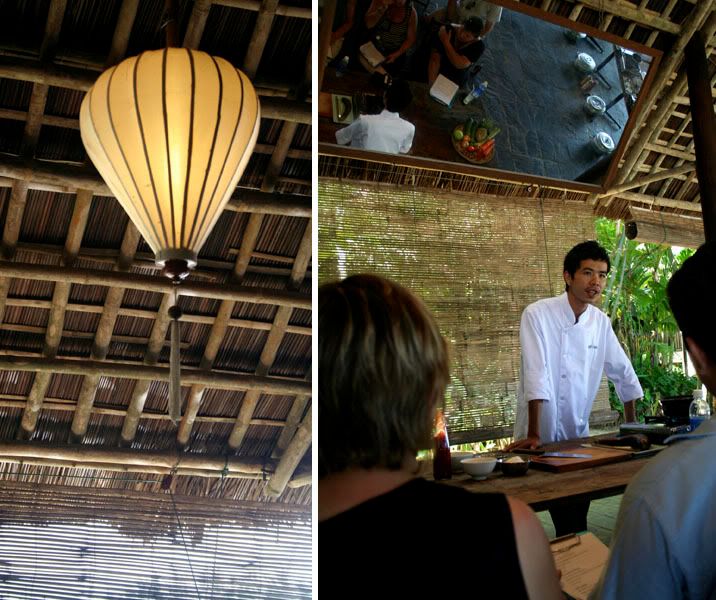
We arrived at Red Bridge Restaurant, easily the most attractive setting for any cooking class we'd taken. Set right on the river, the kitchen was surrounded by lush tropical greenery, and decorated with bamboo blinds and white silk lanterns. After a quick tour of the herb gardens, our guides wished us a good class, and departed-- and we were left to merge the mini groups into one massive class.

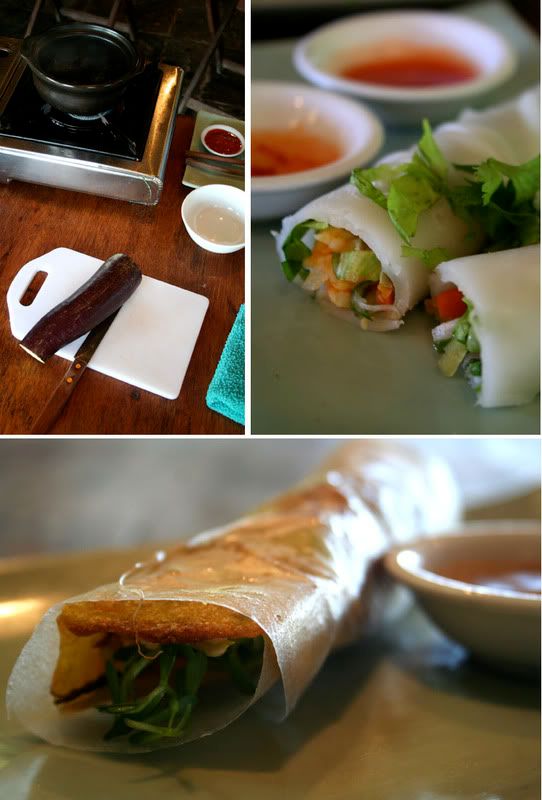
We took seats in classroom like rows of chairs, and after a twenty minute wait, our cooking teacher emerged. He seemed tired, bored, and a little disinterested in the class-- fair enough, if he has to teach multiple 20 person classes a week. There were some weak jokes in his script, but he seemed so lifeless that they passed by without him changing the tone or speed of his reading. He proceeded to make the first dish, the seafood salad, completely on his own-- simply showing it to us. The dish was whisked away by one of the many assistants, and he proceeded on to the claypot eggplant. For this, we got our first taste of 'cooking'- we were shown to our stations, told to slice the eggplants, plop it in the boiling water, and add a cup of tomato sauce. We then returned to our seats, and the claypot eggplant was taken away by the staff. It proceeded basically like that for the rest of the class- we made fresh rice paper, but not the filling for the rolls; we quickly made the banh xeo, being prodded to hurry up the whole time by roaming cooking assistants. If any students made a mistake (which I, of course, made several) the assistants became vaguely annoyed, and either corrected them sharply, or simply did it themselves.

Having spent about an hour watching a cooking demonstration, and maybe fifteen minutes actually cooking, we were lead to the dining room for a late lunch. The lunch, at least, was fantastic. The seafood salad was tangy and spicy, the claypot eggplant rich and flavorful (made with, I suspect, more than just a cup of tomato sauce), and an extra dish, steamed ocean fish, was fantastic.

So now, some thoughts.

Good: The class was well-organized, and aside from the way too long wait for our chef to show up, ran smoothly. The market tour was informative, the boat trip was enjoyable, and the lunch was spectacular.

Bad: Maybe I'm hard to please, but the class was run too smoothly. It felt a little like a Theme Park of cookery-- fair enough, this is Hoi An, after all. But there was nothing personal, no individual character to much of it. We were rushed along an assembly line, getting to slice a vegetable here, and roll a salad roll there. Our cooking instructor was clearly bored, and it affected the atmosphere of the class. And really, aside from the discussion on the market tour, we learned nothing about Vietnamese cuisine and culture, or about what makes the cooking of Hoi An and Central Vietnam unique.

Verdict: Would I recommend it? It's complicated. As Bordeaux pointed out, this was the least enjoyable cooking class we've taken. At all of the others, we enjoyed a connection with our instructor and felt like we really got to try our hands at making some local dishes. At the best classes- like Hidden Hanoi- we actually learned about the culture through learning about their cooking.

And yet, I get the sense that almost everyone at the class had a great time. It was, all in all, a pretty fun day-- there were certainly more activities than at any of the other cooking classes I've taken. And we got an outstanding lunch in an incredible setting. And the price- $18- means that it was actually incredibly inexpensive.

So I think for a visitor to Hoi An looking for a fun day out, it's actually a great activity. It gets you beyond the old town to see some of the surrounding countryside, and you get a great lunch out of it. But for someone really interested in cooking, and in the cuisine of Central Vietnam- I think it's kind of disappointing. The full day class, I read later, is done in smaller groups, and is more geared towards this category of student- but it's a shame that the menu doesn't focus more on regional dishes, or offer some variety or choice. Numerous restaurants throughout Hoi An offer private cooking classes, where you have the choice of what to make-- and that may be the better option.

Thursday, October 02, 2008

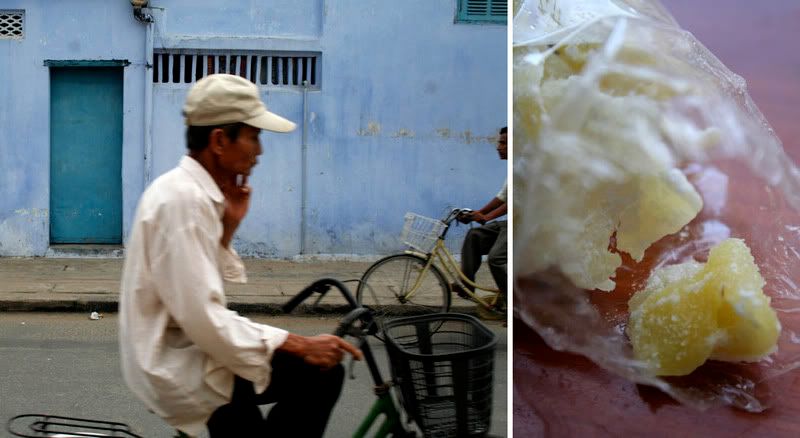
eating culture/eaten: Candied Ginger.

It's undoubtedly very touristy, but I love the sugared ginger sold by street-vendors in Hoi An. It's crunchy/stringy texture and sharp flavor make it the perfect snack after a mellow meal or during a stroll through the market.

Tuesday, September 30, 2008

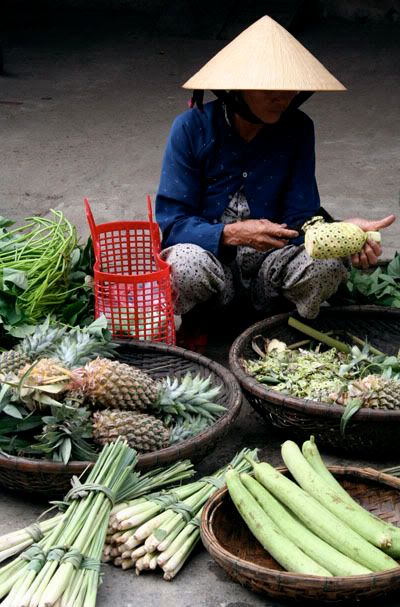
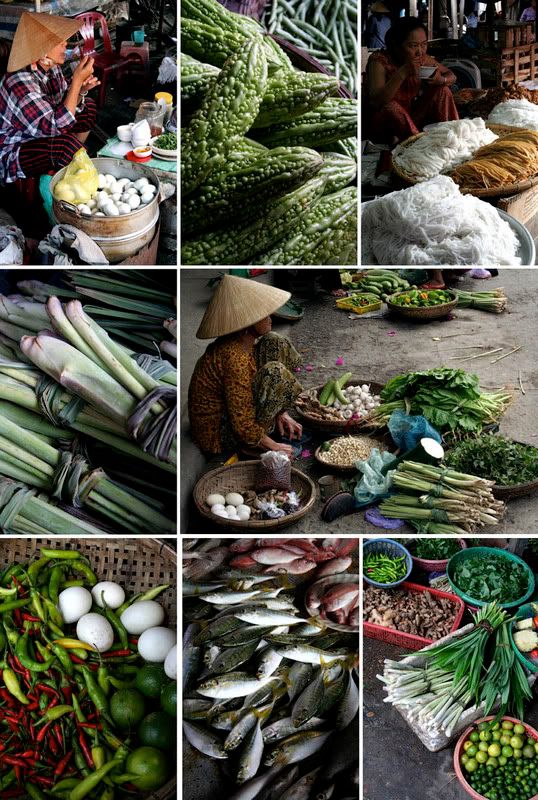
Scenes from a Hoi An market.

Perched at the edge of Hoi An's old town, it's crowded stands almost pressing over the Thu Bon river, sits Hoi An's central market. Though the market's entrance is guarded by stands trying to lure tourists with Tiger Balm and ceramic pagodas, push through and you'll find the darkened interior contains a busy working market.

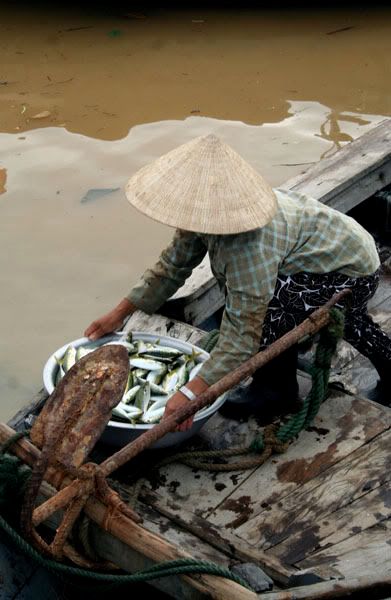
The ground leading inside is a mountainous landscape of herb and vegetable peaks, giving way as you enter to sloping white hills of noodles. Shoppers pause at eight-inch high stools, to sip rich drip coffee or crunch on snacks, like crispy banh khoai or fertilized duck eggs. And at the very edge, where sunlight slices the market open, fresh fish are unloaded from boats coming off the river.

Monday, September 29, 2008

Sinh to bo.

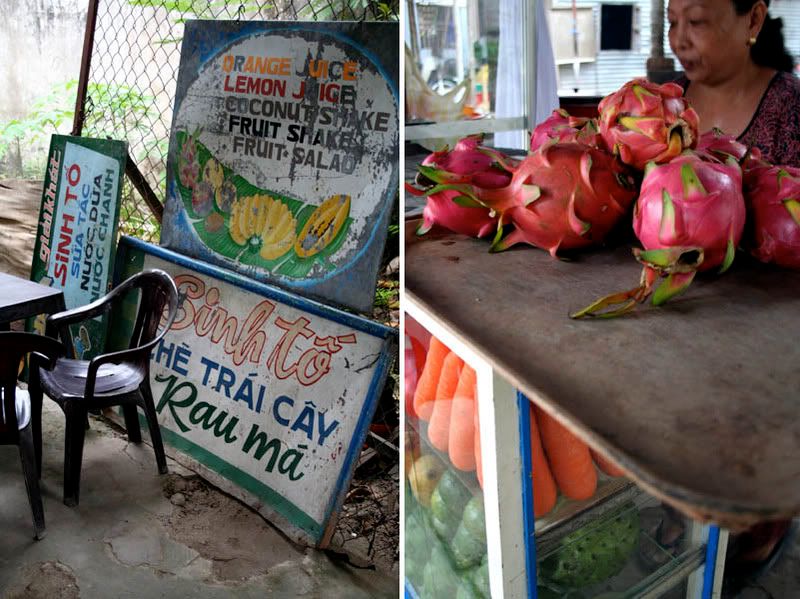
The avenues of Vietnam are dotted with shops and stands offering an incredible variety of sweets, from chewy mung bean parcels, to creamy ice creams, to buttery pastries, to colorful glasses of che'. As plentiful as the options are, however, nothing can compete with sinh to- the simple fruit and milk shake.

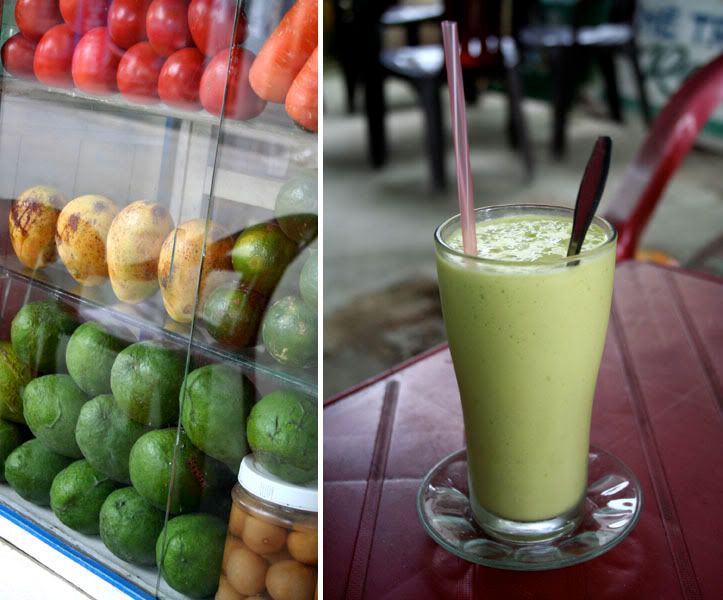
It's hard to choose a favorite- dragonfruit is refreshing, and ripe mango is pretty hard to beat- but lately I'm really fond of sinh to bo, avocado shakes. I first tried a variant in Taiwan, which was made with creme caramel pudding. Though the Vietnamese version is sans pudding, it's still relatively sweet, as its often made with condensed milk. When the balance is right though, the earthy flavor of the avo melts through, lending an offbeat nuance to the rich creamy shake.

Friday, September 26, 2008

Beachside Banh Mi.

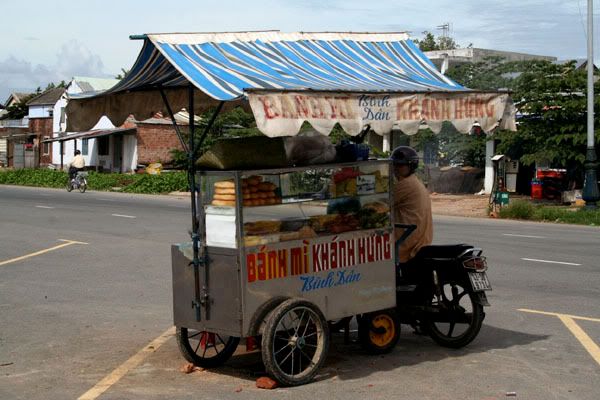
Beachside banh mi stand at Danang's China Beach. I don't think drive-up was ever this good at home...

Wednesday, September 24, 2008

Hello, Danang.

An hour and a half after leaving Bangkok's Suvarnabhumi Airport, our tiny plane touched in Vietnam. We arrived in Danang, our gateway to central Vietnam, and the city where we would begin the next phase of our travels.

Though it's Vietnam's fourth largest city, the leafy avenues move at a sluggish, leisurely pace. Since Bordeaux and I had previously spent most of our time in Hanoi and Saigon, it was strange to see a Vietnamese city that wasn't constantly swirling with activity.

Thankfully, even though we were somewhere new, there were a few comfortingly familiar sights (and flavors) to remind us of why we'd come. More on that coming soon, of course...

Monday, April 28, 2008

Vietnamese drip.

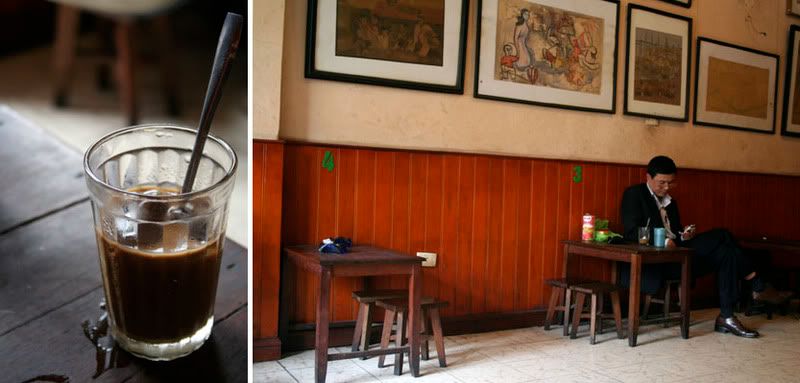
Sitting on low wooden stools in a smoky interior, we watch the door for our waitress. Across from us, two college students play chess, alternating moves on the board with long slow sips from the glasses perched on the edge of the table. Next to us, a young mother chats happily with her friends, pausing briefly to mind her young daughter as she buzzes around them in boredom. Finally, our waitress climbs over the threshold of the stairs, a tray held firmly level in her hands. She lowers down to our table, and sets out our order. Two short glasses of dark, rich Vietnamese drip coffee, resting on a cushion of creamy condensed milk. We stir it together, the viscous milk hesitating before swirling lethargically into dark brew.

Now, I’m sorry, Thailand. I know you have great bag coffee, and hill-tribe grown arabica, and even a fairly decent local chain in Black Canyon- but the best coffee in Southeast Asia is undoubtedly in Vietnam.

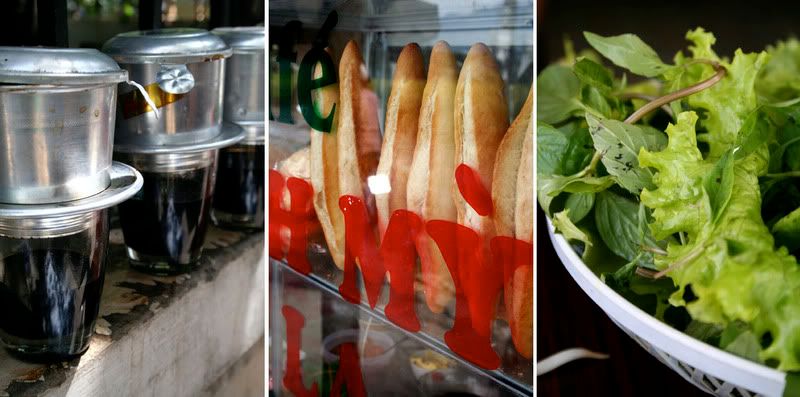
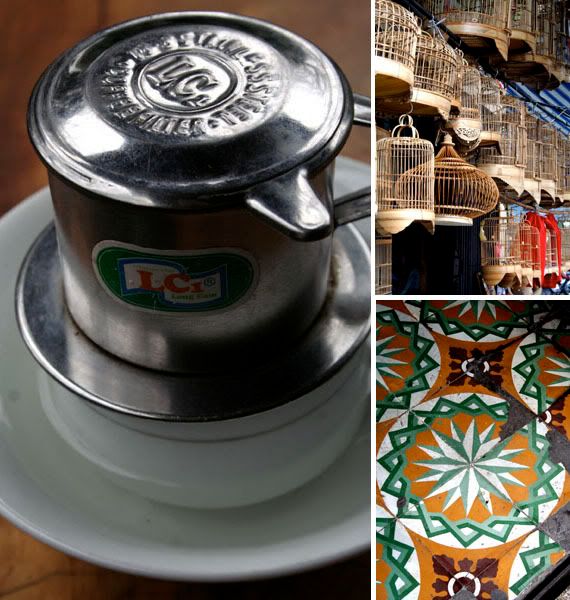
Vietnamese coffee is well known, not just for the quality of its French-introduced beans, but also for its unique form of preparation. Ground coffee is spooned into a tin filter, which is placed on top of a short mug or glass. Hot water is poured into the filter, and the coffee slowly drips into the cup below, usually onto a soft bed of condensed milk. It can be served hot- the thick brown coffee practically melting the sweet milk- or cold, with cubes of ice chilling it into the perfect refreshment for a steamy afternoon. The filter works slowly, as the coffee drip drip drips into the glass below- forcing the drinker to wait and unwind, and fostering a subdued atmosphere for relaxation. Vietnamese drip coffee can be enjoyed all over Hanoi- in settings as diverse as smoky alcove shops, and stylish European style cafes.

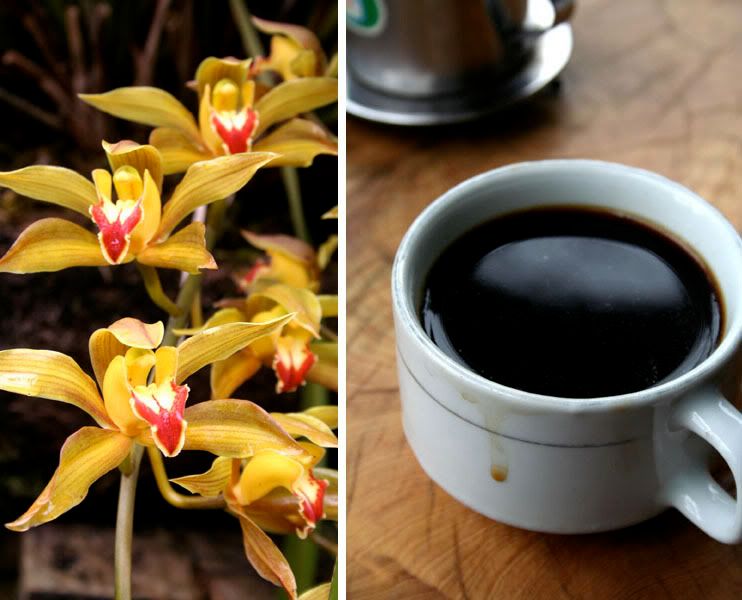
Even outside of Hanoi, coffee in Vietnam can bring some surprises. Looking over a menu in an orchid filled coffee garden in Sapa, we were confused by the listing of drip coffees identified only by the numbers 1 through 9. We enquired, and were informed that they were grades of coffee- Coffee #1 being the cheapest and also the most inferior, Coffee #9 being the best. We ordered two glasses of #9, and we weren’t disappointed. We were treated to two short mugs of unbelievably rich coffee. Blended with the sweet milk, it had a strong flavor of delicious dark chocolate.

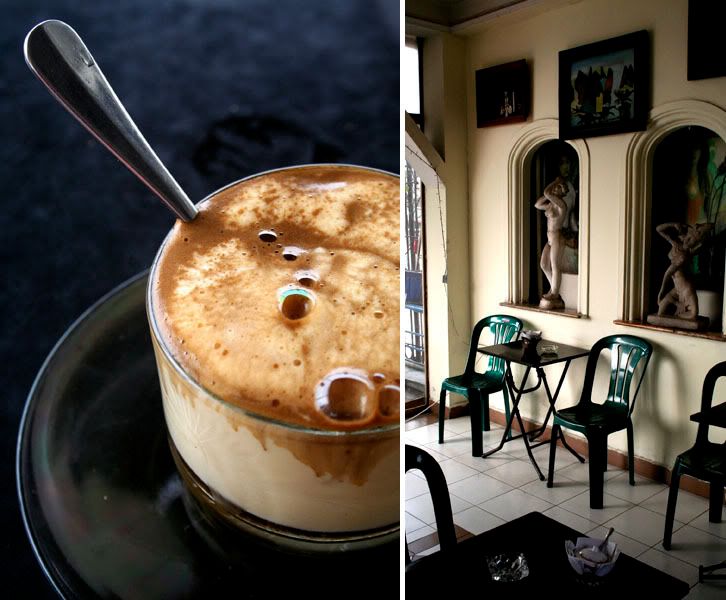
But drip coffee isn’t the only Vietnamese specialty. At Café Pho Co, a well-known Hanoi hole-in-the-wall with great views of the old quarter, Bordeaux ordered a mug of café trung. Its name, meaning ‘egg coffee,’ comes from the fact that it’s topped with a cap of whipped egg; it’s a local take on a cappuccino. Not only does the egg give the foam an impressively thick texture, it also adds an unbelievably rich creaminess, making every spoonful taste like an airy, coffee-tinted custard.

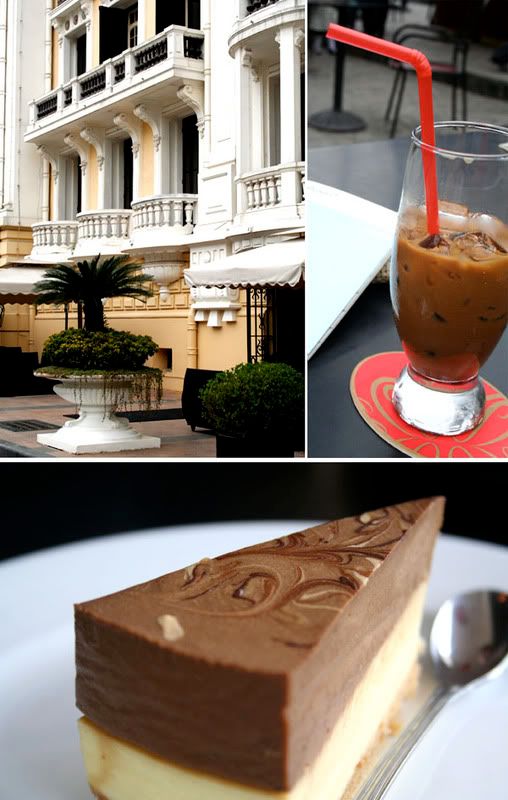
Perhaps best of all is the incredible variety of places in which to enjoy the flavorful local brew. With no Starbucks in the country, a local Vietnamese chain, Highlands coffee, has been able to flourish. Among the lattes and espressos on the menu, local drip coffee receives a prominent place. It also features in their pastry case, in the form of a Vietnamese coffee cheesecake. The bottom layer emulates the sweet condensed milk, while the top layer evokes the dark flavor of strong coffee. And best of all, these treats can be enjoyed in some outstanding locations. In Hanoi, you can sip Highlands coffee in a hip patio below the Opera House, among potted palms on a graceful deck looking over Hoan Kiem lake, or in a lush bamboo garden under the flag tower.

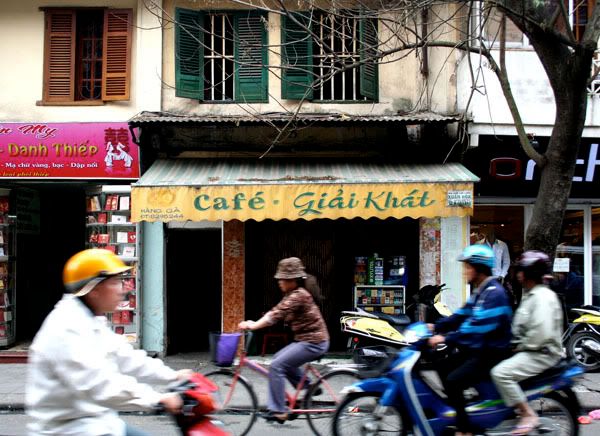
For a more distinctly Vietnamese experience, there are local cafes and coffee stands spilling onto most city sidewalks. Hanoi is packed with independent cafes, their names advertised in pastel hued awnings. They’re often very informal, with low tables on the edging out the door, and a few oil paintings scattered on bare white walls. Some, like Café Lam and Café Pho Co, have become institutions. However, you can get coffee that’s just as rich and flavorful at many of the lesser-known establishments.

Is it worth traveling abroad simply for the coffee? When the brew is as good as Vietnamese drip, the coffee shops as elegant as Highlands Coffee, and the streets as packed with independent cafes as Hanoi: certainly so.

Thursday, March 20, 2008

culturedPRIMITIVE/style: Souvenirs of Indochine.

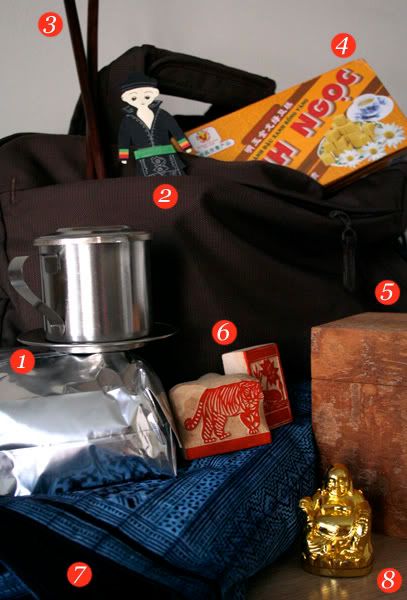
And so, with more than a little regret, we left Vietnam. We really had an awesome time in Hanoi- it's such an amazing city, with incredible food, intriguing architecture, and an engagingly artistic atmosphere. To console ourselves, we took a few things with us from Vietnam. Here are a few of the more interesting items that we brought back with us.

1. Highland Coffee and a Vietnamese Drip. The memory of Vietnam I most wanted to retain was of the delicious coffee. So the first essential souvenir we tracked down were the small metal Vietnamese drips. Later, we sought out the best coffee beans. After sampling several blends at an outlet in the Old Quarter, we chose the Highlands coffee (not connected to the same-named coffee chain). It had a particularly rich flavor, with strong hints of chocolate.
2. Hmong Boy bookmark. The beautifully sewn clothing worn by the Hmong appear in countless postcards and paintings in Northern Vietnam. For some reason, however, these images tend to focus only on the women. Despite being largely ignored, Hmong men actually wear a very intriguing outfit- boots, black shorts, a long jacket, and cap. So when we finally found a paper bookmark featuring one of the Hmong men, we had to get it.
3. Cooking chopsticks. At the end of our cooking course at Hidden Hanoi, Bordeaux and I were each given a set of these extra-long wooden chopsticks, which are perfect for turning spring-rolls in a frying pan.
4. Green pea cakes. It's hard to say what's so addictive about these little green pea cakes. Certainly it's not the chalky texture, or the vague flavor of dry peanut butter. Perhaps its simply the wonderfully unhip graphics on the box.
5. Cinnamon wood box. Our second hotel in Hanoi was located right next door to Marena Hanoi, a wonderful little homewares store that specialized in chic ceramics and elegant lacquerware. There, we found this square box of cinnamon wood, which gives off a deliciously spicy scent. It is currently at use in our kitchen, imbuing the coffee stored within with a cinnamon aroma.
6. Rubber stamps. On our last night in Hanoi, Bordeaux and I encountered an alley in the old quarter that specialized in rubber stamps. We couldn't help but pick up a few of the more intriguing ones, which had some iconic Vietnamese images: tigers, lotus ponds, and hooded cobras among them.
7. Hmong blanket. Leaving our hotel in Sapa, we were constantly hounded by Hmong women selling beautiful hand-sewn blankets. Though they came in many colors, from rust to electric green, the ones that most caught my eye were the blankets in deep shades of indigo. I finally found the perfect one, sold by a woman in thick-eyeglasses.
8. Golden Buddha. In the candy markets of the Old Quarter, Bordeaux and I encountered boxes and boxes loaded with sweets, wrapped candies, and boxes of green bean cakes. We also found containers overfilled with tiny gold Buddhas. We purchased one to investigate, and found that it was filled with an unusual gummy treat.

***
Editor's Note: Though this ends my sequential entries on Vietnam, I have much more to write about Hanoi. Look out for essays on Vietnamese coffee and the Colors of Hanoi in the near future.

Cha ca.

I had planned to take Bordeaux out on our last night in Hanoi, but things didn't go exactly as I planned. The first restaurant I had considered had closed down, and the second was booked for a private event. So with some hesitation, we booked a table at a distant third choice. As the dinner hour approached, I felt more and more uncomfortable with the decision. Considering how great the food in Hanoi is, it seemed wrong to go somewhere that didn't seem perfect for our last night. So at the last moment, we ditched our reservations and sought out a dish we'd been curious about: cha ca.

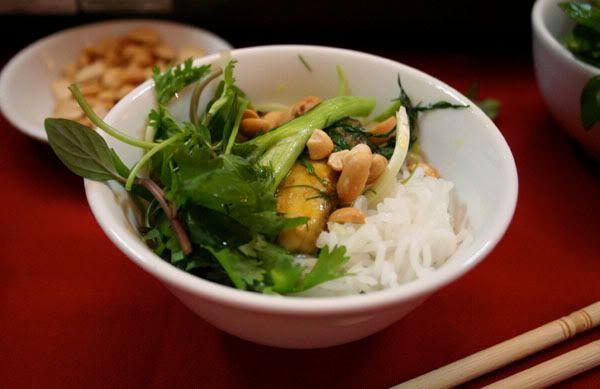
In Hanoi, cha ca is most famously served at the century-old restaurant Cha Ca La Vong, but after comparing reviews, we decided to instead try Cha Ca Thanh Long. The smart but simple restaurant was packed, but thankfully they found a table for us. 'We only serve one dish,' our waitress explained, as a waiter set out a gas cooker on our table. Igniting the flame, he set to work: he sautéed fish, along with spring onion, tumeric, and large handfuls of fresh dill. He served us each a portion, and left the rest to simmer on our table. The resulting dish, eaten with crunchy peanuts on a pillow of cold noodles, was fresh, sharply flavored, and extremely tasty- a combination that reflected all that we love about Vietnamese food. It was one of those great nights when you're grateful that nothing worked out as planned.

Tuesday, March 18, 2008

Hanoi Street Food.

I live in Bangkok, so I'm no stranger to street-side food and sidewalk kitchens. But even so, I was amazed by the variety of delicious food available on the streets of Hanoi. From sour soups of bamboo and duck, to steaming bowls of pho, to baguettes filled with egg and pate, the problem was never finding a good meal, it was choosing what to eat. On our last days in Hanoi, Bordeaux and I weren't only conflicted with how to do everything we wanted, we also struggled to figure out how to eat everything we wanted.

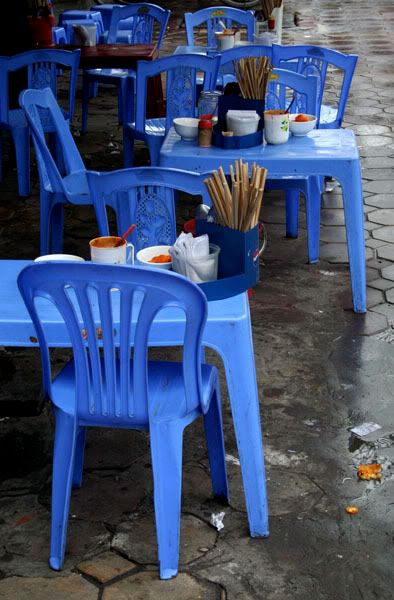
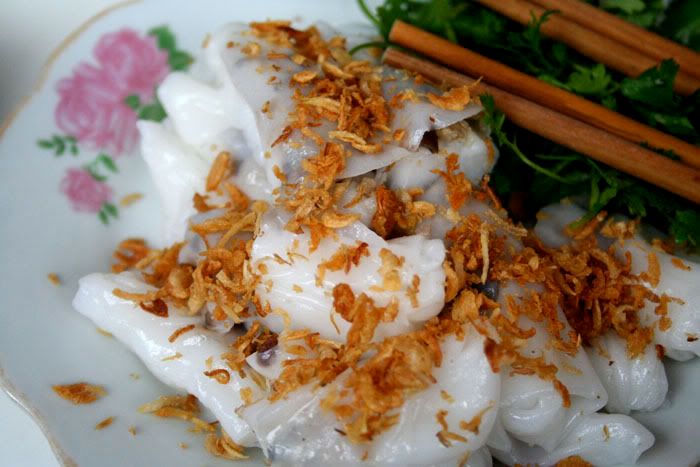
In Vietnam, the primary meal people eat on the street is breakfast. In the early hours of the day, the sidewalks are crowded with people lowered onto plastic stools, tucking into bowls of soup and glasses of strong coffee or powerful rice wine. On an early morning out, Bordeaux and I encountered a woman making banh cuon. She spread rice batter out on the taut surface of a steamer drum, smoothed it like a crepe, dropped in some minced pork and shallots, then gathered it all up into loose rolls. She piled these generously onto a plate, then covered the whole pile with fried garlic and shallots. The dish was so much more amazing than its parts- a crunchy, slippery and very flavorful dish to start the day with.

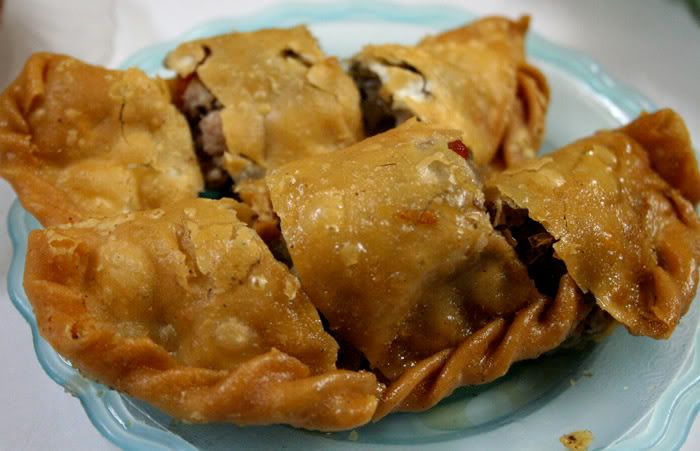
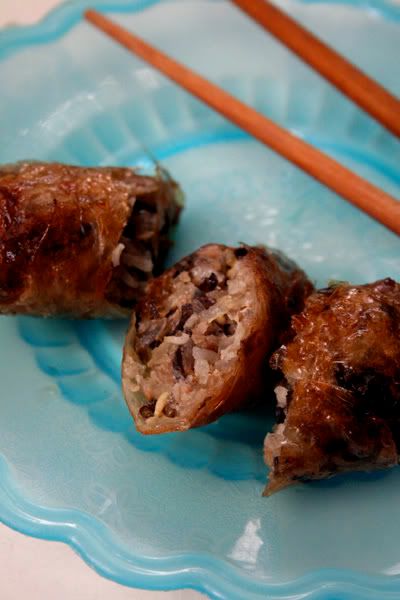
Like in Bangkok, good street food can be found almost everywhere in Hanoi. For example, though the elegant Cathedral district is known primarily for its chic espresso cafes and hip designer boutiques, it also boasts a good range of informal sidewalk kitchens. Just up from the Cathedral square, we visited a little fry-shop that featured a range of simple snacks. Though everything we ate there was good, the tastiest treat was banh ghoi (also: banh goi). It's a small fried pastry with a golden flaky crust that broke open to reveal delicious seasoned pork and mushrooms.

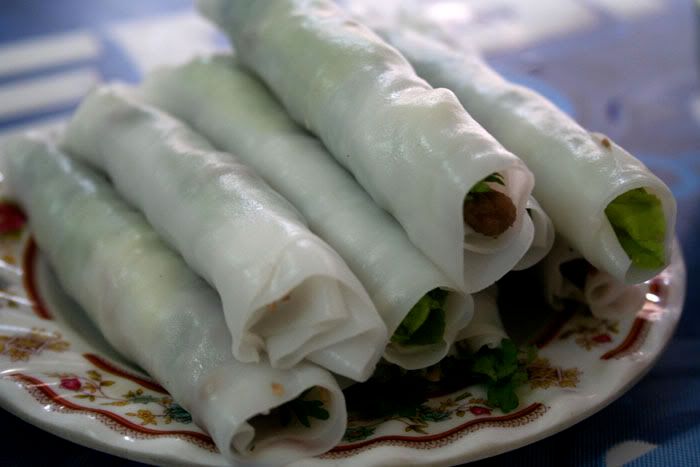
After exploring the neighborhood around West Lake, Bordeaux and I stopped for a snack on the little island of Ngu Xa. The local specialty is pho cuon, and though we weren't sure if we'd be able to find any, we quickly discovered that nearly every shop in the area was advertising them. It thus became not a matter of finding them, but a question of deciding which one to try. We searched out the shop that appeared the most popular, where a group of high-school age girls were busy packing up boxes of the snack for a line of to-go customers. We took a table, and one of the friendly girls brought us a plate. The smooth white wrapping was tightly packed around delicious strips of beef, which were seasoned with a sprinkling of fresh green herbs.

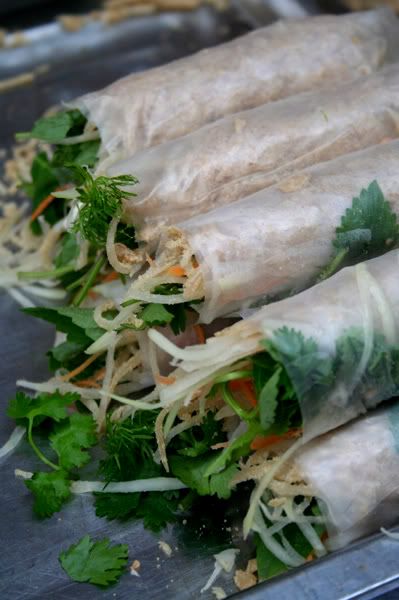
Spring rolls and salad rolls are among the dishes most connected in people's minds with Vietnam, and we did take the chance to sample a few varieities. A tiny stand next to our hotel sold these tasty rolls, made with fresh vegetables, shredded pork skin, and of course, tons of cilantro. The shredded pork skin had an unexpected flavor and texture (salty, with a frayed surface that could almost be described as feeling "furry"), but they added an interesting element to the salad rolls.

Another popular version of the spring roll is nem cua be, often sold at the same stands that make bun cha. These crunchy rolls of crab meat and glass noodles paired perfectly with the smoky pork and fish sauce soup.

And, ok, I know I've already written about binh my pate twice (here and here), but few dishes can match it. On our last night in Hanoi, Bordeaux and I stopped to pick up one final baguette. Even though we'd had it several times already that week, this one somehow stood out above all the others. It was laced with a deliciously spicy chili sauce that contrasted perfectly with the salty pate and sharp cilantro leaves.

*PS- This is my 100th entry written about Southeast Asia! Rather fitting that it's about street-food, I think.

Monday, March 17, 2008

A Cooking Class at Hidden Hanoi.

Several months ago, when Bordeaux and I were first traveling through Southeast Asia, one of our goals was to take a cooking class in each country we visited. Unfortunately, we only managed to take classes in two- we took a Thai cooking class at The Thai Farm Cooking School in Chiang Mai, and a Lao cooking class at Three Elephants in Luang Phrabang. So in visiting Hanoi, one of our chief desires was to take a class on Vietnamese cooking. After some research online and in travel guides, we decided that the course most suited to our interests was the one offered at Hidden Hanoi.

We took a taxi out to Hidden Hanoi, which was located in a beautiful red and gold tube-house near West Lake. From the beginning, there were some minor difference with the other classes we'd taken. The others both started with a tour of a local produce market, but this one began instead with a quiet chat about Vietnamese cuisine. In a sunny room upstairs in the cooking school, our guide An spoke with us over cups of herbal tea. She asked us about what dishes we had tried that we liked, made some comments comparing Thai and Vietnamese flavors, and shared with us some general philosophy about Vietnamese cuisine. An was sweet, engaging and extremely informative, and this opening discussion felt as relaxed as having tea with a friend. I liked that this class followed a different format than most others, and the discussion was a great way to start the course, as it set an inviting atmosphere for the day.

We'd selected the Street Food menu, which to us seemed the best introduction to some basic Vietnamese cooking. The principal dish we were to make was bun cha, a dish of marinated barbecue pork that Bordeaux and I had both become addicted to. In addition, we were making fried spring rolls, and we would accompany the dishes with rice noodles, an herb salad, and a light soup of chili and fish sauce. The kitchen set up was rather different than I'd encountered in past classes. At both cooking schools I'd visited previously, we'd each been in charge of a wok (either alone or with a partner), and we'd been responsible for cooking all of the dishes ourselves. In the end, we each had our own oversized meal to ourselves. Here, we worked communally to prepare the dishes that we would all enjoy together. While Bordeaux and another student chopped vegetables for the spring rolls, I sliced pork and mashed lemongrass together with chili to make the bun cha. We each got to try our hand at the different tasks- slicing produce, rolling the spring rolls in the pan, and fanning the barbecuing pork. In part, this seemed necessary since most dishes take a little time to cook- much different than the quick wok frying of the Thai and Lao dishes. But it also contributed to the relaxed, communal vibe of the meal.

Additionally, it meant that instead of being overstuffed, we had a perfectly sized meal to share (perhaps even a little too big). We took our beautifully prepared dishes to the table, and had a relaxed afternoon meal. The spring rolls were crispy but fresh, the bun cha beautifully flavored from the marinade, and the noodles and fresh herbs were the perfect foil for the heavyness of the meal. More than just a cooking course, I felt as if we'd been given a brief introduction to Vietnamese culture. Our teacher, An, was a great source of information, and while the meal had been wonderful, and the instruction perfect, more than anything, she made the class worthwhile. It takes a long time to make this meal, An told us, so we don't make it often at home- but when we do, it's always better than you can get on the street. She was definitely right.

*****
Editor's Note: I also just wanted to point out that I am posting my entries sort of out of order as I struggle to catch up. So please either scroll down to see what I've posted, or simply check out my entries on Ha Long Bay, Cat Ba Island, the Ho Chi Minh's Museum, street-food in Sapa, and a particularly delicious dish of binh my pate. Thanks, and hopefully I'll be totally up to date soon! -X

Sunday, March 16, 2008

The balanced bun cha.


Most cultures have a sense of balance when it comes to eating. In the states, we use the term “balanced meal”, and use the food groups to define a balanced diet, even if we don’t generally employ those characteristics in every meal. In Thailand, we employ the four flavors (sweet, spicy, sour, and salty) to give our dishes a sense of balance. In Vietnam, balance is an essential aspect of a meal, present not only in the dishes themselves, but in the arrangement of dishes. If the main dish is heavy, the accompaniments should be light. If the main dish is light, the accompaniments should be a little heavier. This isn’t true only of elegant meals or lavish dinners, however. This balance can be observed anywhere- even in a simple street-side meal of bun cha.

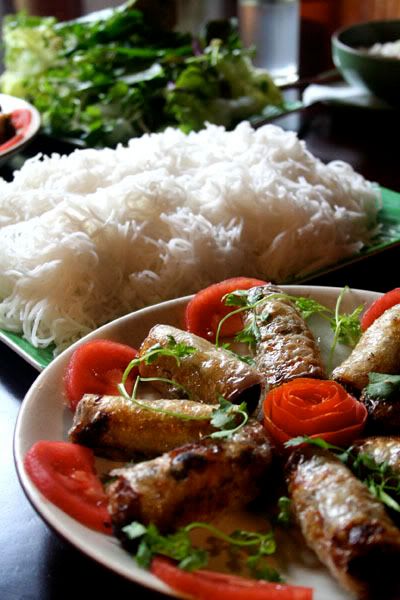
A specialty of Hanoi, bun cha is a deliciously smoky dish of barbecued pork. Walking down the street in Hanoi, it’s hard not to be tempted by the rich woody scent of bun cha sizzling in a sidewalk kitchen. After taking a seat, the waitress confirms our order, and quickly dishes out our food. She first brings the bun cha, ground pork and pork shoulder bacon that have been marinated in chili and lemongrass and grilled over charcoal. It's served in a light soup of fish-sauce, garlic, chili and a sliced crisp vegetable. Since bun cha is fairly heavy, it’s served with two very light dishes. The first is a plate of simple rice noodles, reflective of the role rice plays as foundation for all Vietnamese meals. The second is a basket of raw herbs: purple mint, sawtooth coriander, cilantro, and other mixed greens. By alternating tastes of the richly flavored meat with cleansing mouthfuls of noodles or sharp fresh bites of herbs, the heaviness of the meal is lifted, creating a filling lunch that doesn’t weigh us down.